

A Peter Thiel-funded startup launched this month will use an “AI jury” to “subject the media’s claims to systematic investigation and judgment.” That same system of AI adjudication assigns a numerical value — the so-called “Honor Index” score — grading the trustworthiness of individual reporters. And for a starting price of $2,000, anyone can pay for the company to review and adjudicate complaints they may have about a news outlet or reporter.
Objection AI was founded by Aron D’Souza, a lawyer best known for leading the Thiel-funded lawsuit that bankrupted the digital news outlet Gawker in 2016. D’Souza has described Objection as a private arbitration court, which individuals can turn to when they feel they have been unfairly maligned by reporters or pundits. “Your reputation takes years to build and seconds to destroy online,” the company wrote in a recent post on X. “Objection makes adjudication fair, fast, and affordable.”
The company is funded with millions of dollars in funding from Thiel, former Coinbase CTO Balaji Srinivasan, and other investors.

Although it carries no legal or formal weight, Objection has put significant effort into making its judgments appear authoritative.
Its AI jurors are fed information and evidence gathered by human investigators whose collective work history the company frequently cites as a source of legitimacy. We have “a team of FBI, CIA, former agents, who will investigate the story that’s been written… line by line, sentence by sentence,” D’Souza told a British news show earlier this month.
For those unmoved by spycraft, Objection hypes the purported capabilities and impartiality of its AI jury, which is comprised of models from xAI, Anthrophic, OpenAI, Google, and Mistral.
“Artificial intelligence adjudicates through a scalable, auditable, incentive-free process,” the company states on its website. “Diverse foundational models debate adversarially - advocates build cases, cross-examiners expose flaws, a neutral ensemble verifies with explicit standards and Bayesian reasoning… AI can be trained to exclude emotion, bias, and ideology. Model diversity cancels blind spots. And it never gets tired.”
Objection also leans heavily on judicial trappings to dress up its reviews, including case numbers and official-sounding case names. “Public v The Wall Street Journal,” reads a label that Objection assigned to its pending investigation of a story the paper published on Donald Trump’s relationship with Jeffrey Epstein.
To promote Objection, D’Souza has claimed that leading AI models apply “law consistently 100% of the time,” adding, “It’s become obvious that lawyers are probably the most displaceable profession, but judges are, too.” However, large language models used by lawyers frequently produce factual errors and hallucinations filed in court. Last week, Sullivan & Cromwell, a top Wall Street law firm, had to apologize after it submitted a key filing that contained erroneous case citations generated by AI.
“AI-assisted dispute resolution for when you speak to the press”
Objection is Thiel’s latest campaign against the press. He previously spent $10 million secretly bankrolling the lawsuit that the late wrestler, whose real name was Terry Bollea, brought against Gawker for publishing a sex tape. Thiel appeared to hold particular animosity toward Gawker due to a 2007 article it published identifying him as gay.
Objection, meanwhile, appears to be a direct response to the Silicon Valley elite’s growing hostility toward reporting on their business, personal, and political exploits.
Elon Musk has repeatedly accused the “legacy media” of lying “relentlessly.” David Sacks, a venture capitalist who recently served as the White House’s AI and crypto czar, has described the “legacy media” as “spokespeople for the Democrat Party.” And Jason Calacanis, a tech investor who hosts a podcast with Sacks, recently fantasized on X about executing an “epic” hostile takeover of the New York Times so that he could force one of the paper’s tech reporters to “pitch me three stories of technology improving people’s lives every Monday at 730am.”
In another post, Calacanis offered a succinct description of his cohort’s feelings about the press. “FOUNDERS: DON’T ENGAGE WITH THE MEDIA,” he wrote. Musk cosigned that advice.
Objection advises potential clients to require that journalists who want to interview them first sign a standardized contract agreeing to have the company arbitrate any “media disputes” that may arise from the exchange. “Fast, fair, AI-assisted dispute resolution for when you speak to the press,” reads ad copy promoting the contract template on Objection’s website.
One example shared by Objection features the founder of an AI company asking a reporter from the New York Tribune (a long-defunct paper) to sign the contract before an interview. “Sure, no problem, signed,” the fictitious reporter replies.
There is also the Honor Index, the aggregate scoring system that Objection uses to grade individual journalists. So far, the company has not publicly assigned grades to any real journalists. But an example template showed that reporters will be docked if they do not participate in the company’s investigations of their reporting.
It is doubtful that any serious reporter would participate in an AI-led judgment of their work. Further, as part of the company’s push to have the media take part in its tribunals, D’Souza has said that journalists would need to upload information identifying anonymous sources they cite in their reporting directly to Objection’s AI systems. “The AI will read that set of data and say, okay, this is high-quality reporting,” D’Souza told TechCrunch in an interview. D’Souza also suggested that Objection could provide journalists who share information about confidential sources “a certificate to say you can use that anonymous source in a certain way, and it’s been independently verified in a fully trustless, open source system.”
This process, according to Objection, is actually a service to the news media, as AI adjudication will free journalists from being “forced to act as judges.”
“A global AI arbitration court”
Is Brigitte Macron, the first lady of France and a mother of three, “definitely a man?”
Officials at Élysée Palace will be pleased to learn that following weeks of research and computation, one model used by Objection has ruled, with 89% confidence, that Brigitte is not a man.
The case, which stems from a conspiracy theory popularized by right-wing podcaster Candace Owens, is one of numerous claims that Objection is evaluating for “public interest,” rather than an investigation conducted for a paying client seeking to rehabilitate their image. In fact, despite launching more than two weeks ago, every single claim the company has investigated publicly was initiated by one of Objection’s employees.
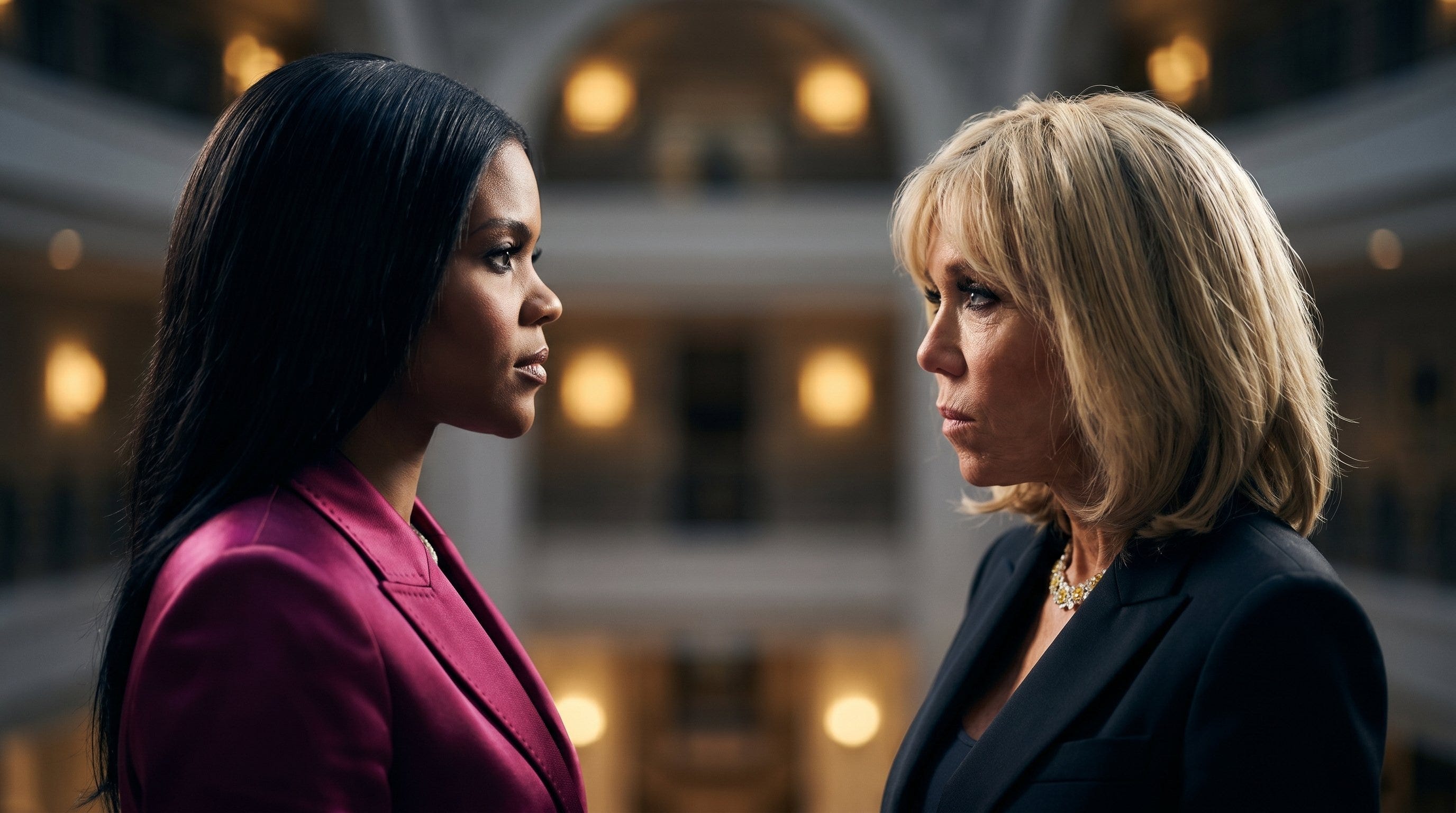
In addition to its “transvestigation” of Brigitte Macron, Objection has issued rulings on two other cases: That sexual abuse took place at a Christian summer camp in Missouri and that podcaster Joe Rogan did not recommend the use of livestock dewormer to combat COVID-19. Once the company’s AI adjudicators complete their analysis, Objection shares a link to the ruling on X, alongside an AI-generated face-off poster featuring the two opposing parties.

The company is also investigating New York Times reporting on David Sacks using his White House access to augment his investments, a CBS Miami report on abuse faced by detainees at Alligator Alcatraz, and whether Israeli Prime Minister Benjamin Netanyahu is a war criminal.
Objection does not plan to stop at journalism. The company’s goal is to one day become “a global AI arbitration court” capable of resolving “contract conflicts, commercial disagreements, reputational claims, scientific and technical disputes — all adjudicated at dramatically lower cost, far higher speed, and greater accuracy than medieval court systems built for a pre-digital age.”
Every day brings another new Black Mirror episode into existence.
Because there is no better use for AI? What happened to all the claims of medical breakthroughs? Finding cures for diseases? Eradicating world hunger and poverty? Instead they are doing investigations into people who hurt their poor little feelings. Seriously, how is it possible that every one of these man babies weren't loved enough as children?