

The biggest lie in media is the one that it tells about itself.
Journalists at many mainstream media publications insist that their coverage is objective and unbiased. This isn't true.
Two of the biggest purveyors of this lie are Mike Allen and Jim VandeHei, the co-founders of Axios. The Axios audience "Bill of Rights" promises that "all employees are asked to refrain from taking/advocating for public positions on political topics." The document also pledges that Axios will "never have an opinion section." Axios seeks to garner trust by positioning itself as neutral on all political topics.
VandeHei has promoted this view repeatedly in his public commentary. In a December 2024 speech, VandeHei advocated for a "clinical" approach to journalism, one that is detached from any ideology. In a May 2024 CNN interview, VandeHei said that the best way for reporters to restore trust is to keep their opinions to themselves and "stop popping off in ways that make people distrust the work that you do."
John Harris, who started Politico with Allen and VandHei, wrote that the pair "cleave to a scientific ideal of journalistic detachment, the way a surgeon cannot tolerate even the slightest bacteria on his instruments."
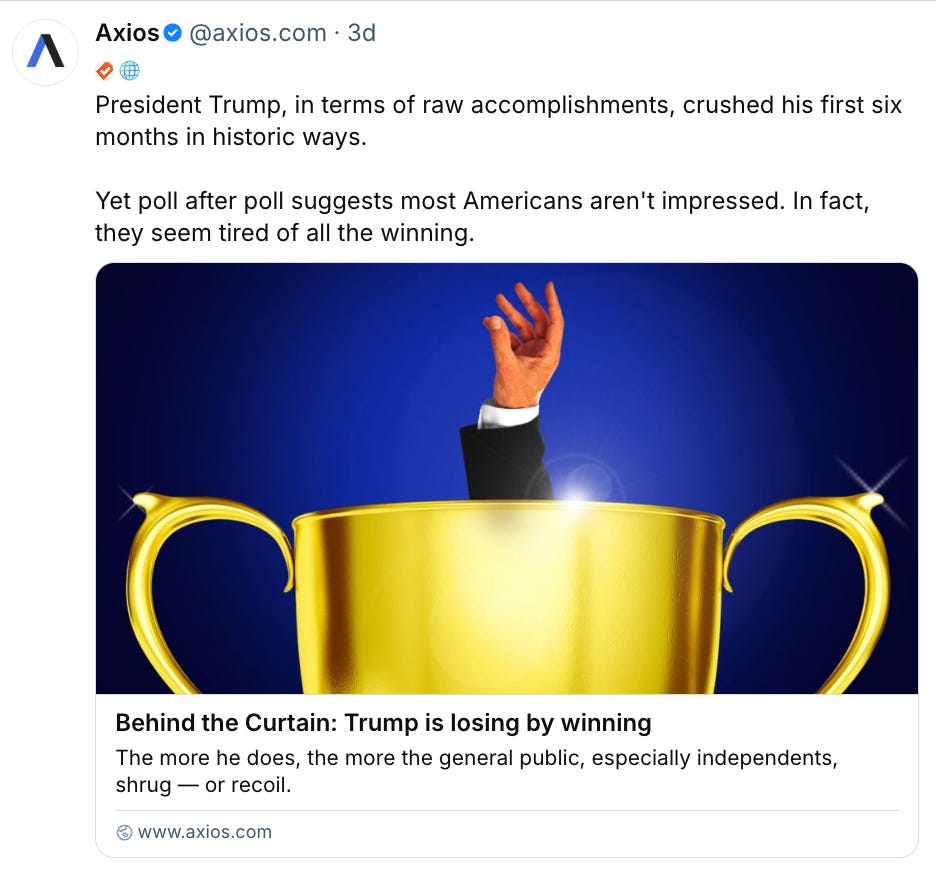
So, how did Allen and VandeHei cover the first six months of Trump's presidency? "President Trump, in terms of raw accomplishments, crushed his first six months in historic ways," the pair wrote in a piece published last Wednesday. Allen and VandeHei listed Trump's "wins": "Massive tax cuts. Record-low border crossings. Surging tariff revenue. Stunning air strikes in Iran. Modest inflation." They describe the last six months as "the very best chapter of his presidency."
But Allen and VandeHei are puzzled that, despite all this success, Trump's approval ratings are very low. They offer this explanation: Americans "seem tired of all the winning." Ultimately, they blame Trump's unpopularity on the fickleness of voters who can't figure out what they want. "[V]oters demand change," Allen and VandeHei argue, "then flinch when it arrives too fast or too hard."
Notably, in the piece, Allen and VandeHei cite conversations with "Trump advisers," "a longtime Trump aide," and "Trump aides" concerning Trump's record over the first six months. There is no mention of views expressed by Trump's critics or even anyone not working for Trump.
While the piece suggests a handful of explanations for Trump's low approval ratings, including increasing the deficit, cutting Medicaid, and the Epstein controversy, the piece does not mention any of the following:
1. Trump's signature legislation will reduce income for the poorest 40% of Americans while providing a windfall to the top 0.1%.
2. Trump pardoned over 1500 people convicted or awaiting trial for their role in the January 6 attack on the U.S. Capitol, including those convicted of assaulting police officers, using deadly weapons, and destroying government property.
3. Trump has decimated funding for cancer research.
4. Trump deployed the military against Americans protesting his immigration crackdown.
5. Trump flew dozens of people from America to a prison in El Salvador that is notorious for torture and human rights abuses.
There are dozens of other examples of unpopular actions taken by Trump that could be added to this list. In light of these facts, describing Trump's first six months as "the very best chapter of his presidency" and "winning" is not an objective assessment.
Indeed, VandeHei and Allen have political opinions and express them publicly. VandeHei simply redefines his right-wing ideology as patriotism. "The American miracle rests on untamed democracy, the animal spirits of capitalism, the magic of unrestrained innovation, and the soft power of a vigilant and vibrant free press," VandeHei wrote in a December 2, 2024, Axios column. "I'm a believer in — and beneficiary of — all four."
On January 20, 2025, the day Trump was inaugurated for the second time, VandeHei and Allen wrote, "Think of the U.S. government as a once-dominant, lean, high-flying company that grew too big, too bloated, too bureaucratic, too unimaginative." The piece says Trump has a vision to remake government that "binds Trump with leading innovators." The pair wrote that an "optimistic scenario" is that the second Trump presidency could "jar lawmakers and the public into realizing how a slow, bloated, bureaucratic government handcuffs and hurts America in the vital race for AI, new energy sources, space and overall growth." They stated it is "correct" to believe "America's government is so vast, so complex, so indebted that it makes fast, smart growth exponentially more complicated."
VandeHei and Allen then outlined a plan for fixing the federal government's problems — "cut workforce," "cut costs," "break stuff," and "ignore the whiners." While this is presented as a common-sense approach that a CEO would take, it essentially parrots the plans from the early days of the Trump administration.
VandeHei and Allen have repeatedly written columns presenting Trump's second-term economic agenda as beneficial — "Washington's open for business" and "America's 'uncorked' economy."
Whether capitalistic innovation should be "unrestrained" or whether government has grown "too big" are core political debates in the United States. Some people, like VandeHei and Allen, believe America should be deregulated to allow maximum flexibility for the wealthy to deploy their capital. (This core right-wing belief ignores the reality that rapid deregulation has created numerous economic crises over the course of American history.) Others believe that in a time of extreme economic inequality, a more robust government role is necessary to achieve other priorities, including poverty alleviation, environmental protection, public health, and safety.
VandeHei and Allen have beliefs, but claim to be objective because they consider their right-wing beliefs, particularly on economic issues, to constitute fundamental truths. People with differing conceptions about the role of the free market and the regulatory state, on the other hand, are dismissed as biased or misguided.
Perhaps this is why VandeHei and Allen don't struggle to explain poor polling for Democrats, writing in March that the party was in a "deep dark hole" because "most current political, cultural, media and generational trends are cutting against them."
In response to a request for comment from VandeHei and Allen, Axios spokesman Jake Wilkins provided the following statement:
Axios provides essential clinical reporting drawn from conversations with top leaders and experts. The analysis — never opinion — in these columns reflects that, and we stand by our journalism.
Pretending that expressions of right-wing economic ideology are “clinical reporting” is quite lucrative. In 2018, one of Axios' launch partners was Koch Industries, the conglomerate run by right-wing billionaire David Koch, who spends hundreds of millions of dollars promoting Republican candidates and causes. While at Politico, Allen was accused of including paid ads in his newsletters for the Chamber of Commerce, the nation's largest corporate lobby, without proper disclosure. The Chamber of Commerce ads, according to Washington Post media critic Erik Wemple, were indistinguishable from content written by Allen promoting the Chamber of Commerce. There were similar issues with content and advertising about Goldman Sachs, Bank of America, and the National Retail Federation.
In other words, corporate America, which shares Allen and VandeHei's views on government and regulation, spends millions supporting their work through advertising. Allen and VandeHei's work, on the other hand, is often indistinguishable from corporate advertising and PR.
This approach has made Allen and VandeHei very rich. In 2022, they sold Axios to Cox Enterprises for $525 million. The deal was made as Cox Enterprises appeared to be exiting the media business. But the Cox family, which privately owns the company, has a "long history" of supporting conservative political causes.
Cox's only previous experience in digital media was creating the right-wing website Rare in 2013. (The site shuttered in 2018.)
Rare's slogan? "Red is the center."
Axios, Politico, Punchbowl, etc. are all the same. They are run by and for political hacks who see every issue in "both sides" terms, staying neutral by ignoring or downplaying all the bad shit Trump does, and constantly hammering Democrats for not fixing or stopping all the bad shit Republicans do. They epitomize the worst of what passes for journalism these days.
Thank you for this important piece. It is astonishing that anyone could regard the last 6 months with anything but horror. But I guess our "supreme" court 6 are in full agreement.