

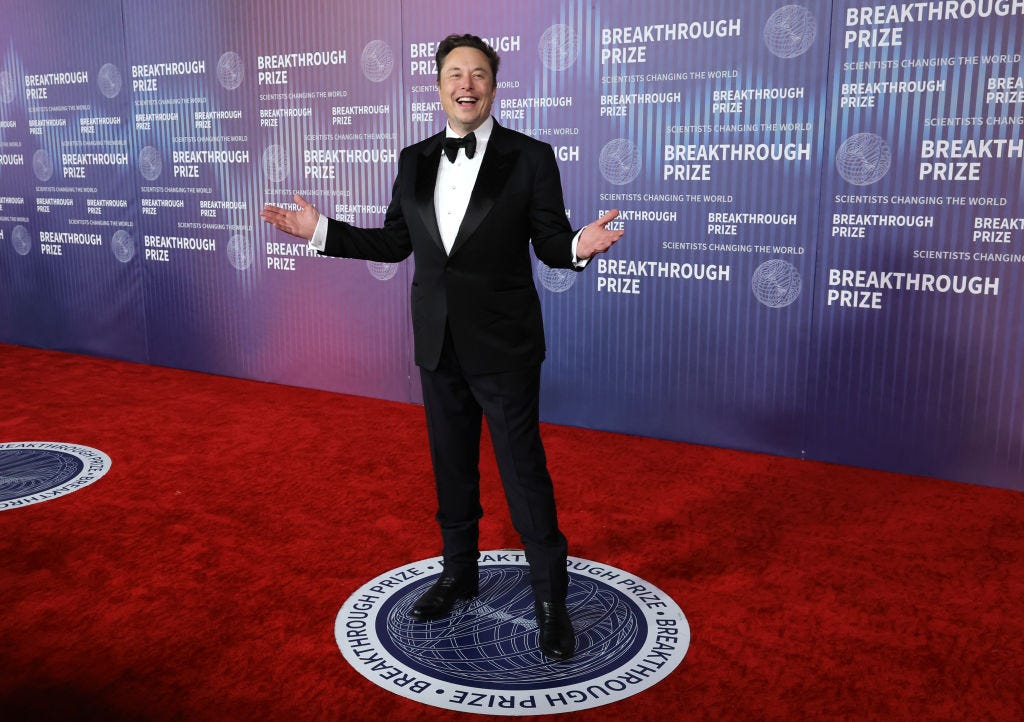
On Monday morning, Elon Musk announced in a post on his social media platform X that he plans to give American children one share of SpaceX, his rocket, satellite, and AI company. “Next year, I will give one of my SpaceX shares to every kid in America,” Musk wrote. “This will be the first of many.”
One share of SpaceX stock would be worth around $146 for each child, based on Friday’s closing price. According to 2025 census data, there are around 72 million children in the United States. If Musk donated one share to every child, the giveaway would be valued at around $10.5 billion today.
Musk did not provide any details on the giveaway, including whether shares would be given to every person under 18 or the exact timing of the giveaway. It is also not immediately clear how Musk would distribute the SpaceX shares to American children. On X, Musk responded “Yes” to a post about the shares potentially being distributed via Trump Accounts. A person familiar with the matter told Bloomberg that Musk has “agreed in principle to distribute the stock through the Trump Accounts initiative.”
On Monday, President Trump celebrated Musk’s announcement, writing in a post on Truth Social that the shares would be going to Trump Accounts. “A BIG THANK YOU to our legendary friend, Elon Musk, for his incredible generosity in giving SpaceX Stock to millions of American children through TRUMP ACCOUNTS!” Trump wrote.
Trump Accounts are savings accounts for children that were launched on July 4. This summer, Trump said in an interview that he believed that Musk would donate SpaceX stock to Trump Accounts. “Well, I think that he will do that,” Trump told CNBC. In July, SpaceX President Gwynne Shotwell separately announced that she and her husband would be donating a share of SpaceX to around two million children with Trump Accounts.
While, at first blush, it seems like an act of charity, there are reasons to be skeptical of Musk’s motivations.
Changing the narrative
A Quinnipiac poll conducted last month found that 74% of Americans have little to no trust in the leaders of AI companies. This is a major problem when AI companies are seeking approval from communities to build massive data centers, trying to convince millions of Americans to buy their products, and lobbying for legal protection from liability risks.
Is Musk motivated by a sincere desire to help American children? Or is this just a public relations gimmick? Influential figures in Musk’s orbit have suggested rehabilitating the image of the AI industry is at least part of the motivation.
David Sacks, Musk’s longtime friend and co-chair of the President’s Council of Advisors on Science and Technology, has been advocating for AI companies to donate stock as a way to change the perceptions of the public. In a post on X, Sacks wrote, “I hope every AI company will follow the lead of [Shotwell] and give American kids a vested interest in their success. This would do much to improve the public’s image of AI.”
A memo from the Treasury Department on Trump Accounts says, “Donors are attracted by the hope that a stock contribution with a five-year holding period may lead recipients and their families to feel that they have a stake in the fate of the corporation to a greater extent than if the child’s holdings of the corporation were only through an index fund.” Any child who has a Trump Account will not be able to sell their donated SpaceX stock for at least five years.
There is considerable potential for Musk and other AI executives to use stock donations to sway the interests of an entire generation of children and their parents. While Musk announced donating one share to all children, future gifts could be targeted to specific geographic areas. For example, if a company wanted to construct a data center in a particular area but was facing pushback, it could donate stock to all of the children in the area.
For Musk, all of this comes at a small cost. Musk is the world’s richest person, with a current net worth of around $904 billion, according to Bloomberg. A donation of $10.5 billion is just over 1% of his net worth.
Musk also may have been seeking to keep up with one of his rivals in the AI industry. On Sunday, Anthropic committed 5% of its shares to the Anthropic Public Benefit Fund, which it described as “a new wholly owned entity dedicated entirely to the public benefit.” Overall, about 20% of Anthropic’s shares have been dedicated to the public good. The co-founders have personally pledged 80% of their equity to charity.
Under Anthropic’s announcement on X, Musk replied, “I recommend giving the shares directly to the public.” The next morning, Musk declared his own donations.
Tax benefits
The donation of SpaceX stock would provide huge tax benefits to Musk personally.
As the founder, Musk paid essentially nothing for his SpaceX stock. Giving the shares away allows Musk to avoid about $2.5 billion in federal capital gains tax.
Because stock donations must be routed to Trump Accounts through a non-profit charity, the donations also count as a tax-deductible charitable donation and can generally be written off at their full market value for up to 20% of the donor’s adjusted gross income.
Musk has not said which private foundation he would make the donation through, but it seems likely that he would use his own Musk Foundation. Not only would this help Musk secure a tax deduction, it would also help the Musk Foundation meet its minimum annual giving requirements — which it has a history of violating.
Private foundations, including the Musk Foundation, are required to give away 5% of their assets each year. According to the New York Times, the Musk Foundation fell short of this 5% requirement in 2021, 2022, 2023, and 2024. The current value of the Musk Foundation is unknown, but its assets were worth over $14 billion in 2024.
The uncertain future
The pledge to donate billions of dollars in stock is just one in a long line of grand promises made by Musk. In several previous cases, he has reneged or not fully fulfilled his promises.
For example, in 2021, Musk told the United Nations’ World Food Programme (WFP) that if they could come up with a $6 billion plan to solve world hunger, he would sell Tesla stock to fund it. WFP quickly sent Musk a plan, but he did not donate the $6 billion.
Musk later donated $5.7 billion in Tesla stock — to his own foundation.
The point of the closing paragraph is a salient one. Elon treats promises like his children: willingly abandoned when he sees fit. Given the personal benefit Musk stands to reap from this stock gift plan, though, it stands to reason he might actually follow through with it. Then again, who knows?
Through their donations won't Musk and Trump have access to the personal information of every child in the U.S.?