

The crypto industry is desperate to pass the Clarity Act, which would legitimize and stabilize its business by providing it with a federal regulatory framework.
Critically, the Clarity Act assigns most regulatory responsibility to the Commodity Futures Trading Commission (CFTC), a small agency with a permissive approach to industry oversight, instead of the Securities and Exchange Commission (SEC), which has a much more rigorous approach to regulation and enforcement.
One of the primary beneficiaries of the Clarity Act would be President Trump himself. As president, Trump has expanded and promoted various cryptocurrency projects, including a special visit to the White House for the largest holders of his meme coin. Trump’s latest financial disclosure revealed he personally earned about $1.4 billion in 2025 from his family’s crypto ventures, including the meme coin and World Liberty Financial. (Retail investors in the same projects have lost billions.) A permanent, relatively permissive regulatory environment would likely make Trump’s holdings even more valuable.
Concerns about Trump using the legislation to further enrich himself have been the principal obstacle to the Clarity Act’s passage in the Senate. The bill needs at least 60 votes, requiring a minimum of seven Democrats, to clear the Senate. Democrats and Senator Thom Tillis (R-NC) have said they will oppose the bill unless it curbs Trump’s profiteering. A key procedural vote is expected to occur Tuesday.
On Monday, Senator Cynthia Lummis (R-WY) released a new version of the Clarity Act that she claimed imposed meaningful ethics requirements on Trump.
“President Trump voluntarily agreed to unprecedented ethics restrictions, holding every federally elected official, judge, and their spouses to some of the toughest ethics restrictions in U.S. history,” Lummis said in a statement. “Democrats got what they wanted; now they need to take yes for an answer.”
The latest version of the Clarity Act, which runs 635 pages, does nothing to meaningfully limit Trump’s conduct.
Trump’s corrupt crypto projects are grandfathered in
The current version of the Clarity Act prohibits “covered individuals” from issuing a digital asset like a cryptocurrency or meme coin. The same group is also prohibited from sponsoring or promoting digital assets.
A “covered individual” includes the President, Vice President, members of Congress, federal judges, and other high-ranking officials. Including the President in this list is one of the concessions being promoted by Lummis.
But this will have little to no impact on Trump. On the last page of the legislation, in a provision ambiguously labeled “Application,” the bill states that the prohibitions apply only to digital assets issued or sponsored on or after the effective date of the legislation. That means the digital assets that Trump has issued and promoted — his meme coin, the World Liberty Financial token, and the USD1 stablecoin — are grandfathered in. They are legal and Trump can continue to promote them in any way he wants.

The “effective date” of the legislation is up to 360 days after the enactment of the Clarity Act, so even if the legislation is enacted this month, Trump could theoretically issue new digital assets well into 2027 that would also be grandfathered in.
So you read this newsletter, but you haven’t purchased a paid subscription. There are two possibilities:
1. You just can’t afford the price of a subscription ($50/year or $6/month) right now. If that is the case, we get it! That’s exactly why Popular Information does not have a paywall. We want everyone to have access to our work, regardless of their financial resources.
2. You value independent accountability journalism and understand why it is critical to preserving and protecting democracy. You have thought about supporting Popular Information, but you just haven’t gotten around to it. That’s how it goes — life is busy.
But maybe today is the day! It takes a minute, and paid subscribers are the entire reason this newsletter exists. To maintain our independence, Popular Information has no advertisers and no corporate owners. We count on readers like you.
Trump does not have to meaningfully divest his holdings
The version of the Clarity Act released by Lummis has a third significant provision: “covered individuals” are prohibited from having a “significant financial interest” (defined as worth $15,000 or more) in a company that earned a plurality of its revenue from issuing or sponsoring digital assets.
The legislation, however, does not prohibit Trump from owning digital assets, which still allows him to profit from the industry he is regulating. Much of Trump’s interest in World Liberty Financial is held in tokens. The text also suggests Trump would be allowed to continue to collect his cut of new token sales as part of a grandfathered sponsorship agreement.
Trump also has a separate equity stake in World Liberty Financial — holding about 38% of the company through an LLC, according to his latest financial disclosure. But he is not required to divest his equity in crypto companies. Rather, the Clarity Act allows him to place his equity in a “blind trust.” But since Trump would know he’s placing his World Liberty Financial stake in a blind trust and the company is not publicly traded, such an action would carry little significance.
No plausible enforcement while Trump is president
Another major objection to the legislation is that only the Attorney General could bring an enforcement action. This would mean that, even if Trump failed to comply with an aspect of the law, it would require Attorney General Todd Blanche to sue him. Some Democrats demanded that state attorneys general be permitted to file suit against officials to enforce the law, to give the provisions that apply to Trump some real meaning.
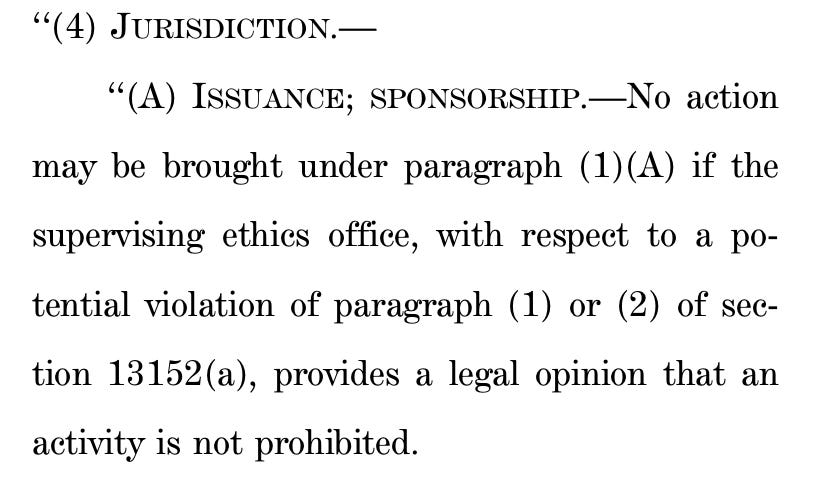
The updated legislation does not provide that. The only option for state attorneys general for enforcement against officials is to file suit against Blanche seeking an injunction. Even that option is foreclosed if the Office of Government Ethics (OGE), which Trump also staffs, issues an opinion that the conduct targeted by a state attorney general is permissible. That limitation is buried on page 631 of the legislation:
In the theoretical case where an injunction is issued, it is unclear what would happen next. Even in the face of an injunction it is hard to imagine a scenario where Blanche, Trump’s former defense attorney, effectively prosecutes Trump. (State attorney generals are able to take enforcement actions against crypto exchanges directly.)
In other words, there is no plausible scenario where the law is enforced against Trump.
Thank you for bringing actual clarity to the Clarity Act.
Only in America 2026 where the governing philosophy is corruption would this even be on the agenda. NO Americans put crypto at the top of their agendas, and yet Washington is consumed by this. I wonder why. If this passes with Dem votes, it just goes to show that the opposition party as currently constructed is useless and worthy of the low approval ratings the public gives it.