

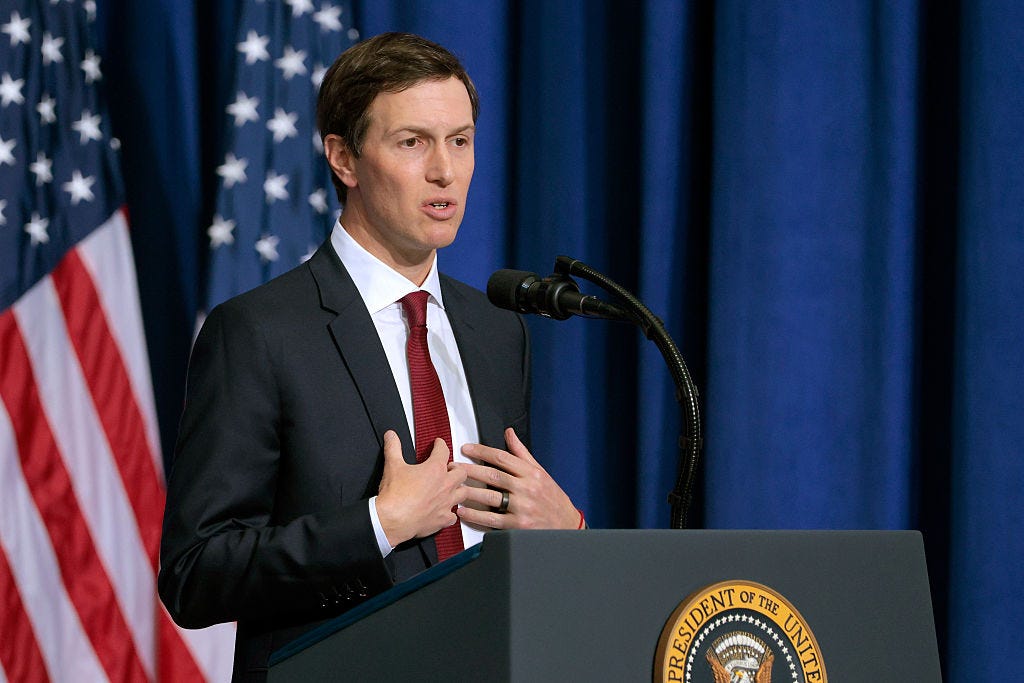
Today in Geneva, Switzerland, Jared Kushner will represent the United States in meetings with Iranian officials — a last-ditch effort to avoid war. Kushner, however, has serious financial conflicts that could make reaching a deal more difficult.
Kushner has played a central role in all of the most important foreign policy negotiations during Trump’s second term. He has been at the table representing the United States in talks concerning the future of Gaza, the war in Ukraine, and now Iran.
Today’s meeting comes at a critical time. Trump has ordered a large military buildup and publicly said he is considering attacking Iran. It is not clear exactly what Trump wants from Iran, but his demands include new limitations on Iran’s nuclear program. (Notably, Trump claimed that his attack on Iran in June 2025 “completely obliterated Iran’s nuclear capability.”) According to reports, if Trump’s new demands are not met, a U.S. attack on Iran could come as soon as this weekend.
Kushner, however, only works as the chief U.S. foreign policy negotiator in his spare time. His main job is as the founder and CEO of Affinity Partners, an investment firm that has raised billions of dollars from foreign governments. Three of the firm’s largest clients are the governments of Saudi Arabia, the UAE, and Qatar. Kushner collects tens of millions in management fees annually from these countries.
Before Trump returned to the White House, Kushner publicly acknowledged that this was a debilitating conflict of interest and pledged not to be involved with the incoming Trump administration.
In a February 2024 interview with Axios, Kushner stated that he would not resume his role as an adviser if Trump were to win the presidency again. Kushner told Axios’ Dan Primack that he made commitments to run his investment firm “for the long term” and “my commitment is to my investors, to my firm, to my employees, [and] to my partners.”
Pressed by Primack, Kushner said he would not accept a role in the new administration even if asked by Trump. “I’m an investor now,” Kushner said. “I served in government, and I think my track record is pretty impeccable. Now I’m a private investor.”
Kushner’s conflicts could make a deal with Iran less likely. Any Iran deal is likely to involve Iran agreeing to restrictions on nuclear development in exchange for the relaxation of economic sanctions. The biggest carrot on the sanctions side is removing sanctions on Iranian oil.
Saudi Arabia, the UAE, and Qatar — Kushner’s clients — are all significant oil producers. A relaxation of sanctions on Iranian oil would increase supply and potentially lower oil prices. Saudi Arabia and the UAE are part of OPEC, an organization that works to keep oil prices elevated by restricting supply.
Saudi Arabia is Kushner’s first and largest investor, committing $2 billion in 2021. In August 2026, Saudi Arabia will have the right to renegotiate its agreement with Affinity Partners or withdraw its funds, giving the country considerable leverage.
Kushner’s central role representing the Trump administration in multiple foreign policy negotiations while accepting tens of millions of dollars in fees from foreign governments may be illegal.
The Trump administration has tried to avoid legal issues by classifying Kushner as a “volunteer” rather than a government official. But a seminal 1977 opinion by the Department of Justice’s Office of Legal Counsel (OLC) found that “an identifiable act of appointment may not be absolutely essential for an individual to be regarded as an officer or employee in a particular case where the parties omitted it for the purpose of avoiding the application of the conflict-of-interest laws.” The OLC found that an individual “engaging in a governmental function” and “working under the direction or supervision of the President” should be considered an SGE.
In Geneva today, Kushner is engaged in activities that can only be conducted by government officials. The Logan Act bars private citizens from engaging in negotiations with foreign governments without authorization. Kushner is acting in an authorized capacity, under Trump’s direction, which creates a host of legal issues. As a de facto government official, the millions in fees Kushner is collecting from foreign governments violate the Emoluments Clause of the Constitution.
"Conflicted" makes it seem like Jared Kushner has actual feelings and morality. "Compromised" seems like a more accurate designation in light of his financial entanglements.
Thank You Judd!
We are not hearing, seeing this information on the nightly news! The PBS news hour reports his activity but hasn’t reported this important details thus not the whole story.
One has to question how this is allowed to happen.
No congressional oversight,etc.