

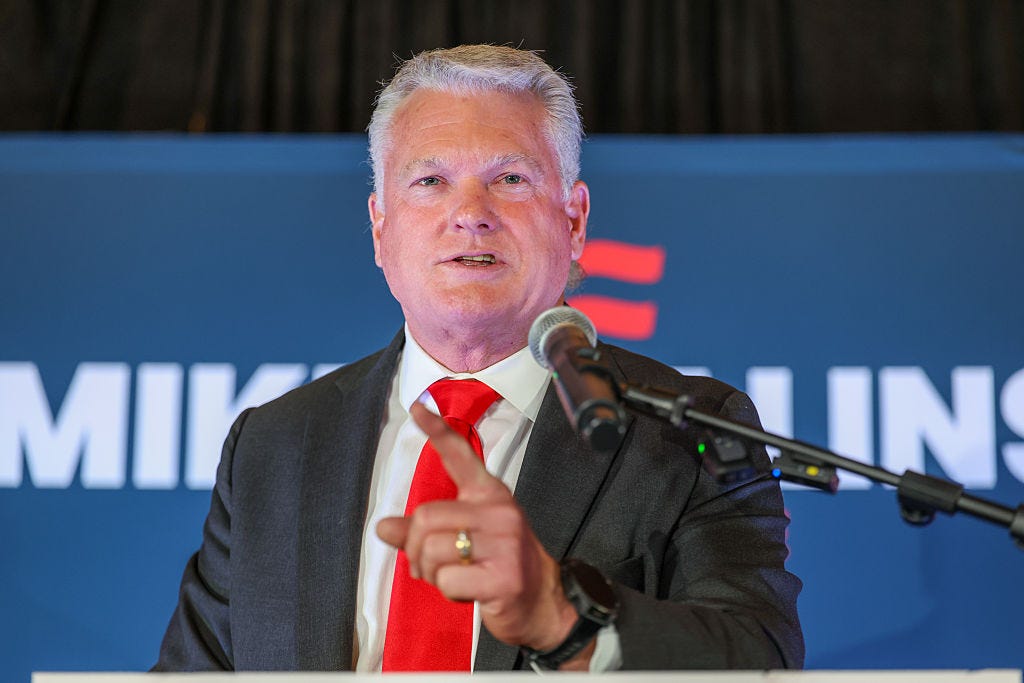
Congressman Mike Collins (R-GA), the Republican nominee for a hotly contested U.S. Senate seat in Georgia, spent over $400,000 of taxpayer money designated for office expenses on TV ads that are virtually indistinguishable from his campaign ads.
Collins paid for these ads using funds provided for the operation of his congressional office. Although it is permissible for such funds to be used for “mass communications” to constituents, the House Communications Standards Manual states that such communications “should not be used for political or personal business.” Further, the manual states that mass communications paid for with office funds should contain “no campaign content” and “no content laudatory of a Member on a personal or political basis.”
“Congressman Mike Collins. Mike you were fantastic,” President Trump says at the beginning of one ad paid for with Collins’ office funds. A narrator then states, “Mike Collins is protecting Georgia by working with President Trump to pass the Laken Riley Act.” The 30-second ad concludes by playing Trump’s praise of Collins again. “He loves this state and he took this very personally,” Trump says. “Thank you, Mike.” The only indication that the ad is not a campaign ad appears in small type for four seconds: “PAID FOR WITH OFFICIAL FUNDS BY THE OFFICE OF MIKE COLLINS.”
Indeed, Collins’ Senate campaign is currently running an ad that is substantively identical. Both ads include the exact same quote from Trump praising Collins, paired with the same video. In his taxpayer-funded ad, a narrator says Collins is “protecting Georgia by working with President Trump to pass the Laken Riley Act.” In his campaign ad, Collins says he “wrote the Laken Riley Act… to protect Georgia families.”
Another reason why these ads were so similar: it appears they were created by the same political ad firm, Smart Media Group. On its website, Smart Media Group says it “powers winning campaigns” and is “trusted by all the top Republican committees.” The firm says it leverages data to produce ads that “help campaigns win elections.” The House Communications Standards Manual also prohibits the distribution of “content developed using campaign resources.”
According to the House Statement of Disbursements, where each member must report their office expenses on a quarterly basis, Collins’ House office paid Smart Media Group over $400,000 between October 2025 and March 2026. This includes a payment for $307,160 on March 16, 2026.
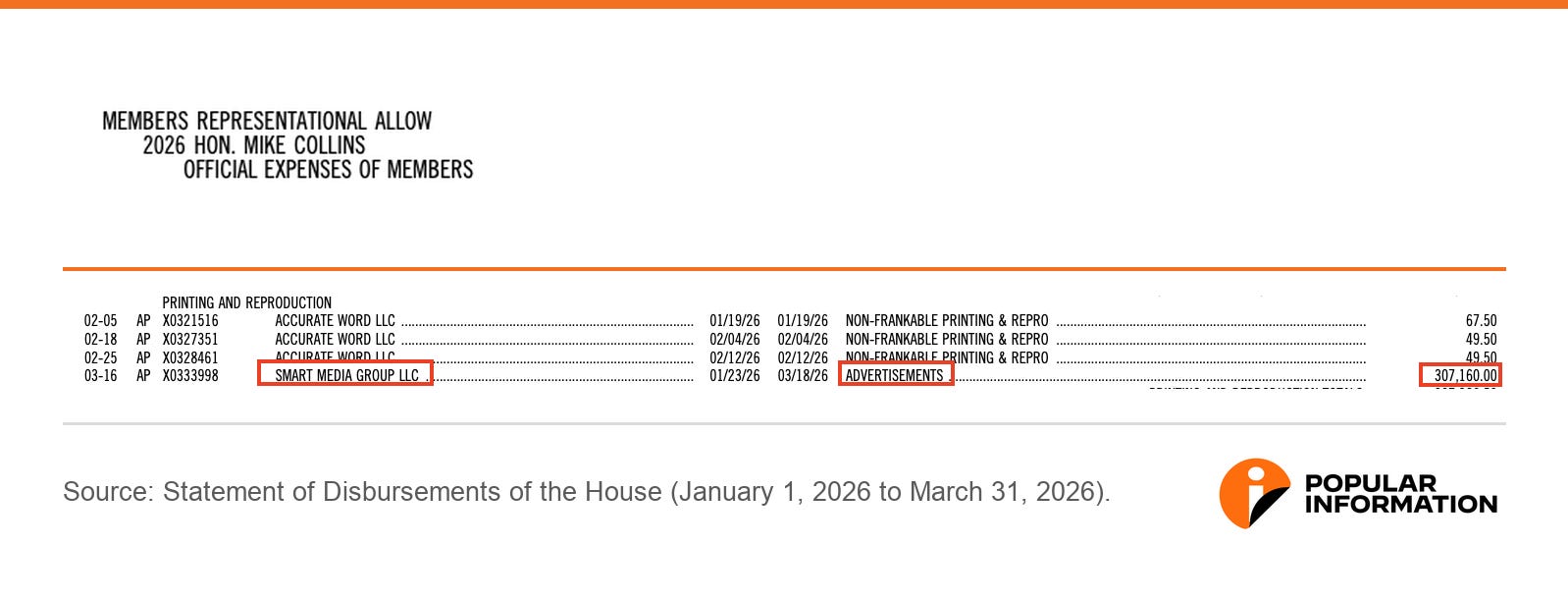
To put that figure in perspective, over the same six-month period, the average Congressional office spent about $33,000 on all mass communications. A Popular Information review of the spending of every House member from 2020 to the present found that the payment of over $300,000 to Smart Media by Collins’ office was the single largest recorded payment for advertising.
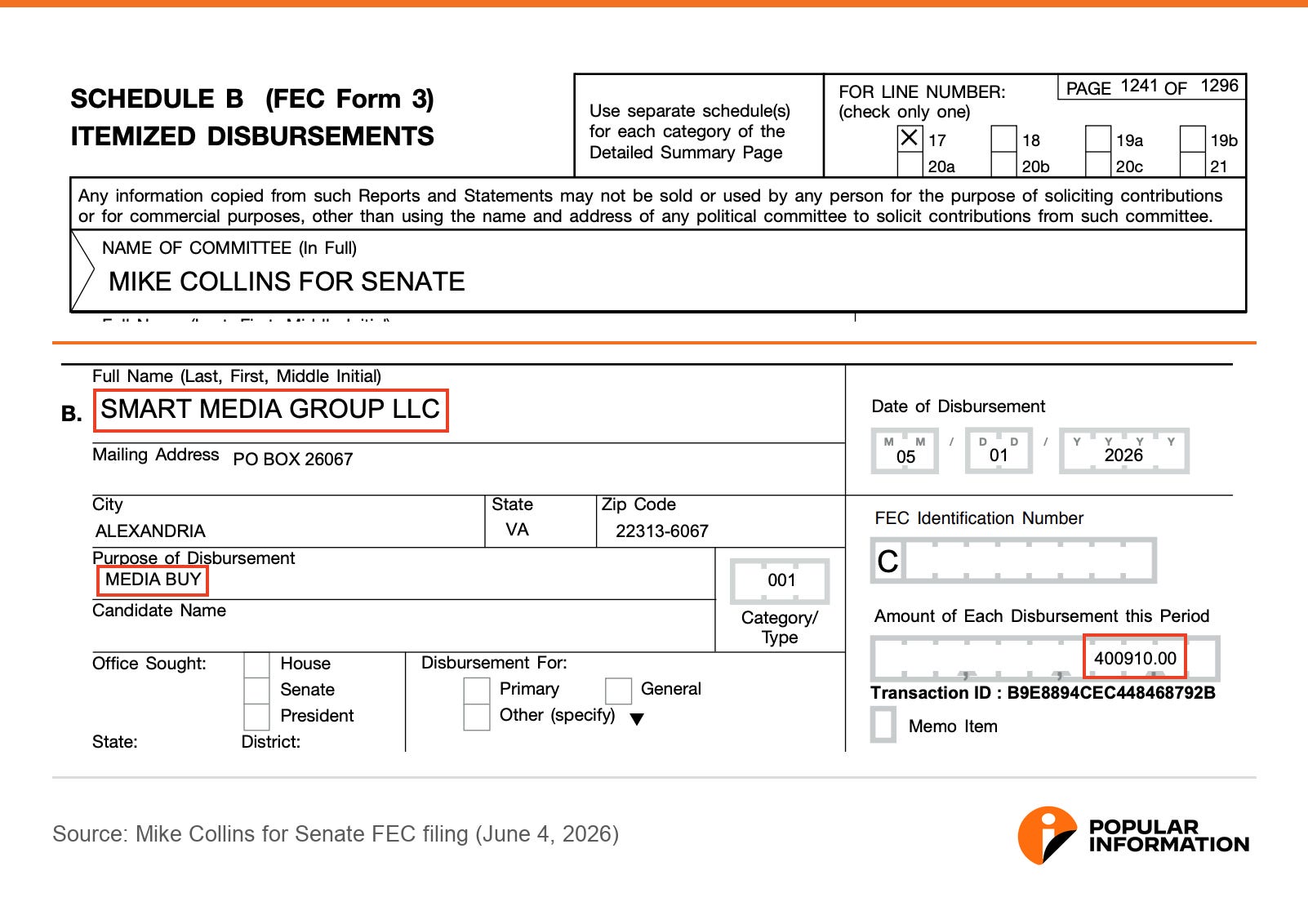
Meanwhile, on May 1, 2026, Collins’ Senate campaign paid Smart Media Group $400,910 for an ad buy.
Unsolicited mass communications paid for with Congressional office funds are prohibited within 60 days of an election. Collins’ taxpayer-funded ad ran through March 18, 2026, just before that 60-day cutoff ahead of the May 19 primary in Georgia.
Collins’ office did not respond to a request for comment.
All unsolicited mass communications, including Collins’ ads, must receive an advisory opinion from the House Communications Standards Commission. Collins’ ads were approved, but the process is a rubber stamp handled by commission staff. There is no public record of any communication being rejected — or even elevated to the six-member commission for a vote.
The use of office funds to run TV and other video advertisements is a relatively recent phenomenon. Prior to 2000, mass communications by Congressional offices were limited to mail. Since the 18th century, members were permitted to send mail using their signature as postage, a process known as “franking.” This was seen as a crucial mechanism “to convey information to their constituents about the operations of government and policy matters before Congress.”
In 2000, the definition of mass communications in the House was formally expanded to encompass “mailings, advertisements, automated phone calls, video or audio communications, and emails.” This opened the door to the kind of taxpayer-funded ads Collins is running.
Several other members of the House, Democrats and Republicans, produce video ads with office funds. One of the more brazen examples is Congressman Brad Sherman (D-CA), who is a member of the House Communications Standards Commission. Collins’ conduct, however, stands apart due to the amount of taxpayer money he is spending, his use of campaign consultants, and the similarity of his taxpayer-funded communications to his campaign advertisements.
If Collins defeats incumbent Senator Jon Ossoff (D-GA) in the general election, he will have to change his conduct. There is no framework in the Senate that allows for the use of office funds for television ads.
Are there any MAGA Republicans for whom any laws apply? They all think they are Trump and can do whatever they want with taxpayer or donor money.
Portrait of a Nation Crumbling. One hopes that this anti-immigrant fever that the right wing has whipped up (again), will fade. Once we have cleared out all people that are 1) non-white 2) seeking a better life and the pursuit of happiness, then will white people be happy?