

Vivek Ramaswamy, a billionaire and the Republican nominee in Ohio’s gubernatorial race, served as the frontman for a dubious pharmaceutical company and then cashed out weeks before its dramatic crash.
In 2014, Ramaswamy founded Axovant, a company he used to buy the rights to an inauspicious Alzheimer’s drug that had repeatedly failed in clinical trials. Axovant then hired Ramaswamy’s mother, who, despite lacking relevant research experience, helped massage data from old clinical trials to make the drug appear more promising. The extent of the elder Ramaswamy’s role has not been previously reported.
In 2015, touting his mother’s reinterpretation of the data to potential investors and regulators, Ramaswamy led Axovant to a $1.4 billion initial public offering, the largest in biotech history at the time. He spent the ensuing two years promoting the drug intepirdine as a possible breakthrough for the millions of Americans who have Alzheimer’s disease.
Then, after structuring the company to insulate himself and other insiders from potential losses, he cashed out through a private back door weeks before another clinical failure cratered the stock price. One state retirement fund for teachers lost more than $1 million.
Ramaswamy, whose gubernatorial candidacy has received tens of millions in combined financial backing from fellow right-wing billionaires Elon Musk, Jeff Yass, and Bill Ackman, reaped an estimated $260 million from Axovant’s parent company.
Ramaswamy has maintained that he is “proud” of his work on intepirdine. “There is probably nothing in a meaningful way we could’ve done differently in the decision of advancing that drug,” he said at a 2018 conference held as the Axovant share price hovered around the $1 mark. “Given those same set of facts… with a different drug today, I think we would make the same decision.”
The Ramaswamy campaign did not immediately respond to a request for comment.
Daniel Skinner, a professor of health policy at Ohio University, noted that while Ramaswamy was never charged with a crime, he profited substantially off of his intepirdine marketing right before the failure of its last clinical trial. “That’s where people have a lot of questions, whenever you kind of pump and dump something,” he said in an interview with Oligarch Watch. “You look back at his words, and he was extremely effusive — really right up to the very end — about the prospects of this working.”
How Ramaswamy’s mother massaged data from failed drug trials
After completing his undergrad at Harvard in 2007, Ramaswamy cut his teeth by co-managing the biotech portfolio of a New York hedge fund. He used the experience to start his own company in 2014: Roivant Sciences, which launched a web of subsidiaries to buy up floundering pharmaceutical drugs from major developers with the goal of bringing them to market.
One of Ramaswamy’s early reclamation projects was SB-742457, a drug to improve cognitive functions in patients with Alzheimer’s disease. Axovant, a Roivant subsidiary, acquired the drug in December 2014 and rebranded it to RVT-101. It later settled on the international nonproprietary name intepirdine.
Axovant purchased the in-license for intepirdine from GlaxoSmithKline for a $5 million upfront payment — a sum that was tantamount to “lunch money,” as one industry publication observed at the time. (A 2026 analysis by Ambrosia Ventures found the median going rate for similar pharmaceutical licensing deals was $50 million.)
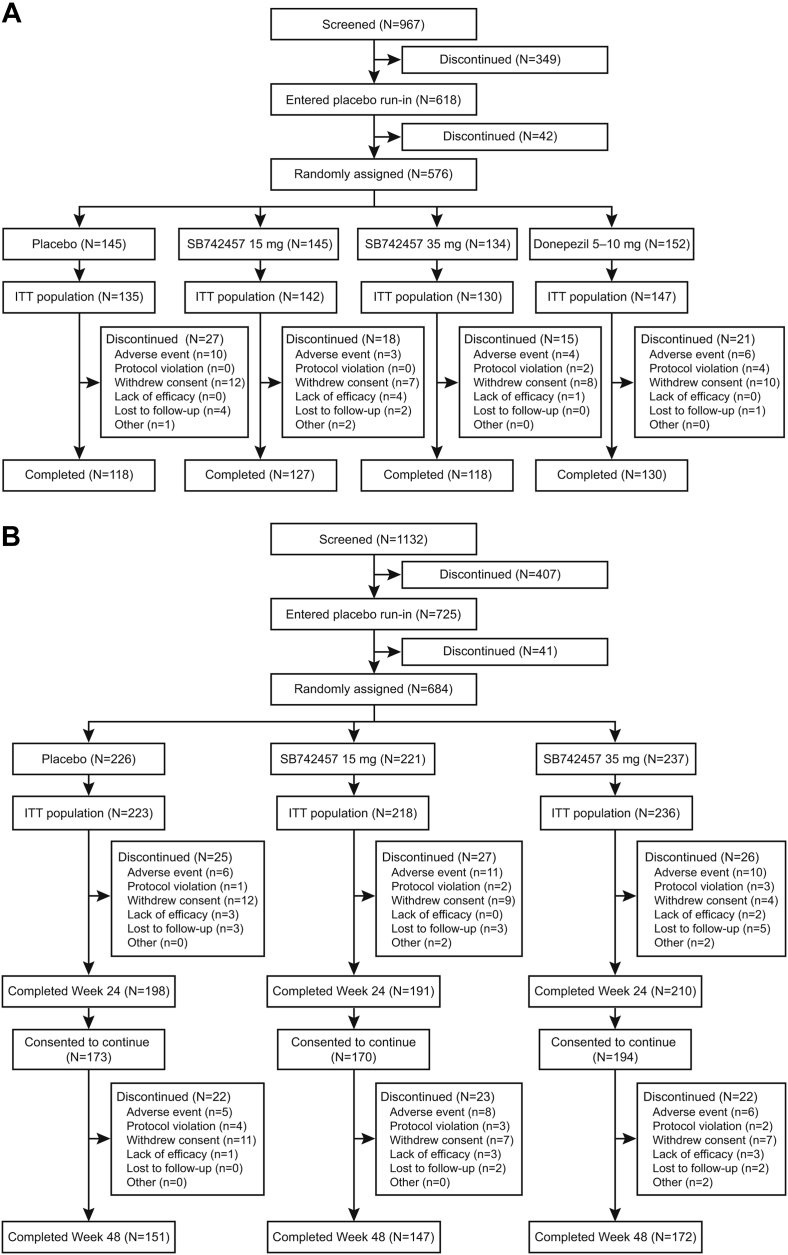
The bargain-bin selloff reflected the drug’s troubled developmental run, which concluded with Glaxo discontinuing it, according to AlzForum. At Glaxo, it had failed multiple Phase 2 clinical trials, including the two most recent trials — involving 576 and 684 patients — before its acquisition by Axovant.
But once in the hands of Axovant, Glaxo’s failed clinical trials were reevaluated to make intepirdine appear full of promise as an Alzheimer’s treatment.
In 2015, Ramaswamy, who was 29 years old at the time, hired his own mother, Geetha Ramaswamy, as Axovant’s vice president of medical and scientific strategy. By July of that year, within weeks of Axovant raising $315 million in its record-setting IPO, the elder Ramaswamy had co-published two analyses on intepirdine despite having no experience conducting clinical trials, an investigation by Oligarch Watch found.
While Geetha Ramaswamy had previously worked in the neuroscience divisions of Abbott Laboratories and Merck, her roles were primarily focused on management, relationship building, and recruiting and training, according to her LinkedIn. “Played a key role in Speaker training .[sic] Valued as a scientific peer by national experts,” reads one of her LinkedIn career bullet points. But Geetha Ramaswamy appears to have never conducted a clinical trial before or during her time at Axovant, nor did she produce significant original research during her career.
At Axovant, her co-analyses pulled from Glaxo’s 48-week, Phase 2b clinical trial of 684 Alzheimer’s patients that found the drug had “failed to achieve formal statistical significance” and had not “met the overall criteria for success.”
However, by omitting huge segments of the original trial data, a “responder analysis” co-authored by Geetha Ramaswamy concluded there was enough evidence to “support the initiation of a Phase 3 confirmatory study evaluating the efficacy of RVT-101 [intepirdine] in mild-to-moderate Alzheimer’s disease in the second half of 2015.”
Instead of measuring patients’ exact cognitive performance while on intepirdine, her analysis merely divided them into two classifications: “responder” and “non-responder.” Put another way, if it were an academic test, a responder analysis would use pass-or-fail grading instead of a numeric system.
An article published last year in the leading peer-reviewed journal Alzheimer’s & Dementia objected to responder analyses for increasing the risk of “causal fraud” when used to evaluate the clinical benefits of Alzheimer’s treatments. “Statistical approaches that rely on a dichotomized binary outcome, including responder analyses… result in a loss of information and reduced statistical power, increasing the risk of false positives and negatives,” wrote University College London’s Kathy Liu and colleagues.
In smoothing over clinical findings that were a liability for her son’s ascending company, Geetha Ramaswamy also stood to profit financially. Along with her annual salary of $250,000, an Axovant regulatory filing from 2015 reported that she was “granted a stock option for 262,500 common shares… with an exercise price of $0.90 per share.”
The other analysis she co-published shortly after Axovant’s IPO was a “completer analysis” that again sugarcoated Glaxo’s failed 684-patient trial — this time, by excluding the more than 30% of patients who had dropped out during the 48-week duration. “Given the low drop-out rate, this analysis provides an accurate representation of the study,” Geetha Ramaswamy and her colleagues wrote in their reanalysis that comprised only “patients with complete data at each study visit.”
Completer analyses have long been panned within the medical research field for producing biased or inadequate findings due to the exclusion of data. In a 2011 article, Thomas R. Fleming, a biostatistician who co-developed the leading statistical method for monitoring clinical trials, criticized completer analyses as “simplistic” and for inducing biases. “Missing data on outcome measures in clinical trials meaningfully reduce the integrity and interpretability of results,” he added.
But the controversial method produced the numbers that Axovant needed.
Days before its record-setting IPO, Axovant shared identical completer analysis data in a June 2015 filing to the Securities and Exchange Commission, in which the company asserted that its drug “has the potential to be a best-in-class 5-HT6 receptor antagonist for the treatment of Alzheimer’s disease based on its safety, tolerability and efficacy for up to 48 weeks.”
Axovant also cited the completer analysis in a July 2015 press release to claim that patients treated with intepirdine suddenly showed “statistically significant benefits” and argue that a Phase 3 trial of intepirdine was justified.
Additionally, analysis co-authored by Geetha Ramaswamy combined three separate patient performance and dementia severity yardsticks: Clinical Dementia Rating - Sum of Boxes (CDR-SB), Alzheimer’s Disease Assessment Scale - Cognitive Subscale (ADAS-Cog), and Alzheimer’s Disease Cooperative Study - Activities of Daily Living (ADCS-ADL). The composite approach seemingly helped Axovant mask the pivotal failure of the original trial’s CDR-SB objective — a test that scores disease severity in Alzheimer’s patients — which Glaxo had used as one of two primary objectives to decide the trial had failed.
Nevertheless, Geetha Ramaswamy’s responder co-analysis pointed to the ADCS-ADL scale as proof that patients on intepirdine had shown improvements, even though it was not deemed to be an essential co-primary endpoint in the clinical trial. The change meant the tests that previously torpedoed the trial no longer had to stand on their own. Geetha Ramaswamy and her team ultimately came away with a contorted but improved p-value score, pulled from the same clinical data that showed the drug had failed.
“A unique drug that we actually think could help millions”
Ramaswamy used his mother’s dubious math to help raise $315 million during Axovant’s $1.4 billion IPO, figures the company reached on no revenue.
In submitting its pre-IPO S-1 form to the Securities and Exchange Commission, Axovant claimed that Glaxo’s Phase 2b clinical trial — the same one that had failed, the same one that Geetha Ramaswamy then cherrypicked from — showed subjects who received 35 mg of intepirdine “in combination with donepezil achieved a statistically significant improvement in cognition at 12, 24 and 48 weeks following initiation of treatment.”
“We believe this is a meaningful result,” the filing continued.
The structure that Ramaswamy used to launch the IPO meant that four parties controlled more than 90% of Axovant shares. Three-quarters of the equity stayed with Roivant, and 13.15% went to Visium Asset Management and RA Capital Management in the IPO. Janus Capital Management, a hedge fund, purchased less than 2%. Public investors and traders were provided a free float of approximately 10%.
In its red flags for identifying potential pump-and-dump schemes, the Financial Industry Regulatory Authority (FINRA) has pointed to a limited public float and the concentration of a company’s IPO shares into a few hands as two marks that investors should watch out for.
To boost the stock, Ramaswamy boasted on CNBC that Axovant was in the catbird seat “for delivering value” to the five million Alzheimer’s patients in the US. Intepirdine, he added, was a “unique drug that we actually think could help millions of patients.”
“If you think about it, we own global rights to a drug that has already demonstrated in a large Phase 2b study efficacy on the two parameters that the FDA has historically required for new Alzheimer’s disease drugs,” he claimed in an interview with Jim Cramer shortly after the IPO. “And actually, we’re only — we believe — we’re only one additional Phase 3 study away from the approval of this drug.” (Along with not having any of its own clinical data, Axovant launched its IPO without a single recruit for future clinical trials.)
One factor contributing to the excitement around intepirdine was the “great hope” shared by patients and their family members who desperately wanted a cure, explained Skinner, the Ohio University health professor. “There’s been extraordinary failure in the Alzheimer’s space,” he added.
Ramaswamy, who signed an SEC filing claiming intepirdine had “best-in-class” potential, fed into that hope by telling Forbes that the drug would make “a huge difference” if approved.
But reality eventually caught up with his claims. In February 2016, Pfizer discontinued its analogous 5-HT6 Alzheimer’s drug because it met pre-specified futility criteria, meaning researchers determined there was no reason to continue clinical trials. A separate 5-HT6 drug being developed by Lundbeck also failed three Phase 3 trials within a six-month span beginning in September 2016.
Unable to sell 75 million Axovant shares on the open market without risking a market nosedive and regulatory disclosures, Ramaswamy monetized Roivant’s position through a private $1.1 billion SoftBank investment. (Ramaswamy never held a direct personal stake in Axovant, instead maintaining indirect ownership through Roivant.)
An SEC disclosure from September 2017 reported that SoftBank had gained “beneficial ownership” over Roivant’s 75 million Axovant shares.
Less than one month later, intepirdine failed its Phase 3 trial, causing Axovant stock to crash 70% in one trading day.
“Heads I win and tails I also win”
After the collapse of the Phase 3 trial, the value of Axovant shares held by the California State Teachers’ Retirement System fell from $1,228,000 to $68,000, per SEC filings. Axovant eventually rebranded to Sio Gene Therapies and lost 99.8% of its value before shuttering completely.
Ramaswamy, meanwhile, made an estimated $260 million during his time at Roivant, according to Forbes.
Since winning the Republican nomination in the Ohio gubernatorial race, Ramaswamy has shied away from discussing his time in biotech, choosing instead to cast his business success story in more vague terms, noted David Niven, a political scientist at the University of Cincinnati.
“One of the defining questions of the campaign will be, are Ohioans talking about this in October — are they aware of how well he did, and how poorly most other folks did on that Alzheimer’s drug?” Niven said in an interview with Oligarch Watch.
The basic reality of how Ramaswamy ran Axovant, Niven added, “was heads I win and tails I also win, in terms of the outcomes of the trials or whether the drugs actually proved useful or not.”
Very Timely Investigated Reporting by Judd!
Ohio wake up and read!
Question:
Why do you folks keep picking Billionaires to represent you?
They only take and They never give back to you!
How’s that working for you?
Judd just keeps the lights On!
Not that liars and cheaters get prosecuted anymore- they get to keep their ill begotten gains while spreading more self graciating lies, lots of lies. And then they try to take over government. This article was so informative and explanatory. I got a real education reading this!