

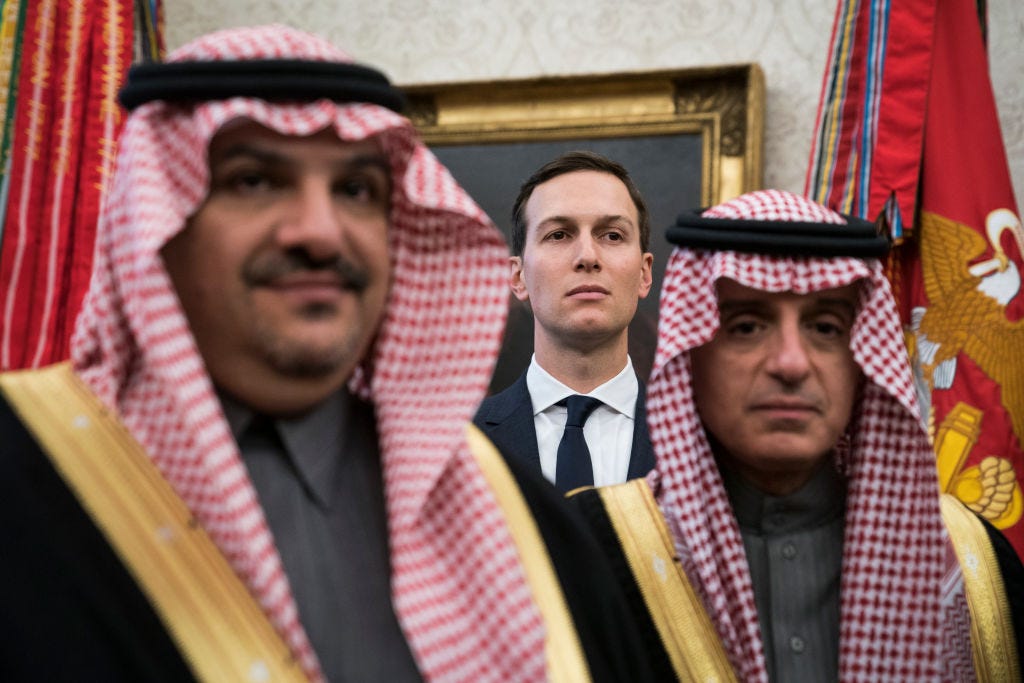
Jared Kushner, who is being paid tens of millions of dollars in annual fees by the Saudi government and other Middle Eastern nations, has taken a central role advising President Trump on Middle East policy.
On Monday, Kushner met in Miami with Steve Witkoff, Trump's envoy to the Middle East, and Ron Dermer, a top advisor to Israeli Prime Minister Benjamin Netanyahu. At the meeting, the trio reportedly discussed a new proposal for a ceasefire and "day after" plans. Two weeks ago, Kushner visited the White House with former British Prime Minister Tony Blair to advise Trump about potential post-war reconstruction plans in Gaza.
Last year, Kushner said this would not happen. In a February 2024 interview with Axios, Kushner stated that he would not resume his role advising his father-in-law if Trump were to win the presidency again. Kushner told Axios' Dan Primack that he made commitments to run his private equity firm, Affinity Partners, "for the long term" and "my commitment is to my investors, to my firm, to my employees, [and] to my partners." Pressed by Primack, Kushner said he would not accept a role in the new administration even if asked by Trump.
Later in the interview, Primack asked whether, as a result of accepting billions in investments from public investment funds run by the governments of Saudi Arabia and the United Arab Emirates (UAE), it would be "very difficult… to do any sort of foreign policy work" in a second Trump administration. "I'm an investor now," Kushner replied. "I served in government, and I think my track record is pretty impeccable. Now I'm a private investor."
Since 2021, Kushner has raised $4.8 billion in capital for Affinity Partners, nearly 99% from foreign sources. Most of the money has come from Middle Eastern governments. $2 billion came from the Public Investment Fund of Saudi Arabia (PIF). The PIF committee that screens investments recommended rejecting Kushner's proposal, citing "the inexperience of the Affinity Fund management" and "excessive" fees. The committee's recommendation, however, was overruled by Crown Prince Mohammed bin Salman, who heads PIF's Board of Directors and with whom Kushner had developed a close relationship.
In 2024, Kushner raised $1.5 billion from entities controlled by the governments of Qatar and the UAE. In a December 2024 podcast, Kushner said that as he raised the new money he "preemptively tried to avoid any conflict." Kushner's financial relationship with these Middle Eastern governments, however, is ongoing.
For example, the Saudi government pays Kushner 1.25% of its investment, or $25 million annually. Other investors pay annual fees of up to 2%. As of September 2024, Affinity Partners had collected $157 million in fees, mainly from Middle Eastern governments.
Kushner is continuing to collect these fees.
Advising the president while simultaneously accepting tens of millions of dollars from Middle Eastern governments would represent a conflict on any topic. But the future of Gaza is a key issue for Saudi Arabia and the UAE, as they seek to expand their political and economic influence in the region.
Saudi Arabia "is spearheading urgent Arab efforts to develop a plan for Gaza's future." The Saudis presented these plans to other countries in the region, including the UAE, earlier this year. They are eager to secure Trump's support for their efforts, even floating the idea of calling it the "Trump Plan" to win his approval.
Now Kushner, who is financially beholden to Saudi Arabia and the UAE, has a seat at the table.
The plan to monetize the devastation in Gaza
Two weeks ago, Kushner met with Trump and Blair at the White House to discuss Gaza. They may have discussed a so-called “GREAT Trust” plan developed by two Israeli businessmen for the post-war redevelopment of Gaza, which would include forcing Palestinians to either leave the territory or move to certain restricted areas during redevelopment. Two staff members at Blair’s nonprofit, the Tony Blair Institute (TBI), reportedly helped create the plan, although TBI denies that they had anything to do with the final product.
While the exact details of the August 27 meeting have not been disclosed, the Washington Post reported that a document outlining the GREAT Trust plan to use public and private investments to redevelop Gaza had been circulating around the White House leading up to the meeting.
In a nearly 40-page document, the Gaza Reconstitution, Economic Acceleration and Transformation (GREAT) Trust plan calls for Gaza to be turned into a set of AI-controlled urban centers surrounded by luxury hotels, data centers, solar power plants, and electric vehicle factories. The development would be funded through the GREAT Trust, which will include a mix of public and private investors.
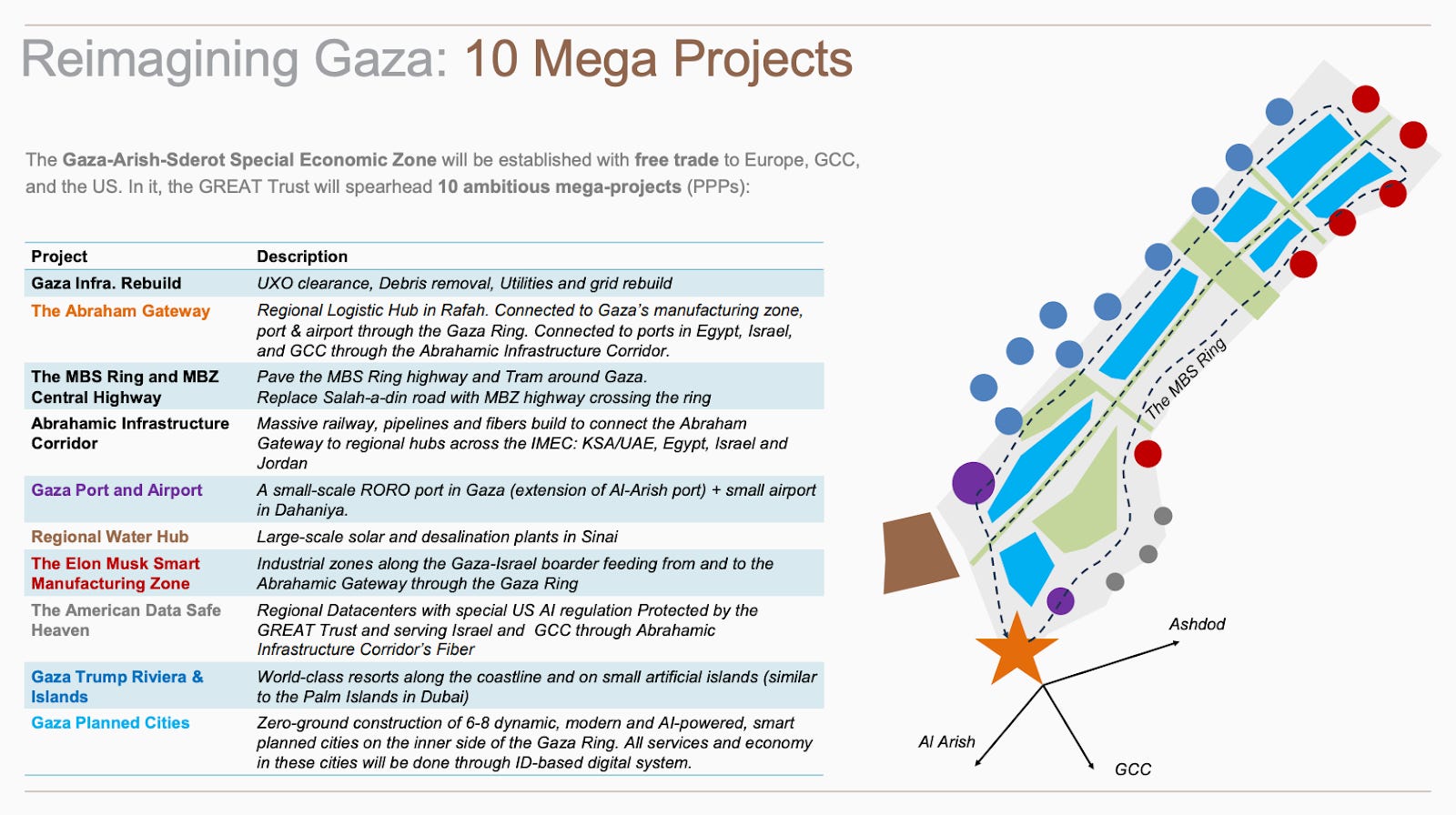
The countries that invest in the GREAT Trust will enter into a multilateral “custodianship” of Gaza with the U.S. and Israel. The GREAT Trust plan says that “ideally” Arab nations will invest in the trust, and it seems to be targeting Saudi Arabia and the UAE in particular. One of the planned projects for Gaza is the construction of a highway system named after Saudi Crown Prince Mohammed bin Salman and UAE President Mohammed bin Zayed al-Nahyan.
During this custodianship, Gazans are to be relocated, either to other countries or designated areas within Gaza, where they will be out of the way while their land is turned into the “Gaza Trump Riviera” and the “Elon Musk Smart Manufacturing Zone.” While the GREAT Trust plan says leaving Gaza will be optional, it does not appear that Gazans will have the option to stay where they are. They can move to the trust’s temporary housing or leave the territory altogether while the redevelopment plan is implemented.
Kushner was an early supporter of the idea to ethnically cleanse post-war Gaza in order to turn it into luxury real estate. In a March 2024 interview at Harvard’s Middle East Initiative, Kushner said that Israel should “move people out” of Gaza to “clean it up,” describing the land as “waterfront property” and “very valuable.” Trump also adopted this idea at the beginning of his second term, saying, “You’re talking about a million and a half people, and we just clean out that whole thing."
The GREAT Trust document is clear that ideally as many Palestinians as possible would choose to leave Gaza. Each Palestinian who leaves Gaza, the plan emphasizes, generates savings of $23,000 and every 1% of the population that leaves generates $500 million in savings. (The plan estimates that it will cost $9,000 in food and housing assistance per person who relocates to a different country, as opposed to $32,000 per person who needs temporary housing in Gaza.)
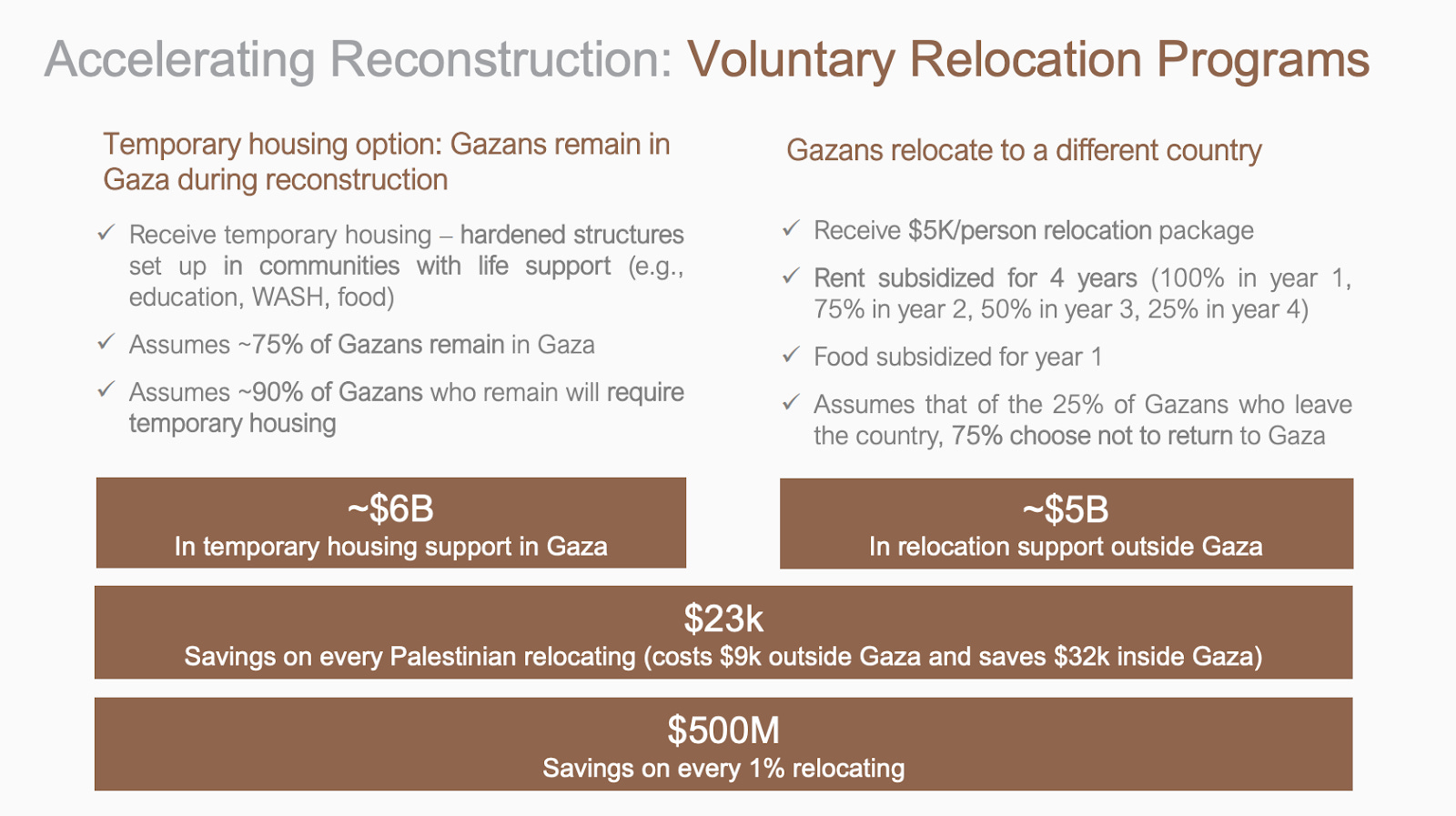
The more Gazans leave, the more money the trust can return to its investors.
The GREAT Trust plan, which purports to find a way to grant self-governance to Palestinians, does not have a clear path for doing so. Only after a “multi-year transition period,” during which Gaza is to be “demilitarized and deradicalized,” will Palestinians gain some form of self-governance, although the countries involved in the “custodianship” will retain some unspecified powers in exchange for their continued financial support. What the plan does provide is a way for wealthy investors and foreign governments, through firms like Affinity Partners, to profit.
We already know people like Jared Kushner don't value Palestinian lives, but seeing the depths of their callous indifference alongside acting in their own self-interest is truly something (awful) to behold.
Forcibly displacing people for the “Gaza Trump Riviera” and the “Elon Musk Smart Manufacturing Zone” — this sounds like the setup for a bad dystopian movie. Spoiler alert: It won’t go well.