

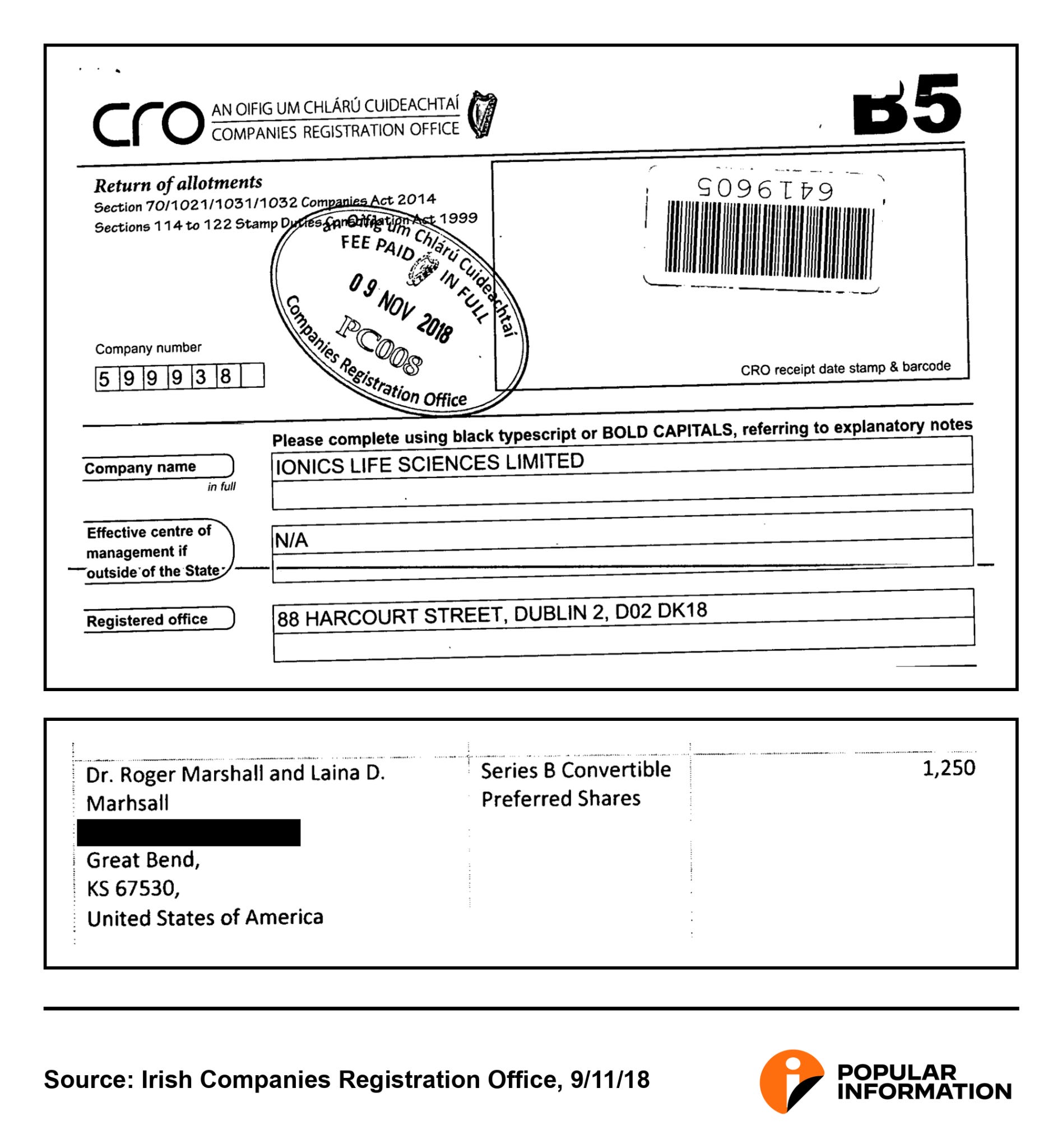
On November 8, 2018, then-Congressman Roger Marshall (R-KS) and his wife completed a purchase of 1,250 shares of Ionics Life Sciences, a privately held company, according to documents from the Irish Companies Registration Office obtained by Popular Information. The Marshalls spent $250,000 to acquire the stock at a price of $200 per share.
It was an impeccably timed purchase.
Ionics Life Sciences is an Irish holding company with no employees. Its wholly owned subsidiary, Genzada Pharmaceuticals USA, Inc., is a Kansas-based firm that is developing GZ17-6.02, an experimental cancer treatment developed from plant extracts, including the black calla lily. The company was founded by Gene Zaid, who has donated $6,800 to Marshall during his career in Congress.
On November 16, 2018, about a week after the Marshalls were allocated their shares, Genzada Pharmaceuticals USA announced the FDA “approved” its application “for a Phase 1 human clinical trial of the company’s flagship molecule GZ17-6.02 (6.02) for patients with advanced solid organ tumors or lymphoma.”
The approval of clinical trials on humans is a major benchmark for the development of any new drug. It typically increases the value of a company by clearing a major regulatory hurdle, moving the drug from the preclinical to clinical stage. Investors value companies like Genzada based on the odds of the drug ultimately reaching the market and, while still a long shot, being cleared for human trials improves those odds.
During a January 2019 visit by local lawmakers to Genzada’s offices in Sterling, Kansas, weeks after the FDA clearance, Zaid described the company as a newly attractive investment. “Now we have something,” Zaid told the lawmakers, according to the Hutchinson News. “Now, if you want to invite friends to invest, you can.”
Under the STOCK Act, Marshall was required to disclose his joint purchase of stock in Ionics Life Sciences within 45 days of his purchase. Marshall did not file his required transaction report, however, until August 28, 2019, more than 240 days late. Subsequent disclosures reveal that the value of his Ionics stock, by 2020, had increased and was now worth up to $500,000.
On the disclosure, Marshall lists the initial purchase date as October 1, 2018, and incorrectly lists its location as Sterling, Kansas. It is Genzada that is based in Kansas, not Ionics. Marshall did not report that Genzada was a subsidiary of Ionics until his August 2026 report.
Marshall’s campaign and Senate office did not respond to detailed questions about Marshall’s purchase of Genzada stock.
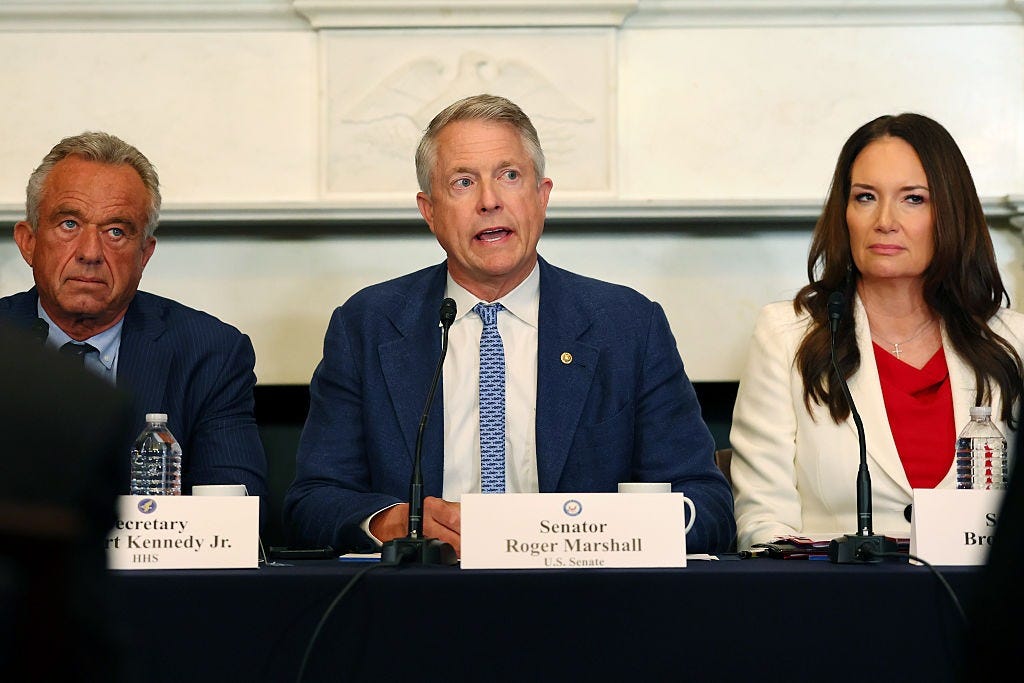
Marshall now oversees FDA, proposed bills that could benefit Genzada
When Marshall joined the Senate in 2021, he joined the Health, Education, Labor, and Pensions (HELP) Committee, which oversees the FDA, the organization that will ultimately determine whether Genzada’s GZ17-6.02 will be approved.
While in this role, Marshall has sponsored legislation that could ultimately benefit Genzada. In 2025, for example, Marshall co-sponsored the Small Biotech Innovation Act. It would exempt drugs created by small pharmaceutical companies from having to negotiate their prices with Medicare. In 2022, Marshall offered an amendment to a reconciliation bill that would similarly exempt “breakthrough treatments and life-saving medicine” from “federal government-controlled drug pricing.” He highlighted that his amendment would benefit emerging cancer drugs. “If Congress eliminates incentives for an industry with a 95-100 percent fail rate in cancer drugs, we’ll never get a cure,” Marshall said. “Americans deserve better.”
He has also publicly advocated for greater access to experimental drugs, a category that includes Genzada’s GZ17-6.02, once they have been determined to be safe. “I think this is the balance here,” Marshall told the right-wing website Just the News in May 2026. “Let’s make sure the drug is safe, but then let the doctors and the patients have more skin in the game and make that determination if they think they should try it or not.”
He has also spoken about his role in evaluating complaints from pharmaceutical companies whose drugs are rejected by the FDA. “[T]he people that struggle to get their drugs approved blow up my office, but then I dig down with the FDA,” Marshall said during an April 16, 2026 committee hearing. Marshall praised the FDA for approving drugs in record numbers despite funding constraints.
This is not the first instance of Marshall’s official advocacy overlapping with his personal financial interests. Last week, the American Prospect reported that Marshall has introduced legislation benefiting Nueterra, a Kansas private equity firm run by Marshall’s longtime business partner and donor Dan Tasset. Marshall’s family has invested in Nueterra funds.
After getting elected to Congress—he was a member of the House before being elected to the Senate—Dr. Marshall maintained his annual practice of getting Continuing Education to maintain and enhance his professional skills and knowledge. However he did substantially adjust the focus of his ongoing continuing education efforts. After all, one needs to focus on the skills most needed to prosper in your current career.
This obviously should be a bigger story. Sadly, I feel like Roger Marshall's relative anonymity, other legislators using their office to enrich themselves, and the general lawlessness of the Trump administration will blunt the potential impact of this reporting. Let's do our part to amplify this investigation.