

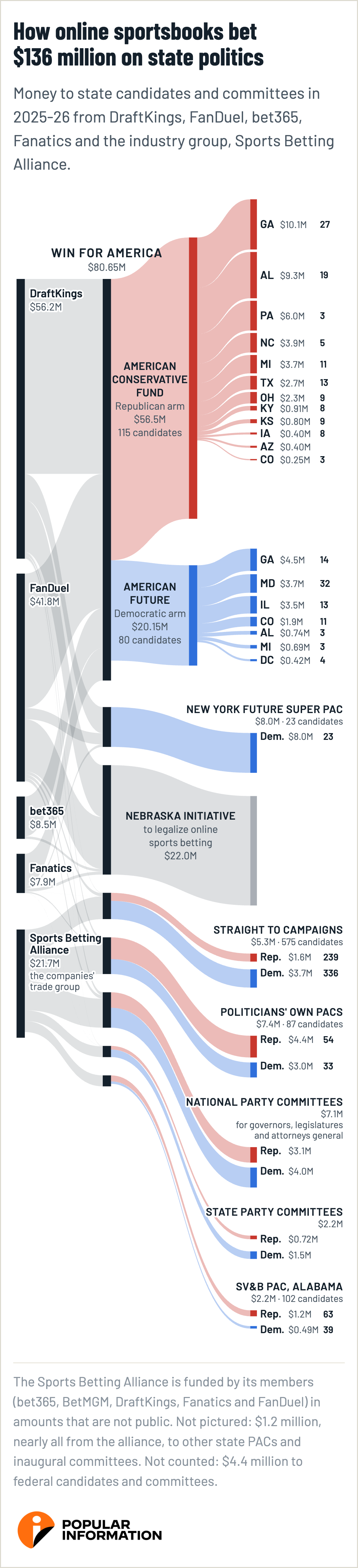
DraftKings, FanDuel, and a handful of other online sportsbooks spent at least $136 million on state elections during the 2026 election cycle, making the industry a dominant force in down-ballot races. The industry spent the money across 36 states, promoting a ballot initiative and supporting or opposing 948 candidates for state legislature, governor, attorney general, secretary of state, comptroller, school superintendent, and other statewide and local offices.
The money was funneled through a complex network of state political action committees (PACs), state super PACs, federal super PACs, leadership PACs, trade groups, state party committees, national party committees, and other vehicles. Popular Information catalogued the full scope of the online sportsbook industry’s political spending by searching data from the Federal Election Commission (FEC), Internal Revenue Service, the Federal Communications Commission (FCC), all 50 states and the District of Columbia. The totality of the industry’s efforts to influence the 2026 midterm elections has not been previously reported.
The money was used to support candidates who, in many cases, were willing to assist the industry in its efforts to legalize online sports betting in states where it is still banned, add online casino gambling in states where sports betting is already legal, thwart proposals to raise taxes on online gambling revenue, defeat proposals to ban prop bets, and undermine emerging competitors.
Most of the cash was provided by the two dominant players, with DraftKings directly contributing $56.2 million and FanDuel kicking in $41.8 million. The bulk of the money, over $80 million, was first donated to Win for America, a federal super PAC.
Win for America distributed nearly all of its cash to two other federal super PACs, $56.5 million to American Conservative Fund, which supports Republican candidates, and $20.2 million to American Future, which supports Democratic candidates. Although American Conservative Fund and American Future are federal committees, they spent their money supporting state candidates with independent expenditures. Their federal campaign finance filings, however, provided almost no information about which candidates the PACs supported, listing the spending under vague categories like “non-federal” media production and placement.
Both FanDuel and DraftKings donated more through the Sports Betting Alliance, the trade organization for online sportsbooks that spent another $21.7 million on state politics. The precise contributions of each company to the group are not disclosed.
Popular Information has, for the first time, traced this spending — along with other direct and indirect online sportsbook spending — to specific states and candidates.
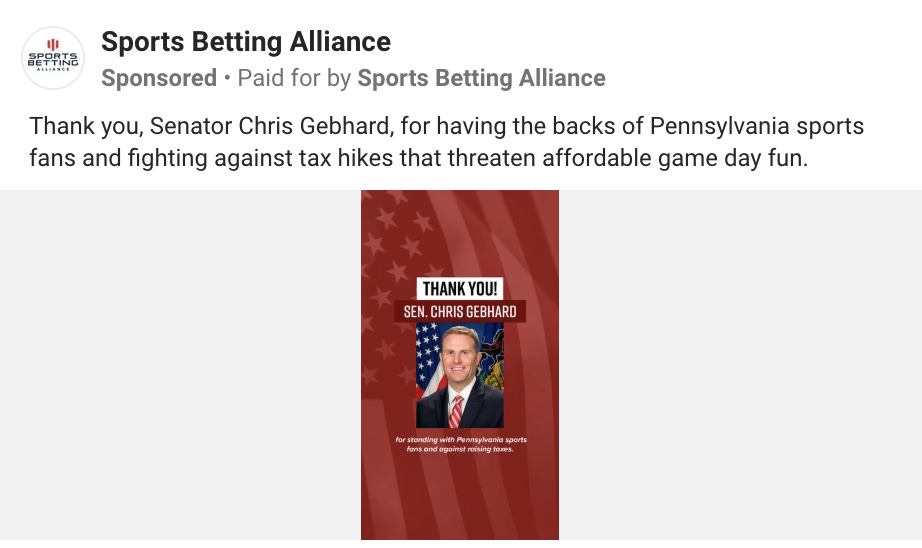
How was this money spent? In Pennsylvania, for example, State Senator Chris Gebhard (R) played a key role in removing a proposed tax increase on online sports betting, which would have funded investments in public transit, from the state budget. The Sports Betting Alliance spent a relatively small amount of money, less than $20,000, running ads on Meta thanking Gebhard for his efforts.
As the election neared, however, the spending exponentially increased while the involvement and agenda of online sportsbooks were obscured.
Win for Pennsylvania, a group that was 100% funded by the Win for America subsidiary American Conservative Fund, spent $654,835 on broadcast TV ads supporting Gebhard and attacking his Republican primary opponent, Clovis Crane. Win for Pennsylvania does not break down its spending by candidate, but Popular Information was able to determine its spending in Gebhard’s race through filings with the FCC by television affiliates.
The pro-Gebhard television ads funded by Win for Pennsylvania did not mention his positions on online sports betting but praised Gebhard for supporting President Trump, deporting immigrants, and building a border wall. The anti-Crane ads attacked Crane over alleged DUI charges.
Win for Pennsylvania also spent as much as $99,000 on dozens of online ads on Meta and Google platforms promoting Gebhard and attacking Crane. One ad attacked Crane for voting “against President Trump and our America First agenda“ in Republican primaries that Crane, then a registered independent, was not eligible to vote in. None of them mentioned gambling.
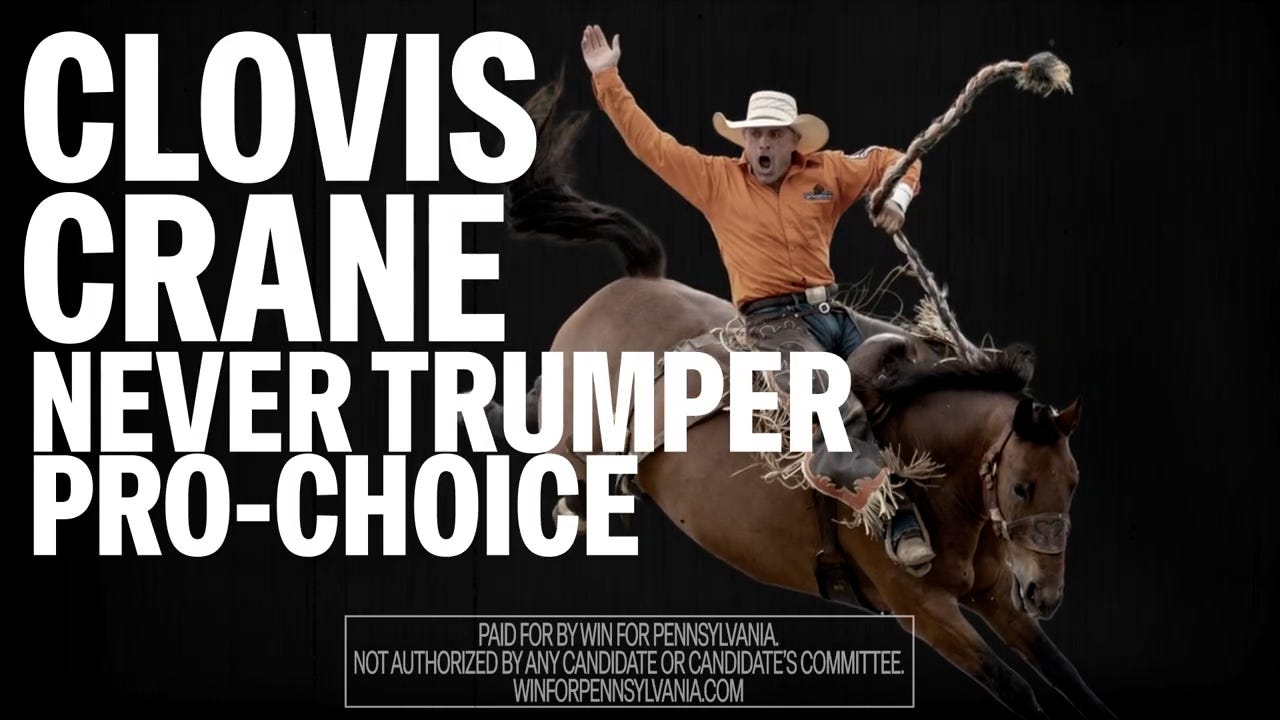
The more than $700,000 Win for Pennsylvania spent promoting Gebhard and attacking Crane substantially exceeded the total amount raised in the primary by Crane’s campaign, about $550,000. Gebhard romped to a primary win, beating Crane by 35 points.
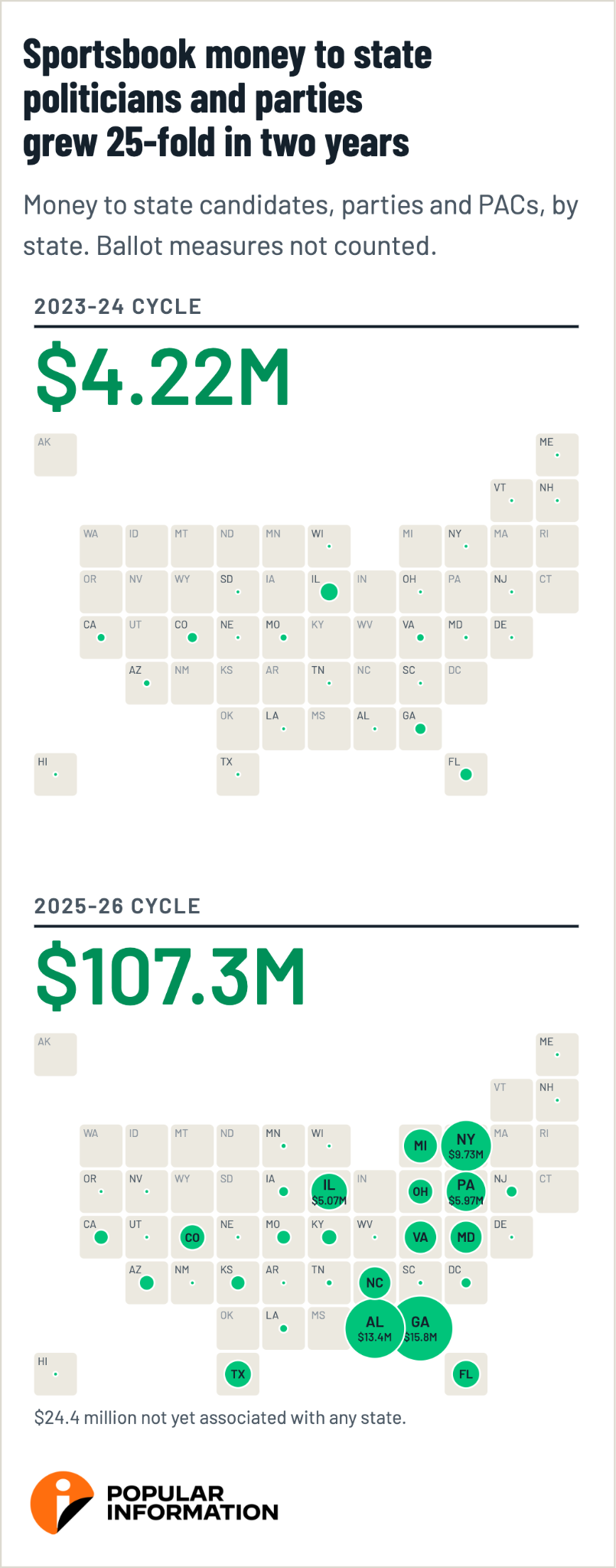
Outlays during the 2026 midterms represent a dramatic increase in the scope and breadth of political spending by online sportsbooks. In the 2024 election cycle, almost all industry spending was devoted to supporting a ballot initiative in Missouri to legalize online sports betting. Online sportsbooks spent about $4 million supporting state-level candidates during the 2024 cycle. During the 2026 midterms, that figure increased to $107 million — a 25-fold increase.
Armed with this cash, online sportsbooks secured key policy wins in some states. In other instances, the industry came up short of its ultimate goal but was nevertheless able to demonstrate its political influence.
Enriching politicians in the Empire State
In New York, FanDuel and DraftKings funded a state super PAC called New York Future. During the 2026 midterms, New York Future spent $8 million on independent expenditures supporting or opposing 27 candidates. Among the beneficiaries was State Senator Joseph P. Addabbo Jr. (D), who chairs the Senate’s gambling committee. New York Future spent over $125,000 backing Addabbo’s campaign.
The ads highlighted Addabbo’s positions on guns, anti-hate crime legislation, and domestic violence. They did not mention gambling.
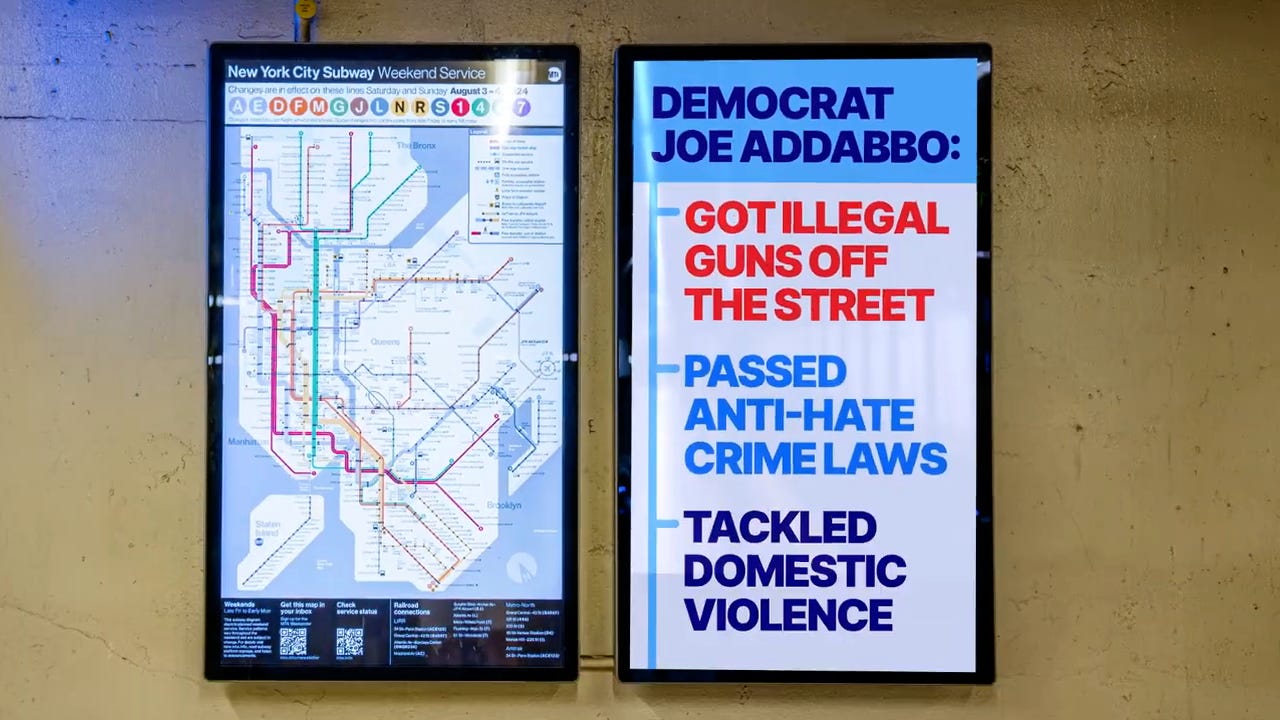
Addabbo authored legislation banning “sweepstakes” casinos, which is a key priority of online sportsbooks because they compete with traditional gambling. (Sweepstakes casinos attempt to evade traditional gambling regulations through a scheme that involves packaging play money with other tokens that can be redeemed for cash.) Addabbo also sponsored a bill legalizing online casino games, a key priority for online sportsbooks that would like to expand their operations to include traditional casino games like slot machines and blackjack.
When the State Assembly passed a bill restricting advertising by online sportsbooks, Addabbo did not bring it up for consideration. Bills banning online sportsbooks from sending push notifications, requiring online sportsbooks to set default spending limits, and restricting bets from college campuses also died in committee.
In 2025, Addabbo also co-hosted a seven-episode podcast series, “Place Your Bets, New York,” on gambling co-sponsored by the Sports Betting Alliance. (Addabbo did not list any compensation for hosting the podcast in his financial disclosure report. Income of $1,000 or less from a single source is not required to be reported.)
Online sportsbooks also spent $1.2 million supporting New York Governor Kathy Hochul (D) through another state super PAC, Greater Empire State. When Addabbo’s sweepstakes casino bill passed the legislature, Hochul signed it into law.
Betting on the Buckeye State
In Ohio, Representative Brian Stewart (R), the chairman of the House Finance Committee, was heavily backed by the online sportsbook industry. Stewart presented a budget that dropped the governor’s plan to double the state tax on sportsbooks and forcefully opposed Governor Mike DeWine’s proposal to ban prop bets.
The ads by Win for America’s American Conservative Fund promoted Stewart as an “America First Conservative” who “championed historic property tax reform” and supported law enforcement. They did not mention his positions on gambling.
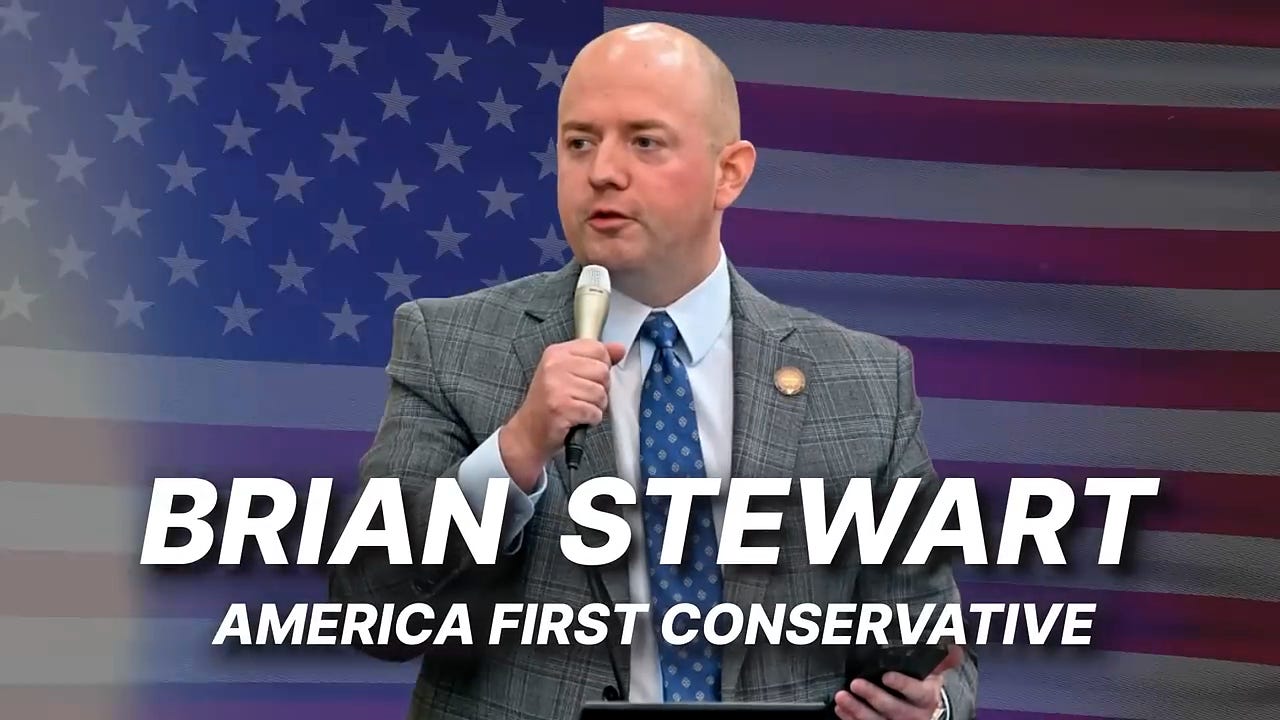
Stewart won his primary election over Republican challenger Patty Hamilton by a 17-point margin and prevailed easily in the general election.
The precise amount that the online sportsbook industry spent in Ohio in support of Stewart and other industry-friendly politicians through Election Day is unknown because American Conservative Fund appears to be out of compliance with state campaign finance law.
Ohio law requires federal super PACs, each time the PAC files with the FEC, to also file with the Ohio Secretary of State, “an itemized list of the contributions, expenditures, and independent expenditures made in connection with state and local elections in Ohio.” American Conservative Fund registered with the Ohio Secretary of State on March 9, 2026. (The organization misspelled its name as “AMERCIAN CONSERVATIVE FUND.”) But, according to the Ohio Secretary of State website, American Conservative Fund (using both the correct and incorrect spelling) has not filed any reports, despite filing with the FEC on April 15, July 15, and October 15.
In response to a request for comment, a spokesperson for Win for America told Popular Information, “Win for America and its allied PACs take compliance with state laws seriously. In Ohio, ACF [American Conservative Fund] followed the guidance of the Secretary of State, which can be found here.” That guidance, however, merely restates Ohio law and requires a state filing with each FEC report. Asked for clarification, the spokesperson responded, “All required docs were filed.”
A review of data from the FCC, Meta, and Google reveals that Win for America, through American Conservative Fund, spent at least $2.3 million to influence Ohio state elections.
Dollars for the Old Dominion State
In Virginia, the state’s more permissive campaign finance laws allowed the Sports Betting Alliance to donate nearly $4 million directly to state candidates and committees.
A bill to allow online casino games, which would allow the online sportsbooks to expand their offerings, initially was rejected by the Virginia House by a vote of 46-49 on February 17. Virginia House Speaker Don Scott (D), whose campaign and leadership PAC received $625,000 from the Sports Betting Alliance in 2025, then called a recess. When the House voted again, 25 Democrats switched their vote and the online casino bill passed by a vote of 67-30. In the Virginia Senate, a version of the bill passed the chamber in February after five Republicans bucked their party and supported the legislation. Four months later, as first reported by the Poole Report, all five Republicans received $100,000 each from the Sports Betting Alliance, the largest donation any of the senators had ever received.
Because there were differences between the House and Senate bills, a conference committee was created. The bill ultimately failed to become law when the conferees were unable to resolve their differences.
Basically a case study in the corrosive influence money has on politics, a truly bipartisan issue. The breadth of these donations and the total spent by online sportsbooks are jaw-dropping.