

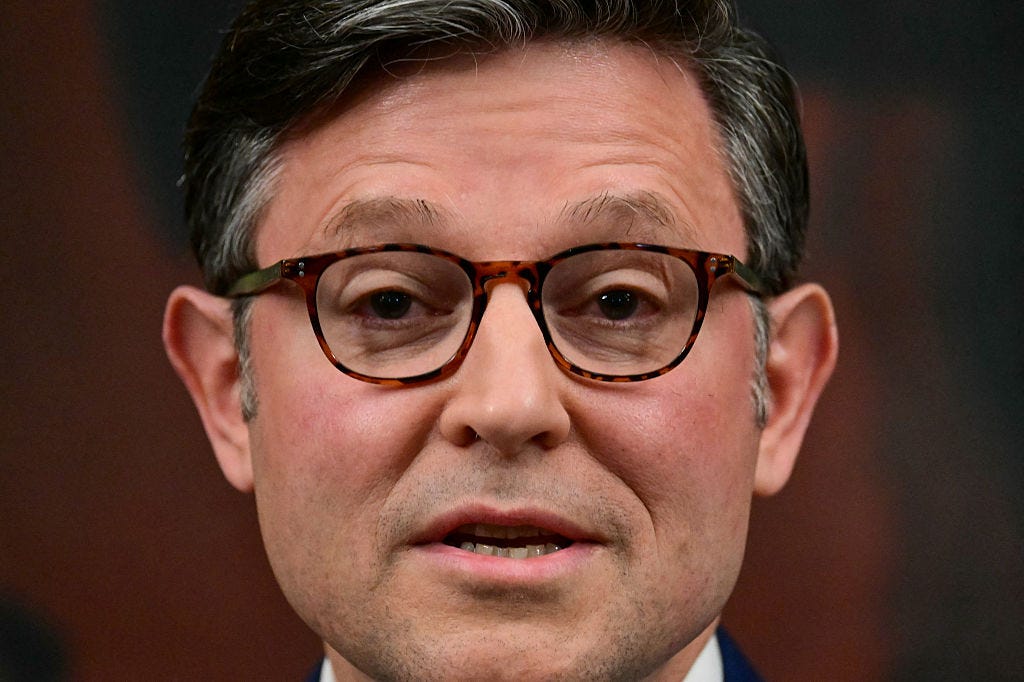
On September 23, Adelita Grijalva won a special election to represent Arizona in the House of Representatives in a landslide, collecting 69% of the vote. Forty-three days later, House Speaker Mike Johnson (R) has not sworn in Grijalva. Johnson’s obstruction has prevented Grijalva from providing the decisive signature on a discharge petition that would force a House vote on the public release of the Epstein files.
The failure to swear in Grijalva is unprecedented. A Popular Information analysis of the 59 other House special elections since 2015 reveals that the average time between winning an election and being sworn in is less than 11 days. Since Johnson became Speaker in October 2023, special election winners have been sworn in, on average, about seven days after the election.
The current 43-day delay is already eight days longer than the previous record.
Johnson has offered numerous, sometimes contradictory, explanations for the delay. None withstands scrutiny.
In an October 19 interview on ABC News, Johnson stated that he was following the “Pelosi precedent.” Johnson said that when his “dear friend from Louisiana, Julia Letlow, was elected to fill the seat of her deceased husband because of COVID, Nancy Pelosi took 25 days to swear her in.” However, as ABC’s Jon Karl noted, Letlow was sworn in 25 days after her election, as that was the date Letlow requested.
In the same interview, Johnson cited Pelosi’s decision not to swear in Pat Ryan (D-NY) and Joe Sempolinski (R-NY) in 2022 for 21 days, until the House returned from its scheduled recess. Previously, Johnson had claimed it was “standard practice“ to “schedule a swearing in for the Representative-elect when the House returns to session.” Johnson has canceled 14 scheduled legislative sessions since Grijalva’s election.
But earlier this year, Johnson swore in two Republican special election winners, Jimmy Patronis (R-FL) and Randy Fine (R-AZ), while the House was out of session. Johnson held a pro forma session for the swearing-in ceremony within 24 hours after their victories. Patronis and Fine provided critical additional votes to Republicans’ slim House majority. Since Grijalva’s election, the House has held 13 pro forma sessions, but Johnson would not swear her in.
Johnson has also claimed that he was delaying Grijalva’s swearing-in so that she would have “all the pomp and circumstance“ of having the full House attend the ceremony. Grijalva said she’s not interested. “I don’t need pomp and circumstance,” she said. “I just need to get to work for southern Arizona.”
Johnson claims that his refusal has nothing to do with the Epstein files. But Grijalva campaigned on a pledge to sign the discharge petition that would force a vote to release the files. That vote would almost certainly pass, since it would be unlikely for someone to sign a discharge petition and then vote to keep the Epstein files under wraps.
Trump has reportedly been told by Attorney General Pam Bondi that his name appears multiple times in the Epstein files. Trump has subsequently called the Epstein files a “hoax“ and efforts to compel their release “bullshit.”
Previous delays involved close elections or personal choice
The previous record for the longest delay between a special election and its winner being sworn in was 35 days. In 2017, Jimmy Gomez (D-CA) delayed his own swearing-in for more than a month due to what he said was a “family conflict.” However, then-House Majority Leader Kevin McCarthy (R-CA) accused Gomez of “abdicating” his responsibilities in the House to take a final vote as a California state assemblyman. The state assembly was set to vote on controversial climate change legislation the week after Gomez’s election, but the vote was delayed for weeks and likely needed Gomez’s support to pass. Ultimately, Gomez joined the U.S. House before the California vote took place.
After Gomez, the next longest delay — 30 days — was in the special election of Conor Lamb (D) to Pennsylvania’s 18th congressional district. Lamb’s election took place on March 13, 2018 and while some outlets called the race the next day, Lamb was ahead by just over 600 votes. Lamb’s victory was not certified until April 2, at which point the House was in recess. The House returned from recess on April 9 and Lamb was sworn in on April 12.
Troy Balderson (R-OH) waited 29 days to be sworn in after his special election on August 7, 2018. However, it took 17 days to count the votes, and it was not until August 24 that Balderson was declared the winner, defeating his opponent by less than 1%. He was sworn in just over a week later, on September 5.
Similarly, it took Mary Peltola (D-AK) 28 days after her election on August 16, 2022 to be sworn in, but it was not until two weeks after her election that all votes were counted and she was officially declared the winner. Peltola was declared the winner on August 31, 2022 and sworn in 13 days later.
Chris Jacobs (R-NY) also waited 28 days to be sworn in after his special election on June 23, 2020. However, the House was not notified by the New York State Board of Elections that Jacobs was expected to be the winner until July 17, at which point the results were still not certified — likely due to the large number of absentee ballots cast in 2020. Jacobs was sworn in four days later on July 21.
It was 27 days after Montana’s May 25, 2017 special election to fill its then at-large congressional district that the winner, Greg Gianforte (R), was sworn in. However, state officials at the time said that this hold up was due to a delay in certifying the election results. Montana’s secretary of state certified the result on June 15, notified the House on June 19, and Gianforte was sworn in two days later on June 21.
Grijalva’s lawsuit
On October 21, Grijalva and the state of Arizona sued the House of Representatives over Johnson’s delay in swearing Grijalva in. The lawsuit, which was filed by Arizona Attorney General Kris Mayes (D), states that it is “about whether someone duly elected to the House – who indisputably meets the constitutional qualifications of the office – may be denied her rightful office simply because the Speaker has decided to keep the House out of ‘regular session.’”
Mayes writes that the Constitution does not give the Speaker the ability to “thwart the peoples’ choice of who should represent them in Congress by denying them representation for a significant portion of the two-year term provided by the Constitution.” The lawsuit also contends that Johnson “has not identified any valid reason for refusing to promptly seat Ms. Grijalva,” and that the delay is injuring Grijalva and the people of Arizona by “denying [Grijalva] the ability to exercise the authority of a member of the House.”
The lawsuit alleges that Johnson is delaying the process to prevent Grijalva “from signing a discharge petition that would force a vote on the release of the Epstein files and/or to strengthen his hand in the ongoing budget and appropriations negotiations.” Mayes asks that, if Johnson continues to delay Grijalva’s swearing-in, she is sworn in by someone else authorized to administer oaths.
Johnson called the lawsuit “patently absurd,” claiming that he is “following the precedent.”
Little Johnson is a viper in a nerd costume. He is truly so dangerous. Thank you, Judd, for covering this crucial issue. The #DirtyOldMan's minions are putting it all on the line to prevent the release of the Epstein files.
Johnson is right that the lawsuit is absurd, but that’s not the fault of Grijalva or the state of Arizona. The blame is purely on him. With most other jobs, a dereliction of duty such as this would be grounds for removal. "Precedent," my tuchus.