

As the 2026 midterms approach, President Trump is facing headwinds.
Trump’s job approval is low and has declined rapidly since September. A recent Gallup poll found that only 32% of Americans approve of how Trump has managed the economy. Even in the best of times, the party in power typically loses seats in a midterm election. In 2026, Trump and the Republicans are at risk of losing the House and, potentially, the Senate.
The most straightforward way to try to buck these trends is money. Cash for candidates to promote their strengths and exploit their opponents’ weaknesses. Likely the biggest source of cash in the 2026 election will come from Leading the Future (LTF), a group formed just a few months ago.
LTF has already secured more than $100 million, including $50 million from venture capitalists Marc Andreessen and Ben Horowitz and another $50 million from OpenAI co-founder Greg Brockman. Other known supporters include Joe Lonsdale, the co-founder of Palantir who recently advocated for the return of public hangings, and the AI company Perplexity. The full list of donors to LTF is unknown because the organization is so new it has not yet had to make a substantive filing with the Federal Elections Commission.
According to its website, LTF is “focused on advancing a positive, forward-looking agenda for AI innovation.” It plans to do that by “identifying, maintaining, and growing pro-AI candidates.”
The effort, at least at the outset, was nominally bipartisan. LTF indicated it would “back candidates of both parties who support a national framework for artificial intelligence regulations.” In addition to Zac Moffatt, a prominent Republican operative, LTF hired Josh Vlasto, a Democratic operative who has worked for Senator Chuck Schumer (D-NY) and former New York Governor Andrew Cuomo.
This did not go over well with the Trump White House. “AI has no better ally than President Trump, so it’s inexplicable why any company would put money into the midterms behind a Schumer-operative who is working against President Trump to elect Democrats,” a person “familiar with Trump’s thinking” told NBC News in October. “It’s a slap in the face, and the White House has definitely taken notice.”
This shot across the bow appears to be working.
On Wednesday, LTF released its first two television ads. The first ad promotes Republican Chris Gober, a candidate for Congress in Texas’ 10th District. Gober is in a crowded field seeking to replace Congressman Michael McCaul (R-TX), who is retiring.
The ad promotes Gober as a “Trump Conservative” who “knows what it takes to win a fight.” It claims that “as a lawyer, Gober defended President Trump against the radical left.” This is not exactly true, but Gober did represent Elon Musk’s pro-Trump Super PAC, America PAC.
The ad does not mention AI, but says Gober supports “American technology investment right here in Texas, so we can defeat China.”
The second ad attacks Alex Bores, a Democrat running for Congress in New York. Bores, who is currently serving in the New York Assembly, sponsored the RAISE Act. Bores’ bill, which passed the legislature, requires AI companies with more than $100 million in revenue to publish security protocols, disclose serious safety incidents to the New York Attorney General, and ensure their models do not create an unreasonable risk of mass casualties or economic losses in excess of $1 billion.
The LTF ad accuses Bores of empowering “dysfunctional bureaucrats” to regulate AI, which would “crush innovation,” “cost New York jobs,” and “fail to keep people safe.” The ad also claims that Bores is “backed by groups funded by convicted felon Sam Bankman-Fried.”
That last claim is not accurate. Bores has received donations from people associated with the effective altruist movement, which is concerned with AI safety. Bankman-Fried, prior to his arrest, supported effective altruist groups.
The larger point is that LTF is currently attacking Democrats and promoting Republicans. That is exactly how Trump and his allies want it to operate. If the pattern continues, it could potentially have a significant impact on the 2026 election.
Trump’s leverage
This year, OpenAI and Andreessen Horowitz have “aggressively lobbied” for Congress to pass legislation that would ban state-level AI regulation. They are not having much success.
Over the summer, Senator Ted Cruz (R-TX) introduced a proposal to include a 10-year moratorium on state AI legislation in the Republican “Big, Beautiful Bill,” but the Senate voted 99-1 to remove the provision. More recently, Trump pushed for lawmakers to include a provision preempting AI laws into the National Defense Authorization Act (NDAA), but text for the defense bill released this weekend did not include the AI proposal. House Majority Leader Steve Scalise (R-LA) said last week that the NDAA “wasn’t the best place for this to fit,” The Hill reported.
Now, Trump is taking a different approach. On Monday, Trump posted on Truth Social that he will be signing an executive order this week that will preempt state AI laws. “There must be only One Rulebook if we are going to continue to lead in AI,” Trump wrote. “You can’t expect a company to get 50 Approvals every time they want to do something. THAT WILL NEVER WORK!”
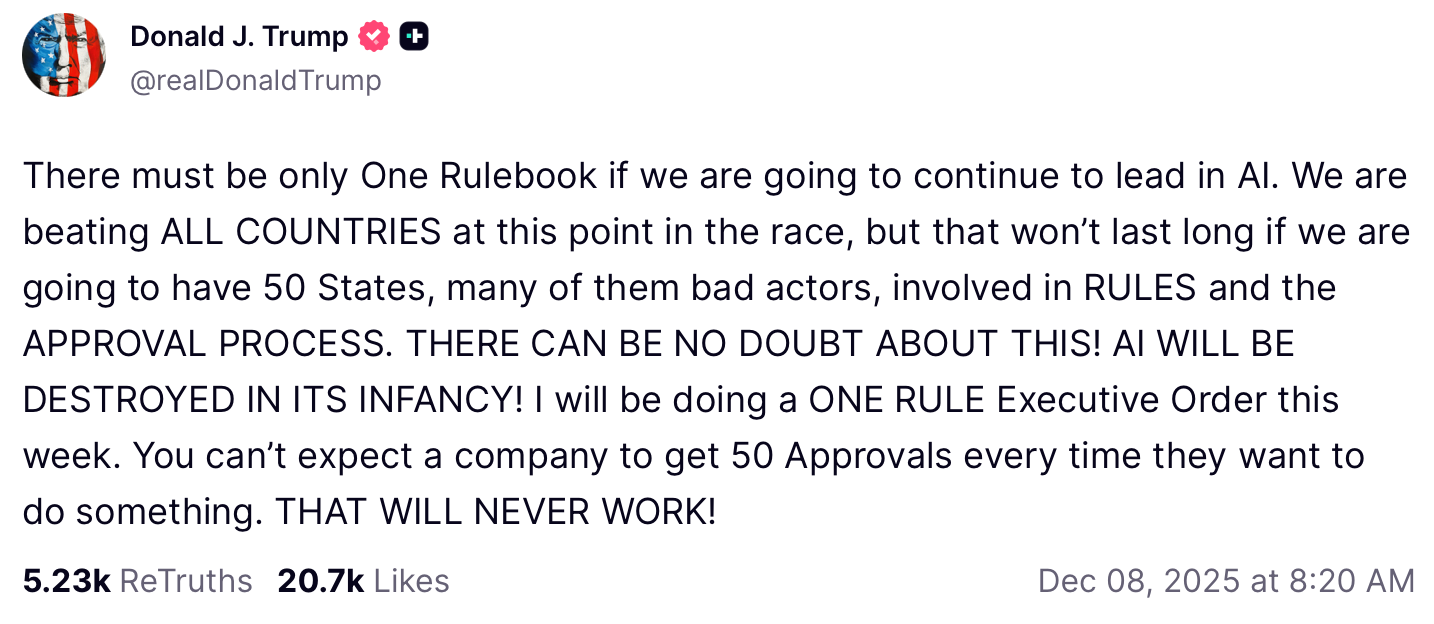
A leaked draft of the executive order teased by Trump draws directly from a policy memo published by Andreessen Horowitz in September. The Andreessen Horowitz memo argues that the Commerce Clause prohibits states from regulating AI companies because it “prevent[s] states from imposing excessive burdens on interstate commerce.”
The leaked executive order would require that the Attorney General assemble an “AI Litigation Task Force” to overturn state laws regulating AI, arguing such laws violate the Commerce Clause. It would also withhold federal broadband grants from states that implement AI regulations.
This is a novel and controversial interpretation of the Commerce Clause. Practically all business conducted in 2025 has some connection to the internet. If any state regulation impacting internet commerce were prohibited, states would be virtually powerless to impose any commercial regulations. The director of U.S. policy at LawAI told Politico “that states have the authority to regulate technology within their borders and that the laws passed so far don’t run afoul of federal powers under the Commerce Clause.”
Notably, while Trump has talked about a new AI executive order and a draft was leaked, Trump has not signed it yet. This gives him substantial leverage over LTF and other powerful players in the AI industry.
The practical case for AI guardrails
Setting aside speculation that AI models pose an existential risk to humanity, the technology, as it exists today, can cause real-world harm.
AI tools can have a deleterious impact on mental health, especially for users who are using chatbots for hours a day. A November New York Times investigation reviewed 50 cases of people having mental health crises while talking to ChatGPT. Of these 50 people, nine were hospitalized, and three died. One person who died by suicide was a teenager.
Researchers posing as teen users found that several popular AI companions (chatbots specifically designed to be “friends”) encouraged risky behavior during mental health crises, instead of directing users to support. The AI companions also readily shared information about how to build deadly weapons, provided sexually explicit content that sometimes included child abuse, and promoted cyberbullying.
Other dangerous use cases involve using AI to create bioweapons or generate fake pornographic images with another person’s likeness.
While AI companies have promised to self-regulate, they are more focused on getting their most powerful models to the public as quickly as possible. In the absence of federal regulations, state-level action is the only alternative.
In recent months, California has passed several new laws regulating AI. The most prominent, the Transparency in Frontier Artificial Intelligence Act, requires companies to create and disclose safety protocols and provides whistleblower protections. Other bills require age verification for certain AI products and safety measures for minors using AI companions.
The $100 million lobbying blitz by the AI industry is not about innovation, it is about control. When corporations pour that kind of money into Washington, they are not buying dialogue, they are buying the rules themselves. Delay becomes domination, stretching oversight until profits are locked in. Spectacle becomes distraction, dressing up greed as “competitiveness.” Cruelty becomes normalization, embedding exploitation into law so it looks like progress.
This is the behavioral pattern across institutions: uncertainty weaponized, anxiety provoked, ethics sidelined. The AI industry knows regulation is coming and would rather purchase immunity than earn trust.
Until we name money as manipulation and lobbying as theater, we will keep mistaking corruption for governance.
—Johan
I’d like to know who the 32% of Americans are that still approve of this murderous, grifting, outright thieving, raping, traitorous, corrupt regime are and slap ‘em upside the head. SEVERAL times. Unfortunately, it’s some of our family members and neighbors. It’s beyond insane. OPEN YOUR EYES, DAMN IT!!