

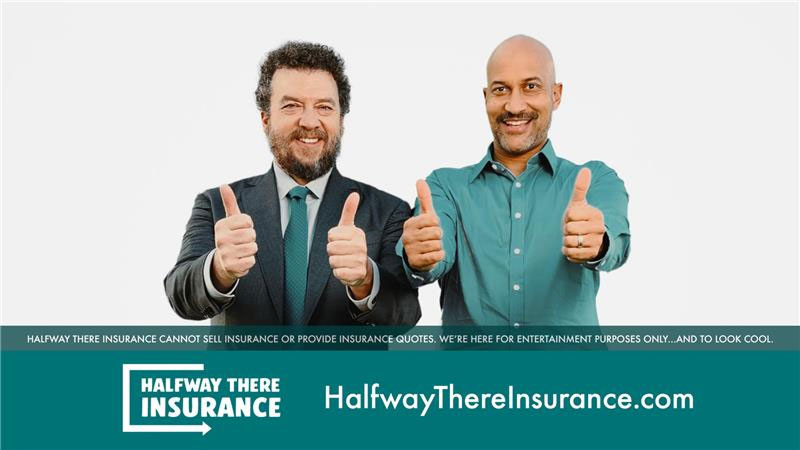
In an ad campaign that has blanketed the airwaves this year, State Farm compares itself to a sleazy fictional competitor, Halfway There Insurance. The commercial features two popular comedic actors, Danny McBride and Keegan Michael Key, riffing to the Bon Jovi classic, Livin’ on a Prayer.
“There’s damage to your home on this block,” McBride and Key croon. “We won’t make things right, cuz filing a claim is tough.” The comedy duo stresses that, unlike State Farm, their pretend company will not live up to its promises and does not care about customer satisfaction. “So forget what we told you. It ain’t worth squat. It doesn’t make a difference if you’re happy or not,” they sing.
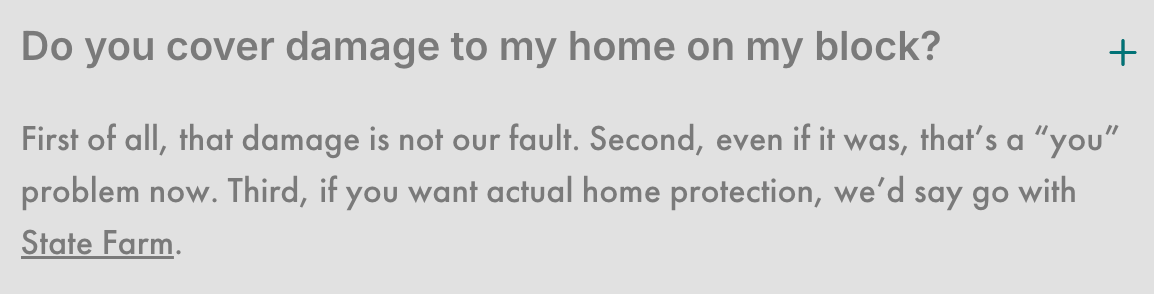
A website created by State Farm, HalfwayThereInsurance.com, jokes that Halfway There Insurance will just claim that home damage is not their responsibility. For “actual home protection,” the website advises, “we’d say go with State Farm.”
No expense is spared on the campaign, which debuted during the Super Bowl. The ad concludes when Jon Bon Jovi himself, riding in a red convertible with State Farm pitchman “Jake,” offers a disgruntled Halfway There customer, played by actress Hailee Steinfeld, a lift. “Stop living on a prayer and get State Farm,” Jake says.
The Halfway There campaign is one of countless ads with a similar message: State Farm is a relatable and ethical company that will be there to assist you when you need them. “Like a good neighbor, State Farm is there,” is the company’s iconic slogan. According to a document filed with the National Association of Insurance Commissioners and obtained by Popular Information, State Farm spent an astounding $1.139 billion on advertising in 2025.
According to an enforcement action filed by the California Department of Insurance (CDI) this week, the experience of being a State Farm customer has little in common with the advertising copy. CDI “announced a major enforcement action against State Farm General Insurance Company after an expedited investigation uncovered significant mishandling of insurance claims filed by survivors of the 2025 Los Angeles wildfires.” According to CDI Commissioner Ricardo Lara, “State Farm delayed, underpaid, and buried policyholders in red tape at the worst moment of their lives.”
As part of the investigation, CDI examiners reviewed a sampling of 220 claims. In more than half the claims (114) CDI determined that State Farm violated state law. In a legal filing known as an “Order to Show Cause,” CDI summarized State Farm’s violations:
The examination showed a troubling pattern of claims handling practices by [State Farm], including: slow and inadequate investigations of claims; underpayment of claims; numerous instances where multiple claims adjusters were assigned, over a short period, causing policyholder confusion; a lack of reasonable standards for prompt investigation and processing of claims, including in regards to smoke damage; and/or, delayed or inadequate communication with policyholders. These practices failed to comply with applicable laws regulating the fair handling of claims and related regulations resulting in unfair and unlawful burden to policyholders during a declared state of emergency.
The CDI is seeking authority to suspend State Farm’s license in California for up to a year. That would mean the company could not write new insurance policies during that time.
State Farm flatly rejected the conclusions of the CDI investigation. “California’s homeowners insurance market is the most dysfunctional in the country, and State Farm has worked to be part of real solutions,” the company said in a statement. “Wildfire survivors deserve real solutions - not a distorted picture of State Farm’s response.”
The investigation revealed a more nuanced picture. State Farm denied fault in some cases but admitted fault in others, “often saying that the problem was due to issues with specific adjusters.”
According to CDI, State Farm could face $2 million or more in penalties. $2 million represents less than one day of State Farm’s annual ad budget.
State Farm aggressively pursued the California home insurance market
In the years before the wildfires, as other insurers were more cautious in California, State Farm blitzed the market, even while being aware of the risks.
A 2025 report from the Wall Street Journal found that, in the years after the COVID-19 pandemic, State Farm “gobbled up market share… by insuring high-value homes in the Pacific Palisades and other Los Angeles neighborhoods that many of its competitors rejected as too vulnerable to wildfires.” In 2023, the company took in “$2.7 billion of home-insurance premiums in the state,” a 70% increase compared to five years earlier.
“State Farm was the only—and I mean the only—big insurer that would take everything” during that time period, an owner of an independent insurance agency told the Journal. One insurance agent said that the only quote that he could get for a high-value home in 2022 was $20,000, until State Farm insured it for $6,000.
State Farm knew about the risks even as it expanded. According to the Journal, consultants told State Farm that there was a high risk of a fire. State Farm also knew it was selling policies that had unsustainably low premiums. But it continued to ask California “for a fraction of the increases that would be needed to bring its rates up to the necessary levels” in 2021 and 2022.
In 2023, that abruptly changed. State Farm began asking the state for much higher increases in home-insurance rates. Shortly after, the company announced that it would no longer be accepting new home-insurance policies in California.
In March 2024, State Farm announced that it would be dropping coverage for a total of 72,000 houses and apartments in the state beginning that summer. A CDI spokesman told CBS that around “1,600 policies in Pacific Palisades were dropped by State Farm in July.” An analysis by CBS News San Francisco found that State Farm dropped over 2,000 policies in two other zip codes in Los Angeles. Customers whose policies were not being renewed were advised to get insurance through California’s Fair Access to Insurance Requirements (FAIR) Plan, which is used as a last resort and typically offers less coverage for a higher price.
In January 2025, State Farm reversed course and announced that it was offering to renew residential policies that it had intended to drop in Los Angeles County. But the decision only applied to policies that were still held by customers before the Los Angeles fires. Customers whose coverage had already been dropped before the fire are out of luck.
Unregulated capitalism has brought us here.
If only Barry Manilow had known when he wrote the jingle, “Like a good neighbor, State Farm is there.” I hope you don’t find out that Band-Aid is sticking it to us in ways it shouldn’t or I’ll have no childhood jingles left to sing.