

Top Trump negotiator retains partnership with Ukraine-sanctioned billionaire
Steve Witkoff coached a top Putin aide on managing Trump and created a peace plan that mirrored Russian demands
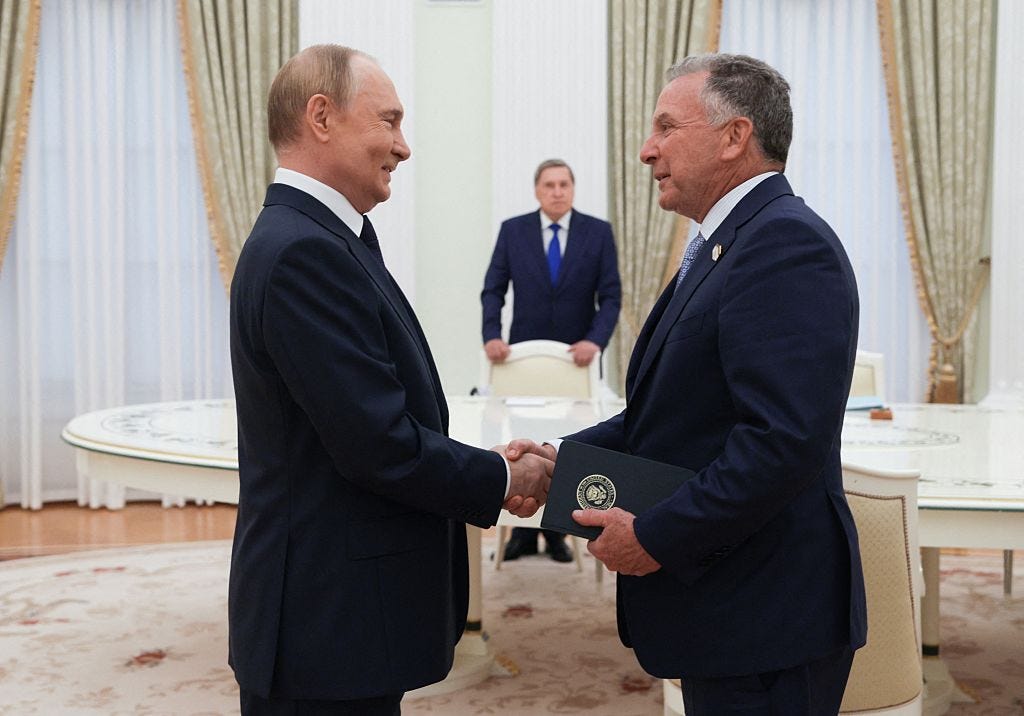
Steve Witkoff, a fellow real estate developer and frequent golf partner of President Trump, was appointed by Trump as special envoy for peace missions, tasked with negotiating a peace deal between Russia and Ukraine. Witkoff, a billionaire with no previous diplomatic experience, is in charge of mediating an extraordinarily complex international conflict, a role that requires him to be trusted by both Russia and Ukraine as an honest broker.
An investigation by Popular Information reveals that, while serving in this role, Witkoff has maintained an active financial partnership with Len Blavatnik, a billionaire with ties to Russia who has been sanctioned by Ukraine. Witkoff and Blavatnik are co-developing a massive residential real estate project in New York City. The relationship raises additional questions about the nature of Witkoff’s role.
A transcript of an October 14 phone call leaked last week to Bloomberg News revealed that Witkoff has been coaching his Russian counterpart, Yuri Ushakov, and advising him on how to undermine an upcoming call between Trump and Ukrainian President Volodymyr Zelenskyy.
Witkoff advised Ushakov, the top foreign policy advisor of Russian President Vladimir Putin, that Putin should call Trump quickly, before a scheduled meeting with Zelenskyy. During the call, Witkoff recommended Putin “congratulate the president” on the cease-fire between Israel and Hamas, and praise Trump as “a man of peace.” That phone call took place on October 16 and appeared to have the desired impact. In a “tense“ meeting with Zelenskyy the following day, Trump rejected Ukrainian requests for Tomahawk missiles.
Further, in the leaked October 14 call, Witkoff appears to suggest that he partner with Russia to create the “Trump plan” to end the war in Ukraine. “We put a 20-point Trump plan together [for Gaza] that was 20 points for peace and I’m thinking maybe we do the same thing with you,” Witkoff said. “Maybe [Putin] says to President Trump: you know, Steve and Yuri discussed a very similar 20-point plan to peace and that could be something that we think might move the needle a little bit.”
On October 20, the United States produced a 28-point “Trump plan” which required Ukraine to cede significant territory to Russia, permanently abandon aspirations to join NATO, and limit the size of its army. It was less a peace plan than a laundry list of Russian demands. Indeed, Reuters reported that the Trump proposal, created by Witkoff, was based on “a Russian-authored paper submitted to the Trump administration in October.” (Witkoff’s proposal has since been pared back in an effort to attract Ukrainian support.)
All of which raises the question: Why does Witkoff appear to have so heavily favored Russia during the negotiations? The answer may be buried in Witkoff’s 33-page financial disclosure form, quietly posted to the White House website in September.
The document, known as form 278e, reveals that Witkoff has ongoing financial interests that link him to Russian oligarchs and others hostile to Ukrainian interests.
In 2021, Witkoff partnered with billionaire Len Blavatnik to take over the project now known as One High Line, a massive luxury condo development in New York City’s Chelsea neighborhood. In 2024, Witkoff and Blavatnik refinanced the development for $1.15 billion.
Blavatnik, born in Soviet Ukraine, is a naturalized U.S. and UK citizen. He made his initial fortune investing in Russia alongside sanctioned Russian oligarch Victor Vekselberg. Among other ventures, Blavatnik and Veksberg acquired 40% of Tyumen Oil Company (TNK) for $800 million in 1997 and, in 2003, merged it with the Russian assets of BP. In 2013, Blavatnik and Veksberg sold their stake in the company, netting Blavatnik around $7 billion. Veksberg reportedly has “close ties“ to Putin.
Blavatnik was sanctioned by Ukraine in December 2023 for at least 10 years. Blavatnik claims to have divested from Russia following the invasion of Ukraine, selling a valuable stake in an aluminum business he owned with Veksberg.
Nevertheless, British politicians have faced criticism for accepting donations from Blavatnik in light of the Ukrainian sanctions. He also established the Blavatnik Fund for Innovation at Yale, which has become controversial. “As many of us have begun to learn more about Kremlin-associated oligarchs, we’re deeply uncomfortable with being affiliated with these awards,” Aaron Ring, a recipient of the award, told Yale News in 2022.
As Witkoff serves as Trump’s top negotiator to end the war in Ukraine, Blavatnik remains Witkoff’s most important business partner. The 278e form reveals that Witkoff has maintained his ownership stake in 76 Eleventh Avenue Property Owner LLC, part of his “residential real estate” holding in New York City, and a subsidiary of WG 76 11th LLC. The value of the parent LLC is listed at $50 million or more, the highest valuation category.
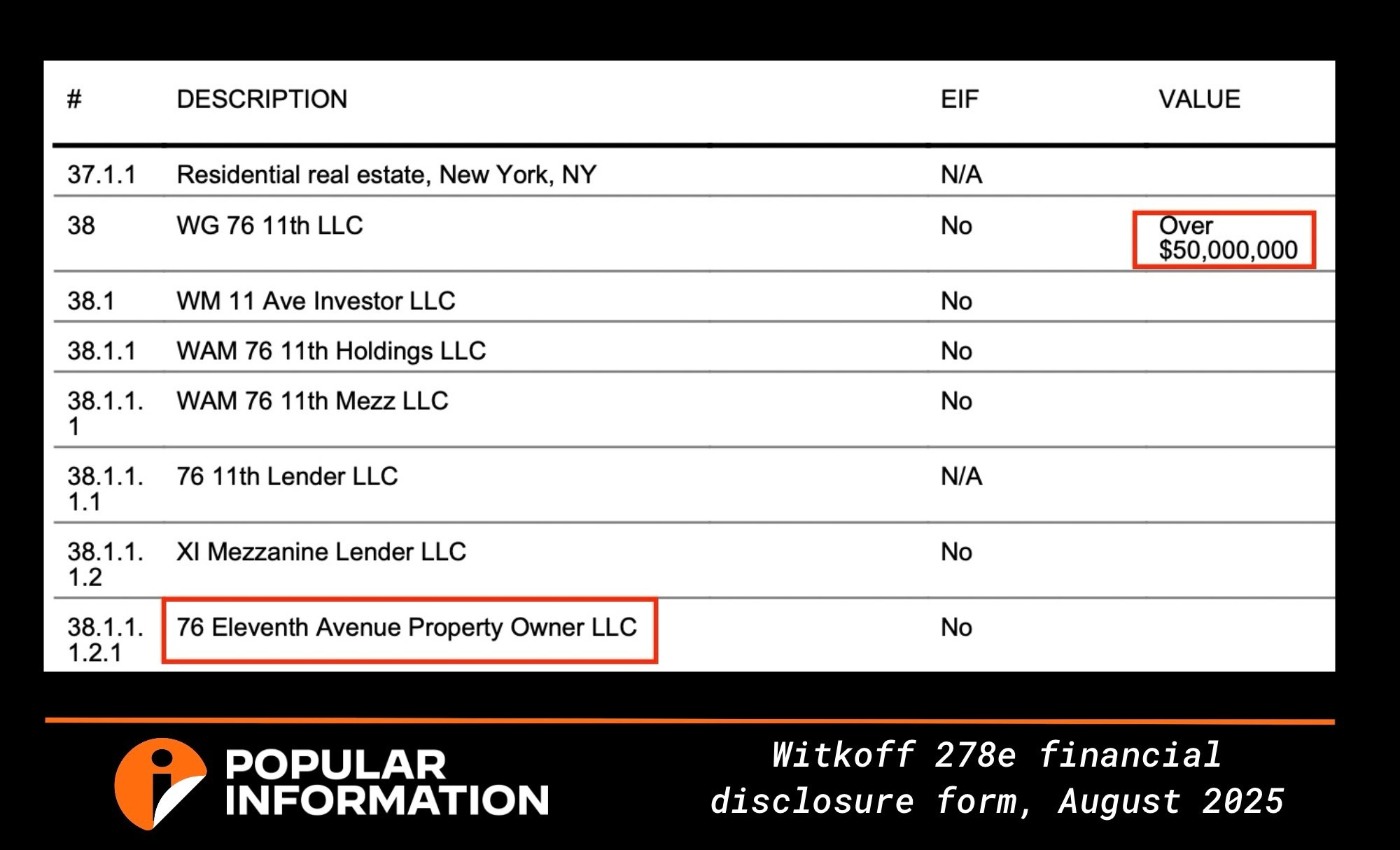
76 Eleventh Avenue Property Owner LLC is the entity selling the condos at One High Line, according to a public document posted by the development.
Witkoff is also partnered with Alex Blavatnik, Len Blavatnik’s brother and the chairman of Access Industries, on Ocean Terrace, an ultra-luxury condo development in Miami. Witkoff’s form lists Ocean Terrace Owners LLC and related entities. While the project is still under construction, there have been hundreds of millions in pre-sales.
What is missing from Witkoff’s federal disclosure
One of the primary purposes of the federal disclosure form is to ensure that the filer is in compliance with the conflict of interest provisions of federal law. All forms must be reviewed by a federal ethics official within 60 days of filing. The federal official then signs the form, certifying that “on the basis of information contained in this report, I conclude that the filer is in compliance with applicable laws and regulations.”
But while Witkoff signed his form on August 13, the version posted to the White House website remains unsigned. This is not an oversight. On November 17, Senators Chris Murphy (D-CT) and Elizabeth Warren (D-MA) sent a letter to the White House Counsel and the Office of Government ethics noting that “no agency ethics official signed the form… even though the 60-day deadline for an ethics official to review his form passed in October 2025.” The Senators say the form “appears to have inaccurate or incomplete information.”
One issue is that Witkoff’s form does not provide full transparency about what financial assets Witkoff currently owns.
The form does reveal that Witkoff “sold an interest in his eponymous real estate management company for $120 million“ as “part of divestiture planning.” But he continues to own a portion of the Witkoff Group valued at more than $50 million, according to the same form. So he has not actually divested from the company.
Further, a partial stake in the Witkoff Group, a private real estate company, is an illiquid asset. So who did Witkoff sell his stake to? Witkoff has not disclosed the buyer. It could be a family member, such as his son Alex Witkoff, who is currently running the company. Such a sale would do little to assuage concerns about conflict.
Diplomacy or kleptocracy?
In addition to his current partnership with Blavatnik, Witkoff is ideally positioned to financially benefit from a peace deal if it includes unfreezing Russian assets. Witkoff appears to be focused on maximizing investment opportunities.
In an unusual move, Witkoff hammered out the peace plan not with a Russian foreign affairs official but with Kirill Dmitriev, the head of Russia’s sovereign wealth fund (RDIF). In 2022, Dmitriev was sanctioned by the United States and banned from the country for his role at the RDIF, which the Treasury Department described as “a slush fund for President Vladimir Putin and… emblematic of Russia’s broader kleptocracy.”
Despite the sanctions, Witkoff requested Secretary of Treasury Scott Bessent allow Dmitriev to travel to DC in April. Bessent reportedly “had questions about the unique request, but ultimately signed off.” Since then, Witkoff and Dmitriev have met multiple times in person, in Moscow and elsewhere, and chatted frequently on the phone. Last month Witkoff and Dmitriev met in Miami to finalize the “Trump plan.”
The 28-point plan specifically contemplates using Russian assets to facilitate American investment. Section 13 contemplates the “lifting of sanctions” and “a long-term economic cooperation agreement for mutual development in the areas of energy, natural resources, infrastructure, artificial intelligence, data centers, rare earth metal extraction projects in the Arctic, and other mutually beneficial corporate opportunities.”
Also present at the October meeting was Jared Kushner, Trump’s son-in-law. Kushner operates a private equity firm, Affinity Partners, that is financed almost exclusively by investments from foreign sovereign wealth funds.
CORRECTION (12/5): This article has been corrected to reflect that Ukraine did not officially offer a rationale for sanctioning Len Blavatnik. Further, Ocean Terrance is being developed by Len Blavatnik’s brother and business partner, Alex Blavatnik, not Len Blavatnik. We regret the errors.
We obviously don’t have a government being run by public servants, it’s being misused to enrich real estate magnates and oligarchs. Vote out the Grand Oligarchy Party.
We simply have to end these financial cabals. As usual, Judd, you are right on top of this chicanery. I am thoroughly sick of defining people in terms of their wealth as if their humanity had anything to do with money. Time to topple the kleptocrats and oligarchs.