

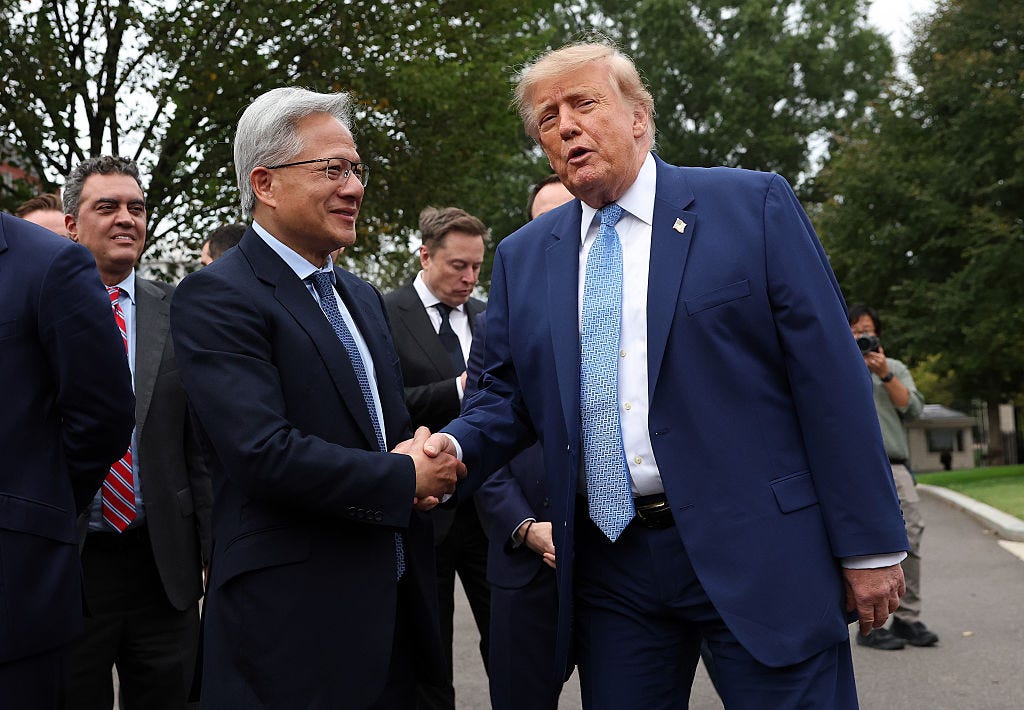
On November 12, Nvidia CEO Jensen Huang resigned following reports that he had an extramarital affair with an alleged Chinese spy. The woman, Alice Huang, was an executive at Megaspeed, a data center company based in Singapore. Alice Huang was suspected of using her relationship with Jensen Huang to facilitate China’s access to advanced AI chips in violation of U.S. export controls.
Jensen Huang also had affairs with two subordinates at Nvidia, including a woman who reported to him directly. Another report documented his history of “berating his employees.” The New York Times reported Huang told one Nvidia executive that “his mother should have aborted him.”
In a public petition, Huang’s backers in the tech world nevertheless called for his reinstatement as Nvidia CEO. The open letter, signed by Elon Musk and others, claimed that they had not seen “evidence substantiating the allegation that the woman at the center of this controversy was a spy.”
On Sunday, the New York Times, citing “multiple people with knowledge of U.S. intelligence reports,” reported that Alice Huang “kept in contact with an official of China’s top spy agency for more than a year while she was carrying out a secret affair with Jensen Huang.”
On Monday morning, the Nvidia board of directors announced that it had reinstated Jensen Huang as CEO. A release from the board said that it had “received input from senior levels of the United States government, and based on that input, the Board is confident that Mr. Huang’s reinstatement poses no national security risk.” (It is unclear how the federal government could provide such assurances, since multiple federal investigations are ongoing.)
One of the government officials who influenced the board was President Trump. Semafor reported that “Trump dialed into Nvidia’s Sunday board meeting to argue for his return.” Asked about his personal involvement during a CNBC interview, Trump said that he had been “speaking to the [Nvidia] board directly and indirectly.” Trump said that he personally “convinced” the Nvidia board, adding “my intervention was very important.”
This is an extraordinary and unprecedented intervention by the president in the internal affairs of a private corporation. A number of factors could have influenced Trump’s decision to get involved. One thing, however, is uncontestable: Trump personally profited from Huang’s return to Nvidia.
Unlike any previous president in the history of the country, Trump has a large portfolio of individual stocks, including Nvidia. Federal disclosures only require Trump to report his holding in a broad range, but at the end of 2025 Trump owned between 67,000 and 311,000 shares of Nvidia stock. In 2026, his Nvidia trades, which include more purchases than sales, suggest he added to his holdings.
On October 28, the last market close before news of Huang’s affair with an alleged Chinese spy became public, Nvidia was trading at $215.38. On November 20, the end of the last trading day before Huang’s return to Nvidia was announced, the stock closed at $125.53. Assuming Trump’s current Nvidia holdings fall in the middle of the reported range, the 41.7% drop cost Trump $18.2 million. (If Trump’s Nvidia holdings were at the highest end of the reported range, the drop would have cost Trump $33.6 million.)
Predictably, Huang’s return spiked Nvidia’s stock 30%, allowing Trump to recoup a significant portion of his losses.
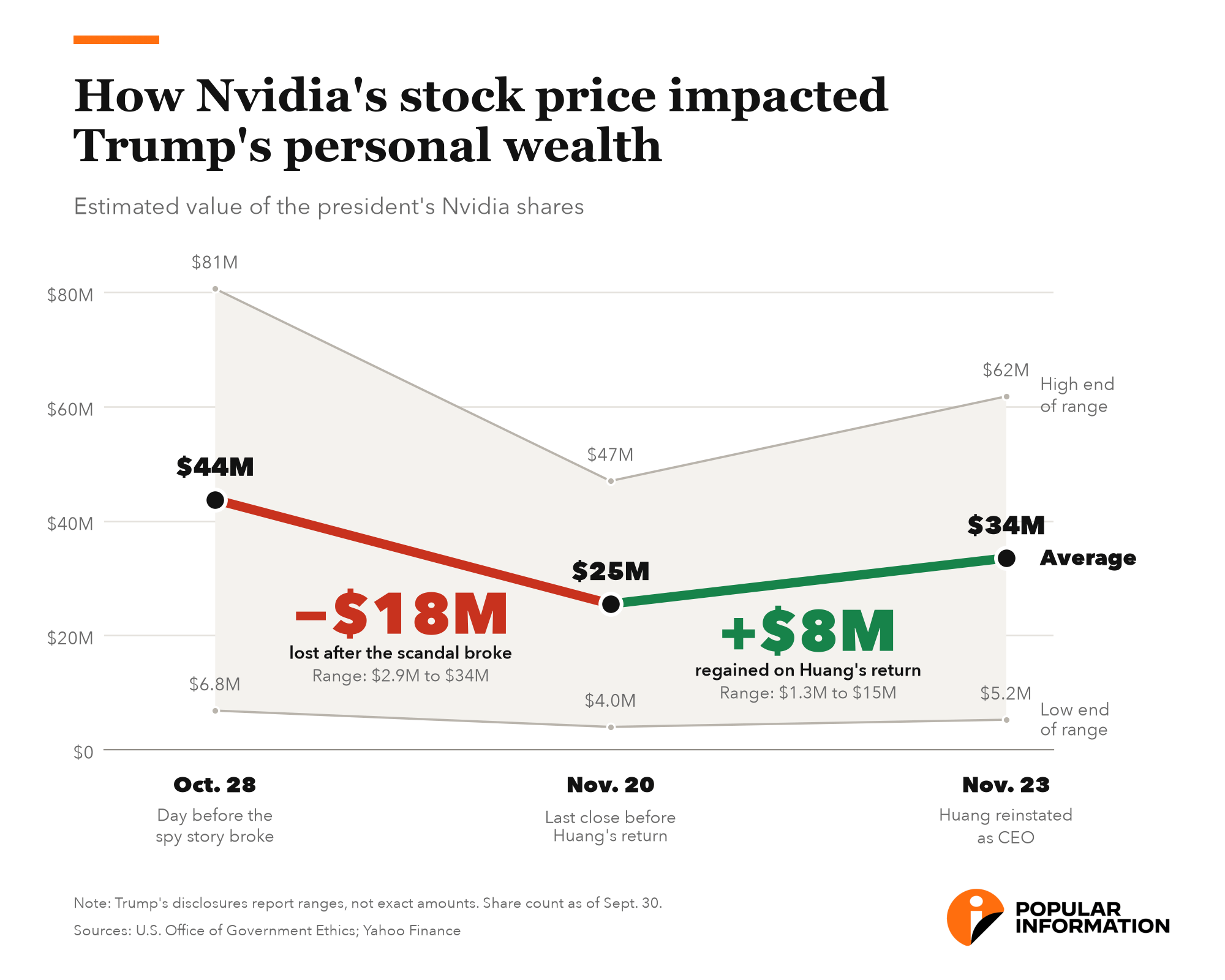
Huang’s departure actually had an even larger impact on Trump’s personal wealth because it caused a major slide in other stocks in the AI sector, including Alphabet, Microsoft, Amazon, Meta, and Tesla. Trump has significant stock holdings in all these companies, which all rose on news of Huang’s return.
Asked on CNBC if the decline in stock prices influenced his decision to pressure Nvidia’s board, Trump said, “Probably so, but the bigger impact was the long term.”
The Nvidia scandal is a Trump scandal
Huang’s return to Nvidia may have also insulated the Trump administration from a larger scandal. The Trump administration has been facing criticism for not putting restrictions on Megaspeed, the company where Alice Huang was an executive, despite it being accused of giving China U.S. chips illegally.
Secretary of Commerce Howard Lutnick reportedly delayed putting the company on the entity list, which is a trade blacklist of foreign companies deemed national security risks. Treasury Secretary Scott Bessent told CNBC that much of the Trump administration, including the Treasury Department, the State Department, the Defense Department, and the Office of the U.S. Trade Representative, wanted to put “Megaspeed on the entity list for months,” but the Commerce Department delayed the process. “Commerce has the pen, and you will have to ask them about their internal processes,” Bessent said.
Axios reported that sources said “Lutnick has spent the last year ‘undoing’ efforts by other administration officials to hold Megaspeed… accountable because of concerns it would escalate the trade war with China.” Lutnick delayed placing Megaspeed on the list even after he was reportedly briefed about Jensen Huang’s affair with Alice Huang months ago.
On Monday afternoon, the New York Times reported that the Commerce Department had added Megaspeed to the entity list.
On November 12, Reuters reported that senior White House officials were “discussing whether Commerce Secretary Howard Lutnick should be pushed out.” Lutnick has also faced scrutiny from bipartisan members of Congress, and has agreed to testify before Congress next month.
Earlier this year, Trump was reportedly close to firing Lutnick after he “acknowledged he had visited convicted sex offender Jeffrey Epstein at his private island.” Lutnick then donated $25 million to Trump’s presidential library, and the matter was dropped, the New York Times’ Maggie Haberman reported.
It appears that Trump is standing by Lutnick again. Earlier this month, the White House said in a statement that Trump “maintains complete confidence in the secretary and his ability to carry out the position as the most transformative Commerce Secretary in modern history.”
Huang’s return to Nvidia may help the Trump administration downplay the severity of the scandal, and in turn protect Lutnick’s decision to not blacklist Megaspeed.
Following the money
While Nvidia stock has enriched Trump personally, the company has also supported his political projects. Nvidia has donated at least $26 million to support Trump during his second term.
The company donated $1 million to Trump’s inauguration fund and another $25 million to the White House ballroom project. The ballroom donation was made anonymously, but Washington Post reporting on internal White House documents connected Nvidia to the funds. Additionally, Huang attended a dinner hosted by MAGA Inc., Trump’s super PAC, at Mar-a-Lago in April 2025. The dinner cost $1 million per person to attend, although MAGA Inc. records do not show a donation from Huang or Nvidia.
In addition to these donations, Nvidia has pledged billions of dollars of investments to support Trump priorities related to AI and manufacturing.
In April 2025, Nvidia announced that it would invest $500 billion in building AI infrastructure in the U.S., and begin producing some of its chips and supercomputers domestically — both major priorities for Trump. The White House praised the move, calling it the “Trump effect.” Nvidia also bought a $5 billion stake in its rival chipmaker Intel in September 2025, just a month after the government purchased a 10% stake in the company to help keep it afloat. According to the New York Times, the Trump administration had asked Nvidia to invest in Intel earlier in the year.
Most recently, on October 8, Nvidia pledged $1 billion to support Trump’s Genesis Mission, a project introduced last year to speed up American AI research and development. On the same day the pledge was announced, Trump awarded Huang the National Medal of Science.
While Nvidia has doled out money, Huang has repeatedly praised Trump and become a trusted adviser to him.
Huang and Trump first met shortly after the inauguration (which Huang did not attend, unlike many other tech leaders), but their relationship took off after Nvidia’s $500 billion AI infrastructure commitment a few months later. Shortly after, Huang came with Trump on his first international trip to the Middle East. On that trip, Trump said of Huang, “We are proud to have you in our country.” Since then, Huang has been a frequent guest at the White House and on Trump’s international trips. They have also spoken on the phone multiple times. Publicly, they have both heaped praise on each other.
Trump has called Huang a “smart man“ and a “very handsome guy.” In March, he appointed Huang to the President’s Council of Advisors on Science and Technology.
For his part, Huang has called Trump “America’s unique advantage.” At Nvidia’s GPU Technology Conference last October, he said, “No one works harder. No one… this president is working like mad to help America be great and for America to win.”
I watched a YouTube short from Matt Bernstein on Jensen's reinstatement, and the sentiment I liked in particular was that he wasn't surprised, but he was outraged. That's how I feel. Trump and Huang are two unaccountable peas in a pod: abusive to their subordinates, serial philanderers, rewarded despite their questionable decision-making. As Bernstein concluded and as the saying goes, it's a club, and we ain't in it.
I'd bet that your numbers are off by an order of magnitude. Given Trump's past behavior, I'd bet he bought millions of shares at the Friday price and profited more than handsomely by Monday afternoon. But this will not end well for Nvidia, for Huang or perhaps finally for Trump. Huang not only banged a spy and at least two employees, he is apparently an abusive boss, bullying, yelling creaming and generally a nightmare to work for or around. This will end up blowing up in the board's face as his behavior continues to cause problems. And when the Democrats take Congress and did into his accounting practices in addition to his transfer of classified material to China it will all come crashing down. Expect the board to be forced out en masse. Expect huge shareholder lawsuits. Expect almost an Enron level company implosion. And with luck, expect Trump to get caught within the blast radius.