

This article original appeared in Popular Information’s sister publication, Oligarch Watch. For more accountability journalism focused on the world’s wealthiest people, subscribe HERE.
Four years ago, Elon Musk conceded that Tesla, his automotive company, would be “worth basically zero” if it failed to deliver true autonomous driving technology.
Since then, Musk, Tesla’s chief executive and largest shareholder, has directed the company to pump tens of billions of dollars into speculative autonomous driving research, development, and hardware. Recently, Tesla used its Gigafactory in Texas to produce scores of Cybercabs, a driverless-only model that the company cannot currently sell or deploy on public roads.
However, the Trump administration is now moving to fulfill the regulatory wishlist necessary for Musk’s autonomous driving dream — including deregulatory actions that would clear the way for automakers to drop traditionally required manual controls and safety features. These changes that would accommodate the Cybercab’s lack of a steering wheel, mirrors, and brake and acceleration pedals.
Accompanying the deregulations is a Department of Transportation (DOT) initiative to establish a uniform framework for evaluating the safety of automated driving systems at the federal level.
Musk — who shelled out $290 million to help elect Donald Trump in 2024 and another $85.1 million this cycle, largely backing congressional Republicans — has long lobbied for a similar national framework. According to Musk, the current fragmented system, in which individual states and cities decide whether automated driving systems are safe enough to deploy on public streets, is to blame for the plodding rollout of Tesla’s so-called Robotaxi ride-hailing service.
The DOT’s push to create a federal safety standard for self-driving systems and to loosen vehicle safety requirements to allow for autonomous vehicles like Tesla’s Cybercab were both included in the White House’s “2026 Regulatory Plan and the Unified Agenda of Federal Regulatory and Deregulatory Actions.” The agenda, a massive document quietly released last week, proposed eliminating or weakening hundreds of federal regulations.
“Tesla will have the largest fleet of autonomous vehicles”
For years, Musk has said the future of Tesla hinges on its ability to create driverless vehicles that it can both sell to consumers and use to dominate the ride-hailing industry.
“Tesla will have the largest fleet of autonomous vehicles as far into the future as I can imagine,” he wrote in a February post on X.
Part of that vision, he has said, includes doing away with steering wheels or pedals, despite the National Highway Traffic Safety Administration (NHTSA), a DOT agency, enforcing a litany of safety standards requiring vehicle manufacturers to include analog controls.
Amid the Trump administration’s deregulatory binge, DOT has proposed carving out numerous special exceptions to the Federal Motor Vehicle Safety Standards (FMVSS) that would apply to Tesla’s steering-wheel-less, pedal-less, and mirrorless Cybercab model.
One new deregulatory proposal from DOT indicates that current FMVSS requirements for vehicle electronic stability controls need to undergo “modernization” to allow approval of automated vehicles “that lack manually operated driving controls.”
Another deregulatory change calls for an “update [to] the light vehicle brake systems standard… to except ADS-equipped vehicles without manually operated driving controls from the requirements for physical brake controls that presume a person is driving the vehicle.”
A third safety overhaul would apply to the Cybercab’s mirrorless design: Because the FMVSS requires that new vehicles be equipped with rearview mirrors and backup cameras, DOT has proposed establishing new functional requirements specific to automated vehicles that would not require vehicles “to be equipped with mirrors and a rearview image display.” Instead, separate requirements would be created for the “detection of… standardized objects that simulate small obstacles such as a child,” according to a deregulatory notice issued by the Office of Management and Budget.
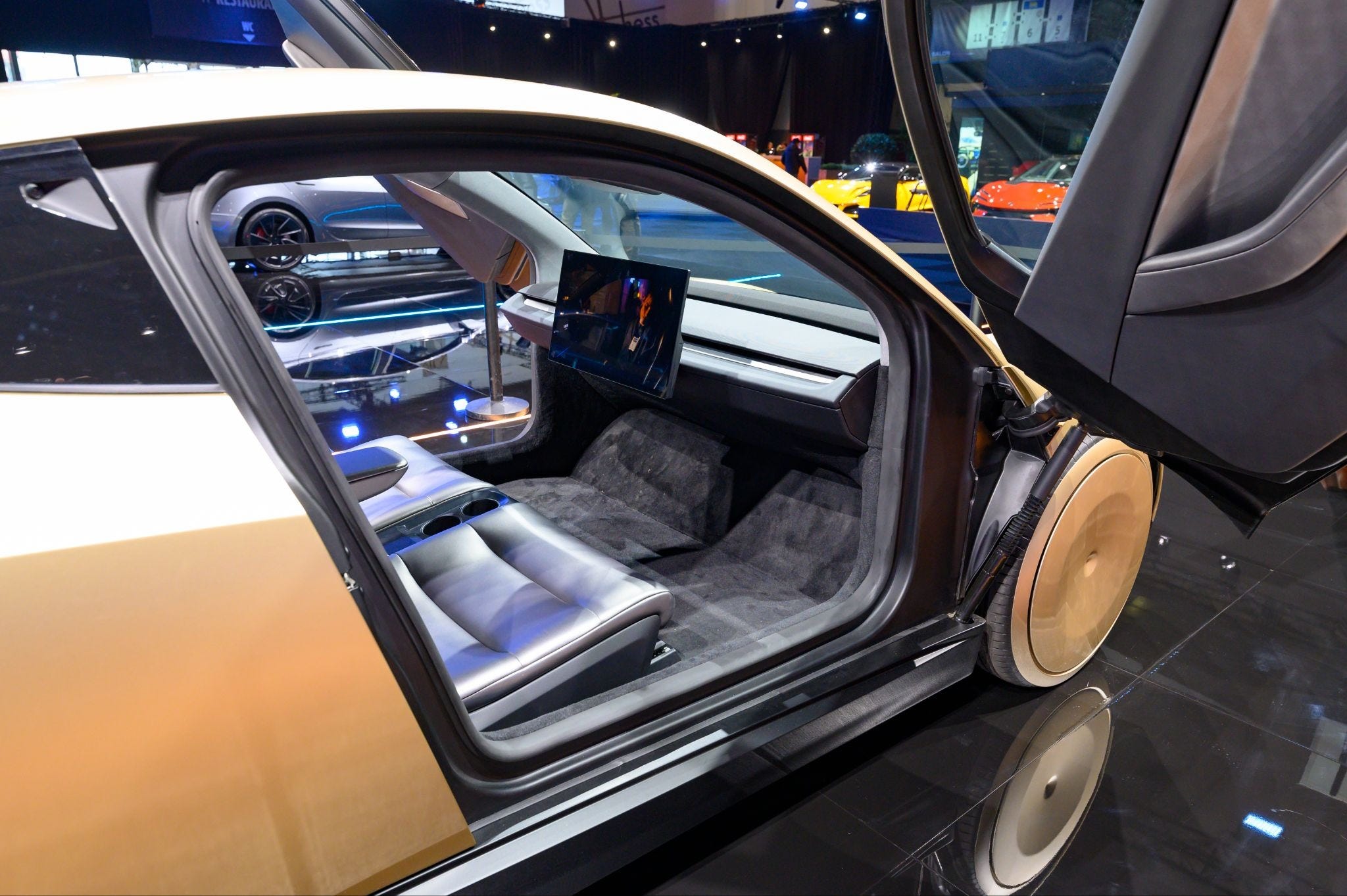
According to Musk’s biographer, Walter Isaacson, the centibillionaire has previously said that Tesla would commit to a car with “No mirrors, no pedals, no steering wheel,” adding, “This is me taking responsibility for this decision. Let me be clear. This vehicle must be designed as a clean robotaxi. We’re going to take that risk. It’s my fault if it fucks up. But we are not going to design some sort of amphibian frog that’s a halfway car. We are all in on autonomy.”
In a July interview, NHTSA administrator Jonathan Morrison made clear that federal regulators were supportive of that vision, saying the agency would “absolutely” do away with the steering-wheel requirement in the future. “If you’re developing a vehicle that is designed never to be driven by a human operator, does it make any sense to require manual controls for the vehicle?” he told CNBC. “I think the answer is pretty clear there.”
“It’d be wonderful for the United States to have a national set of rules for autonomous driving”
Last year, when Transportation Secretary Sean Duffy visited Tesla’s facilities, Musk lobbied for Washington to override states by setting national safety rules for automated driving technologies.
“It’d be wonderful for the United States to have a national set of rules for autonomous driving as opposed to 50 independent sets of rules on a state-by-state basis,” he told Duffy at the time.
Duffy, a former reality TV star, congressman, and Fox Business host, appears to have taken that request to heart.
In a notice listed as a “Deregulatory” agenda item, DOT announced plans for a new protocol to decide the operational “concept” of self-driving vehicles and select “operational areas” where automated driving systems could serve as “the sole driver” of a vehicle. “NHTSA will also identify metrics to predict and to track safety outcomes,” read the notice that was included in Trump’s 2026 “Unified Agenda.”
It continued:
To date there is no uniform approach to assess the safety performance of [Automated Driving Systems] ADS-equipped vehicles intended to operate on U.S. public roads. Currently, ADS entities must navigate a patchwork of State laws and regulations to deploy ADS-equipped vehicles. This rulemaking will provide Federal leadership on the safety performance of ADS-equipped vehicles. A uniform ADS safety performance assessment approach encourages American innovation and ADS development and promotes continued safe operation of ADS-equipped vehicles on U.S. public roads.
So far, Tesla has only tested its driverless Robotaxi ride-hailing service in two Republican states — Texas and Florida — with permissive regulatory environments. Even in Austin, Texas, where Tesla has its largest and longest-running Robotaxi test pool, the company has only deployed a few dozen vehicles. Many of those vehicles are partially accompanied by a human “safety monitor,” and all of them are overseen by remote human operators.
While Musk and other executives have marketed Tesla’s advanced driver assistance systems as up to 10 times safer than human drivers, a Reuters investigation in May found the company had significantly skewed comparison data to arrive at that claim. “The automaker counted Tesla crashes with airbag deployments and compared them with federal data on all crashes in which a tow-truck removed a vehicle — a far less restrictive criterion,” Reuters reported.
Tesla, which has repeatedly missed deadlines set by Musk to achieve autonomous driving, also faces a growing number of lawsuits and investigations into the role its driver assistance systems — Full Self-Driving (Supervised) and Autopilot — have played in fatal crashes.
Has there ever been a time when deregulation helped the people, and not the corporations?
The 'largest fleet of autonomous vehicles" that no one can afford or want.