

Last year, Popular Information broke the news that on October 3, 2025, U.S. Immigration and Customs Enforcement (ICE) abruptly stopping paying third parties for medical care provided to detainees. Third-party providers are used to provide “medically necessary” care including “dialysis, prenatal care, oncology, [and] chemotherapy,” according to ICE.
Prior to that date, payment for medical care for ICE detainees was processed by the Department of Veterans Affairs (VA). But the VA “abruptly and instantly terminated” its agreement with ICE after the arrangement, which dated to the George W. Bush administration, drew criticism from right-wing activists. The activists falsely claimed that undocumented immigrants were siphoning resources from veterans. Actually, ICE was fully reimbursing the VA for the service.
According to documents published by ICE on a government contracting website on November 12, 2025, the termination of the agreement with the VA left ICE unable to “pay for medically necessary off-site care.” ICE described this as an “absolute emergency” that needed to be resolved “immediately” to “prevent any further medical complications or loss of life.”
Eleven months later, ICE still has no system to pay for outside medical care provided after October 3, 2025.
Hospitals and other providers who continue to treat ICE detainees are not receiving payment. UCHealth University of Colorado Hospital, located in Aurora, Colorado, for example, has provided medical care for ICE detainees, including 150 hospital admissions, clinic appointments and emergency visits, since last fall. It hasn’t been paid for any of these services, racking up over $4 million in unpaid bills.
“Like other healthcare providers, UCHealth has been unable to submit claims and has not been reimbursed for care provided since October 1, 2025, because of a disruption in the Department of Homeland Security’s medical payment system,” UCHealth spokesman Dan Weaver told CPR News last month.
Moshannon Valley EMS is a non-profit organization which provides ambulance services in Philipsburg, Pennsylvania. As of June, it had responded to 43 calls to a local ICE detention center since October 2025. It has not been paid for any of that work. “We have to have some faith that someone’s going to do the right thing and compensate us for the work that’s provided,” EMS chief Fred Ferguson told NOTUS.
Internal data obtained by Popular Information reveals that, in 2024, the VA processed over $246 million in medical claims related to the treatment of ICE detainees (and a much smaller number of detainees held by Customs and Border Patrol) by third parties. Data obtained by American Oversight found the VA processed $96 million in claims in 2025 before the relationship with ICE was terminated.
In the absence of payment, it is unclear how many providers, like UCHealth, are continuing to provide treatment and how many are refusing to treat ICE detainees.
An alarming increase in ICE detainee deaths
A report by Human Rights Watch and Physicians for Human Rights found that in “the 500 days between President Donald Trump’s inauguration on January 20, 2025 and June 4, 2026, 52 people died in ICE custody in the United States.” The mortality rate was “nearly four times that of the Biden administration, and more than two and a half times as high as that of the first Trump administration.”
Although the information about these deaths disclosed by the Trump administration has been minimal, “Physicians for Human Rights medical experts had a high suspicion of inadequate or delayed health care in several of the 39 deaths that occurred during the first year of the current administration, raising serious concerns that the deaths may have been preventable.”
The inability of ICE to pay for outside medical care, including emergency services, may be a contributing factor.
For example, on December 3, 2025, Francisco Gaspar-Andrés, a detainee at the Camp East Montana detention facility in Fort Bliss, Texas died of liver failure. According to a report in the San Francisco Chronicle, for two months before his death Gaspar-Andrés “went to the medical unit nine times, complaining of symptoms including bloody stool and bleeding gums.” But he “was sent back from visits to the medical unit with allergy, heartburn and indigestion medications and diagnosed with influenza despite repeatedly testing negative.” By the time he was finally transported to a hospital on November 16, doctors were unable to save his life.
On June 24, the Department of Homeland Security (DHS) Office of Inspector General announced an “evaluation of detainee deaths in ICE custody“ because of “an increase of detainee deaths in ICE custody each year since fiscal year 2022.”
Delay after delay
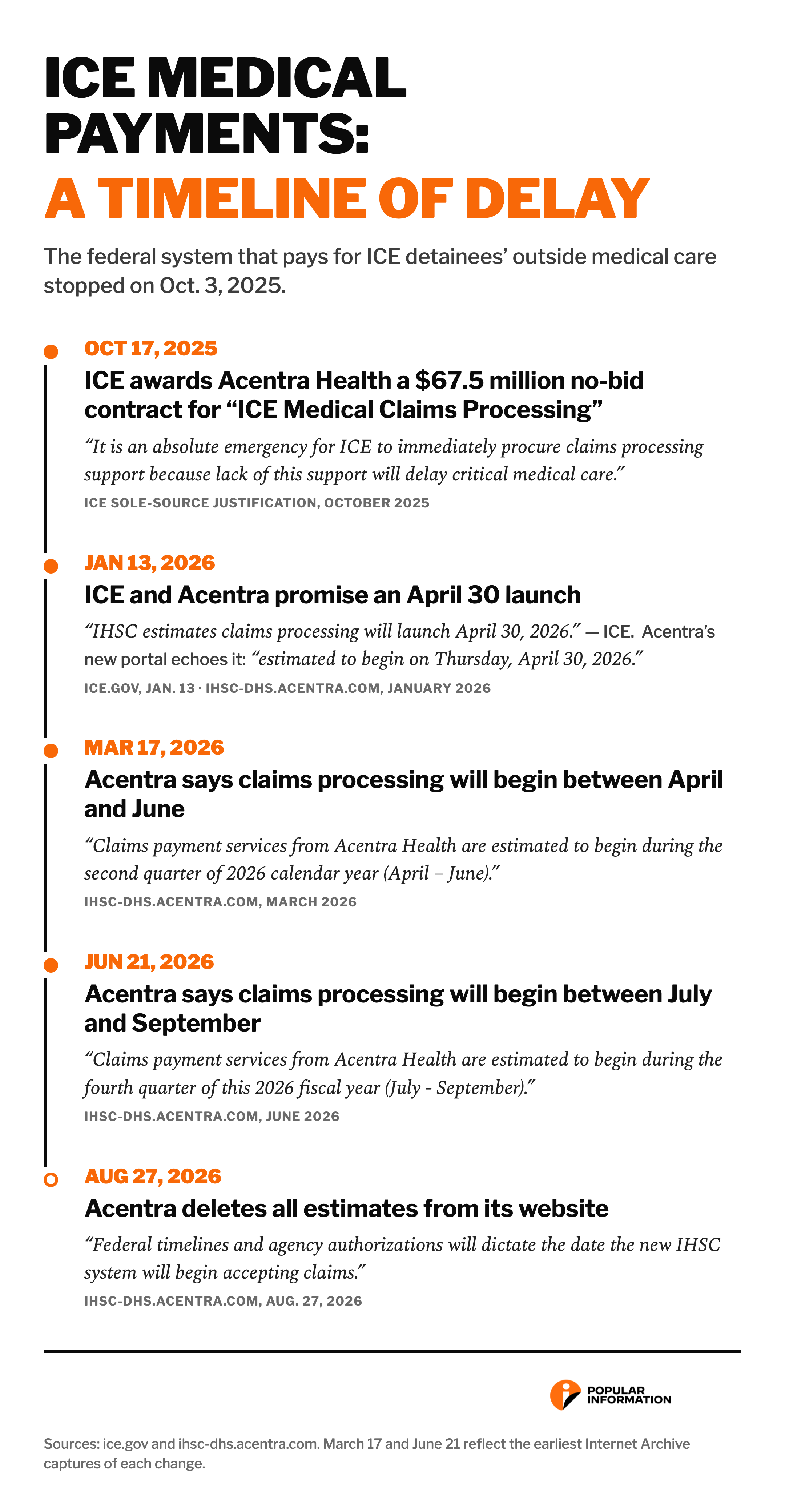
On October 17, 2025, ICE awarded an emergency contract to Acentra Health to create a system “to receive, adjudicate, process, and pay healthcare claims” related to the treatment of ICE detainees by third parties. Acentra, so far, has been paid $36 million to create such a system.
No claims have been processed by Acentra to date. The company, and ICE, originally said that claims processing would begin on April 30, 2026. After that, the date was repeatedly pushed back without explanation. A few days ago, all estimates of a launch date were removed.
Now, Acentra is claiming they were never supposed to process claims at all. They were just creating a system for someone else to use to process claims. At the end of June, DHS put out another request for information to “identify potential vendors capable of providing a comprehensive medical claims processing system.” The first question asks: “What are your typical and realistic timeline [sic] for transitioning complex and comprehensive claims adjudication and provider reimbursement services… ?”
Trump is definitely a Russian asset as he breaks down our nation.
The prevarications of this administration will one day strike us as unbelievable; for now, we accept its depredations as inevitable. Thieves, shills, grifters, and staggeringly uninformed officeholders will fill this very dark chapter.