

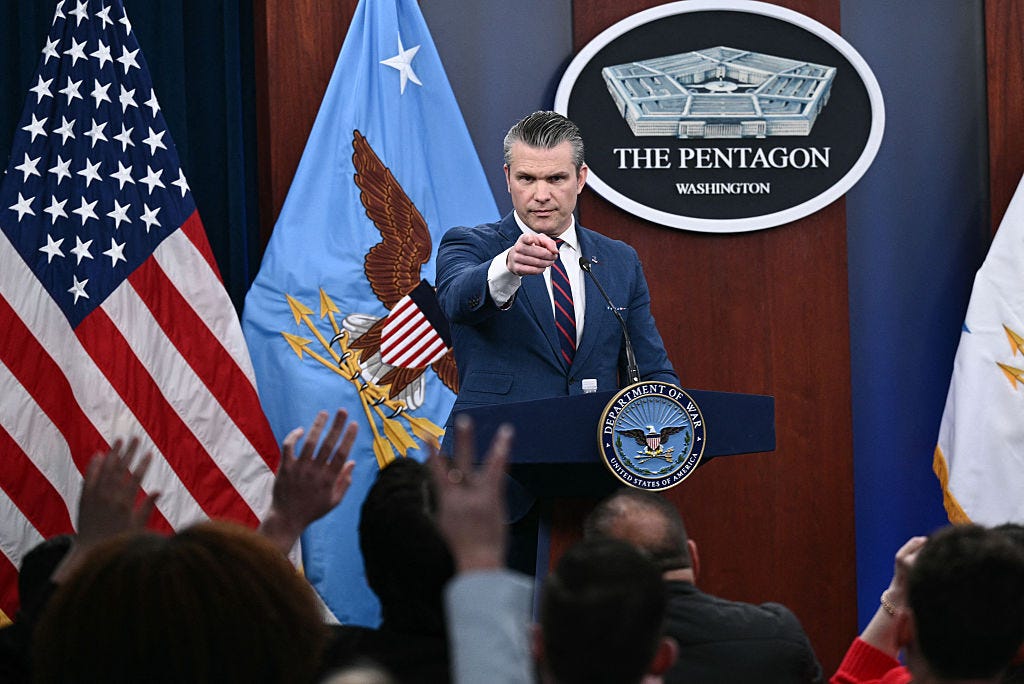
On February 28, President Trump announced that “the United States military began major combat operations in Iran.” The war has claimed the lives of more than 1500 people, including about 1300 Iranians, dozens in neighboring countries, and six U.S. troops. The Pentagon has estimated the conflict is costing U.S. taxpayers about $1 billion per day — and that figure may be too low.
And yet, nine days into the war, Trump and his administration have failed to clearly answer the most fundamental question: Why did the war begin?
Instead, the Trump administration has offered a bewildering series of shifting, contradictory, and factually incorrect answers. In just over a week, Trump and top administration officials have given at least 17 different responses about why the war began:
Iran’s nuclear program was “obliterated” last June, but the U.S. started the war because Iran refused to abandon its “nuclear ambitions.” In his February 28 announcement, Trump said that “in Operation Midnight Hammer last June, we obliterated the regime’s nuclear program.” The U.S. initiated this attack, Trump said, because Iran “rejected every opportunity to renounce their nuclear ambitions, and we can’t take it anymore.”
The U.S. attacked Iran to prevent a nuclear war. “If we didn’t do what we’re doing right now, you would have had a nuclear war, and they would have taken out many countries,” Trump said on March 3.
Absent an attack, Iran would have had a nuclear weapon within two weeks. “If we didn’t hit within two weeks, they would’ve had a nuclear weapon. When crazy people have nuclear weapons, bad things happen,” Trump said on March 4.
Iran is developing long-range missiles that “could soon reach the American homeland.” In his February 28 speech, Trump said that Iran was “developing the long-range missiles that can now threaten our very good friends and allies in Europe, our troops stationed overseas, and could soon reach the American homeland.” The idea that Iranian long-range missiles posed an imminent threat is not supported by public intelligence assessments. An assessment by the Defense Intelligence Agency published last May estimated that Iran would need ten years to develop a missile capable of reaching the United States — if it chose to pursue that capability.
The war is necessary because Iran has too much control over the global oil supply. On March 2, Secretary of State Marco Rubio said, “This terroristic regime, led by radical clerics, has the ability potentially to shut off 20 percent of global energy. That’s the kind of leverage they have because of their navy. We’re going to destroy their navy.”
The U.S. started the war because it knew Israel was going to attack Iran, endangering U.S. troops. “We knew that there was going to be an Israeli action, we knew that that would precipitate an attack against American forces, and we knew that if we didn’t preemptively go after them before they launched those attacks, we would suffer higher casualties,” Secretary of State Marco Rubio said on March 2.
The U.S. did not start the war because it knew Israel was going to attack Iran. The following was an exchange between Rubio and a reporter on March 3: “Q: Mr. Secretary, yesterday you told us that Israel was going to strike Iran and that that’s why we needed to get involved… SECRETARY RUBIO: Yeah, your statement’s false.”
Trump pushed Israel to join an attack on Iran because he believed Iran would otherwise attack first. “You see, we were having negotiations with these lunatics, and it was my opinion that they were going to attack first. …If we didn’t do it, they were going to attack first. I felt strongly about that. …So, if anything, I might have forced Israel’s hand,” Trump said in the Oval Office on March 3.
The U.S. attacked Iran to eliminate the threat posed by its short-range missiles and drones. “The United States is conducting an operation to eliminate the threat of Iran’s short-range ballistic missiles…,” Rubio said in his March 2 briefing. He also cited the need to destroy Iran’s “one-way attack drones.” According to Rubio, these missiles would act as a “shield” and allow them to later produce nuclear weapons. House Speaker Mike Johnson (R-LA) reiterated this claim after receiving a classified briefing the same day. “The objective was to take out those missiles, the short- and mid-range missiles, and their ability to produce them,” Johnson claimed.
The U.S. attacked Iran because “they’ve been killing Americans for 47 years.” This was cited by Trump in his February 28 announcement and by Secretary of War Pete Hegseth on March 4.
The U.S. attacked Iran because Iran is “the weakest they’ve ever been.” Hegseth made this claim as a justification for the War in his March 4 press briefing.
The war on Iran was started because of the “cumulative effect of various direct threats” and Trump’s “feeling, based on fact, that Iran does pose an imminent and direct threat” to the U.S. “This decision to launch this operation was based on a cumulative effect of various direct threats that Iran posed to the United States of America, and the president’s feeling, based on fact, that Iran does pose an imminent and direct threat to the United States of America,” White House Press Secretary Karoline Leavitt said during a press briefing on March 4.
The war is personal payback for Trump. “I got [Ayatollah Ali Khamenei] before he got me,” Trump told ABC News on March 1. “They tried twice. Well, I got him first.” Trump was referring to intelligence that Iran was plotting to assassinate Trump during the 2024 presidential campaign. This rationale was repeated by Hegseth during a March 4 press briefing. “The leader of the unit who attempted to assassinate President Trump has been hunted down and killed. Iran tried to kill President Trump, and President Trump got the last laugh,” Hegseth said.
The U.S. started the war because the Iranians were not negotiating in good faith. “Tehran was not negotiating. They were stalling, buying time to reload their missile stockpiles and restart their nuclear ambitions,” Hegseth said on March 2.
Trump started the war to secure freedom for the Iranian people. “All I want is freedom for the people,” Trump told the Washington Post on February 28.
The U.S. attacked Iran because it was the “last best chance” to do so. “This was our last best chance to strike…and eliminate the intolerable threats posed by this sick and sinister regime,” Trump said on March 1.
The war is a response to Iran’s efforts to interfere in U.S. elections. Trump posted this article on Truth Social on February 28: “Iran tried to interfere in 2020, 2024 elections to stop Trump, and now faces renewed war with United States.”
Nevertheless, Hegseth has described the war’s mission as “very very clear“ and “laser-focused.” Rubio said the war had “a very clear goal“ and he didn’t understand why there was any “confusion.” Leavitt said that Trump had laid out “achievable objectives.”
On Truth Social, meanwhile, Trump declared that the war would continue until he achieved his “objective of PEACE THROUGHOUT THE MIDDLE EAST AND, INDEED, THE WORLD!“
Coming from a truly special kind of crazy, this statement is beyond the pale of any insight, “When crazy people have nuclear weapons, bad things happen,” Trump said on March 4.
He just keeps shoveling s#!t no matter how filthy he gets
"On Truth Social, meanwhile, Trump declared that the war would continue until he achieved his 'objective of PEACE THROUGHOUT THE MIDDLE EAST AND, INDEED, THE WORLD'!“
This has all the energy of "the beatings will continue until morale improves" and even less of the coherence. I believe the Trump administration should continue to be pressed on why we're setting the stage for a military quagmire in Iran, though I don't expect a satisfactory answer to manifest itself.
I also believe that Democrats need to stop couching their opposition to another regime change war with "Iran is bad, but..." rhetoric, in that it accepts hawkish Republicans' framing on the matter. The human toll should be more than enough, on top of the complete lack of a credible justification.