

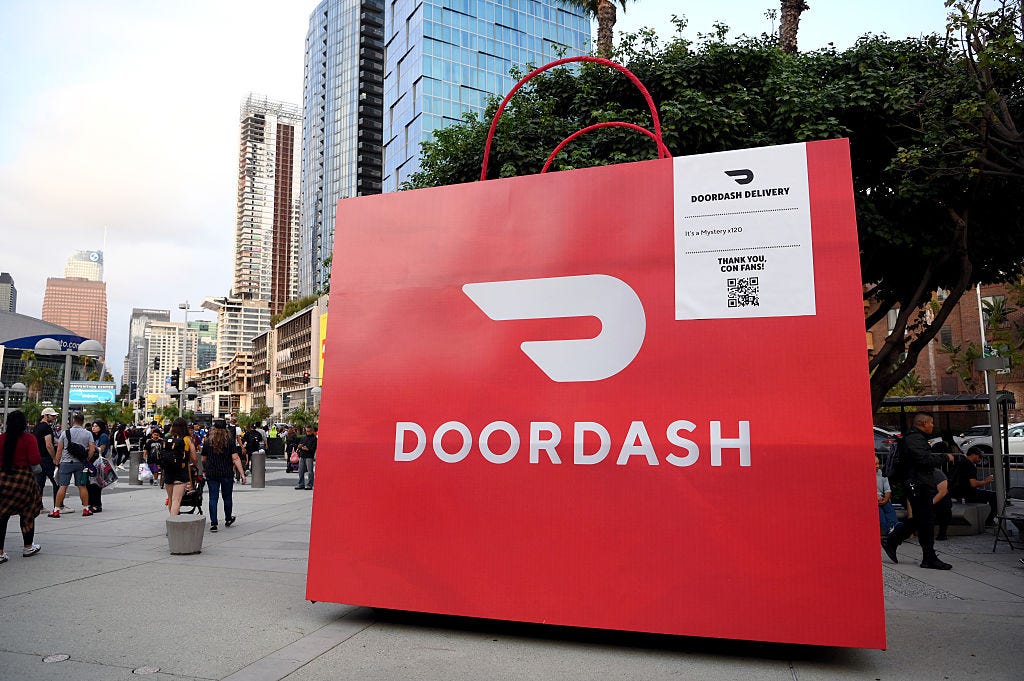
This week, New York City announced a historic $131.5 million enforcement action against food delivery app DoorDash for underpaying or delaying payments to workers. The company will pay more than $115 million to over 260,000 workers who were underpaid. DoorDash will also pay over $16 million in civil penalties and costs.
In a press release, the city said it was “the largest worker settlement in New York City history and the largest settlement involving food delivery workers in the United States.”
According to DoorDash, the median amount paid to workers “will be around $48.” City officials said that over 27,000 workers are owed over $1,000, and around 700 workers are owed over $10,000, the New York Times reported.
“When a worker earns a wage, they deserve to be paid that wage — not tomorrow, not after a lawsuit, but on time and in full,” New York City Mayor Zohran Mamdani said in a press release. “The size of this settlement shows the damage done to workers by wage theft,” Deputy Mayor for Economic Justice Julie Su said. “But it also shows that enforcement matters.”
The settlement stemmed from an investigation by the city’s Department of Consumer and Worker Protection (DCWP) into allegations by DoorDash workers that the company had not properly paid them. DCWP additionally uncovered that DoorDash had been violating a 2023 rule setting a minimum pay rate. The rule “requires companies to pay couriers a base wage of $22.13 per hour, multiplied by the sum of all workers’ total delivery trip time and time spent waiting between orders,” according to Bloomberg.
According to DoorDash, the majority of the settlement (over $83 million) covers violations of the minimum pay rules, including not properly paying for “on-call time,” or the time workers spend on the app waiting between deliveries.
In a statement posted to its website, DoorDash argued that it “calculated on-call time differently than the City,” stating that while it “believe[d] our approach was fair, practical, and legal… rather than spend years fighting over whose method was right, we chose to pay Dashers sooner and use the City’s method going forward.” The company also blamed errors on technical problems or complicated situations.
“Simply put, we screwed up,” DoorDash said in the statement. “Our mistakes meant some Dashers were underpaid or paid late. While these mistakes weren’t intentional, that doesn’t make them okay.”
As part of the settlement, DoorDash also agreed to a compliance monitoring program. The company will submit monthly data reports for three years, make software updates, and create internal controls to prevent new violations. Two worker advocacy groups are also partnering with the city to develop software that will allow workers to share data with the city about their trips and pay.
Affected workers will begin receiving emails about payments next month. At the beginning of next year, there will be a second round of payments as “DoorDash is still correcting elements of the compensable-time calculation logic that caused additional underpayments.”
DoorDash spent over $1 million to defeat Mamdani
DoorDash spent heavily to defeat Mamdani in last year’s election. On May 8, 2025, DoorDash donated $1 million to Fix the City, a super PAC supporting mayoral candidate Andrew Cuomo. At the time, it was “the single largest donation in the race,” according to Politico. (In June, Michael Bloomberg donated $5 million to Fix the City, surpassing DoorDash.)
DoorDash’s super PAC, Local Economies Forward NY, spent over $368,000 on advertisements and other campaign content supporting Cuomo in the lead-up to the Democratic mayoral primary in June 2025. On June 13, 2025, Local Economies Forward NY also donated $150,000 to Competent New York, a committee launched by a public sector union in support of Democratic mayoral candidate Adrienne Adams.
“We’re committed to supporting leaders who prioritize practical, pro-local economy solutions that encourage growth and innovation,” John Horton, DoorDash’s head of public policy for North America, told Politico in May 2025.
Mamdani campaigned on a pledge to further regulate delivery apps. “This is a city where we will choose our own mayor,” Mamdani said in September 2025. “It’s not going to be Donald Trump… It’s not going to be DoorDash.”
Mamdani made the DoorDash donation a campaign issue at a debate with other mayoral candidates, including Cuomo. “I find it ridiculous to hear Andrew Cuomo talk about how we need to regulate the apps,” Mamdani said in June 2025. “How are you going to regulate DoorDash when they are giving you a million dollars to influence your street safety regulations and your labor regulations?”
DoorDash sued to block laws protecting delivery workers
In 2023, DoorDash, Uber Eats, and Grubhub sued New York City over the minimum pay rules that DoorDash has now violated. The lawsuit highlights that DoorDash was (or should have been) aware of the rules and what they required.
The delivery apps argued that the pay minimum would force them to increase prices and cut the number of delivery drivers. While the judge in the case initially blocked the pay minimum, he ultimately allowed it to proceed in September 2023. DoorDash and the other delivery apps appealed this decision, but a New York state appeals court denied them again, and the rule took effect in December 2023.
In 2025, DoorDash and Uber Eats sued New York City again, this time in federal court, to prevent the city from enforcing new laws on how consumers can tip drivers through delivery apps. Until December 2023, the apps allowed customers to tip their drivers at checkout, but the platforms switched to a model that only allowed tipping at the end of a delivery. The city found that this led to significantly fewer tips for drivers, so they enacted a regulation mandating an up-front tipping option. DoorDash and Uber Eats argued this would cause a loss of “goodwill” among customers, but a judge refused to block the regulation in a January 2026 ruling.
DoorDash’s legal troubles beyond NYC
In addition to the New York City settlement, DoorDash has doled out millions of dollars over the last few years to resolve lawsuits and investigations across the country related to pay and other benefits for its drivers.
Between 2020 and 2025, DoorDash reached four settlements with Washington, D.C., Illinois, New York state, and Chicago over DoorDash using tips from customers to cover drivers’ baseline pay. For example, if a driver was guaranteed to be paid $10 by DoorDash for an order and the customer tipped $3, then DoorDash would only pay $7 instead of giving the full $10 in addition to the tip. The lawsuits alleged that DoorDash misled customers about how the tips would be used.
To settle the lawsuits, DoorDash paid $2.5 million in D.C., $11.25 million in Illinois, $16.75 million in New York state, and $18 million in Chicago. (The Chicago lawsuit also included other allegations, so only a small portion of the settlement covered lost tips for drivers.)
In 2021, DoorDash settled claims that it misclassified drivers in Massachusetts and California for $100 million. The drivers alleged that they should have been classified as employees, but DoorDash had been treating them as gig workers, which hindered their ability to receive a minimum wage, overtime pay, and compensation for costs like fuel and mileage.
DoorDash has also settled investigations in San Francisco and Seattle over allegations that the company did not provide mandatory healthcare and sick leave benefits to drivers. DoorDash paid $5.3 million in the San Francisco case and $1.6 million in the Seattle case.
Shaking my head at DoorDash trying to spin this as corporate responsibility when the bulk of the issue is not technical errors that led to missing or late pay, but intentional calculations of on-call time. It's not an aberration but rather part of a pattern of behavior.
Just goes to show that the Business Wing of the GOP still calls the shots in conservative politics. Door Dash donated to Cuomo not because of Islamophobia or racism; but merely to forestall a wage theft investigation.
Seems that the GOP is directly making the case to voters about the strong merits of Democratic Socialism.