

The two largest online sports gambling companies, DraftKings and FanDuel, have already spent millions of dollars on the 2026 midterm elections, according to FEC disclosures filed on Friday. This is a sea change for the industry, which has traditionally focused its political spending on state politics.
The push into federal elections comes as DraftKings and FanDuel face increased scrutiny on the impact of online sports gambling, including several high-profile athlete scandals and research showing a significant spike in problem gambling.
The emergence of DraftKings and FanDuel as major political contributors for the 2026 midterms has not been previously reported. Although the spending is bipartisan, both companies’ giving is tilted toward Republicans.
The deluge of cash reflects the national ambitions of the two companies and their desire to curb federal legislation and regulation that could blunt their expansion. The companies oppose bills that could restrict advertising and fund efforts to combat gambling addiction. Both companies have also recently expanded beyond sports betting into prediction markets, which are regulated at the federal level by the Commodity Futures Trading Commission (CFTC).
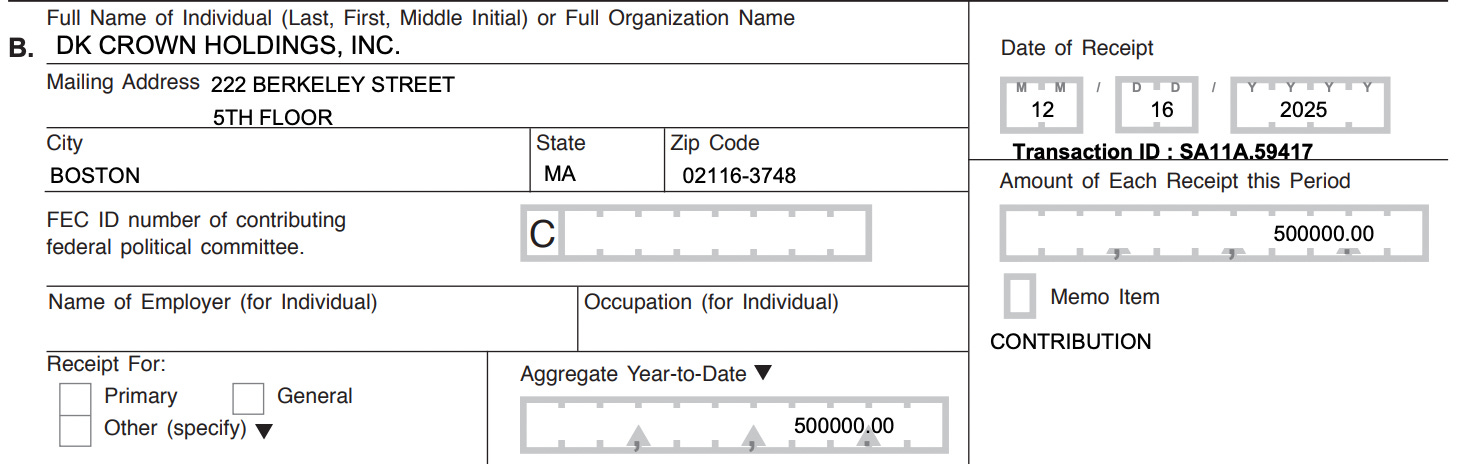
On December 16, 2025, DraftKings donated $500,000 to the Senate Leadership Fund (SLF), a Super PAC dedicated to maintaining Republican control of the Senate. The company, which donates under the name DK Crown Holdings Inc., has not yet donated to the SLF’s Democratic equivalent, the Senate Majority PAC (SMP).
DraftKings also donated $2 million to a new PAC, Win For America, which was created on November 2, 2025. The company was Win For America’s only donor. Then, on November 21, Win for America donated $500,000 to the American Conservative Fund, a dark money group that works in concert with the SLF to boost Senate Republicans. Simultaneously, $450,000 was funneled from Win for America to American Future PAC, a new group that was formed days after Win for America. Win for America is the sole source of funding for American Future PAC. Based on the political consultants involved and the messaging of American Future PAC’s nascent website, it appears likely to support Democratic candidates.
Prior to this spending, the only federal political donation DraftKings has made since its founding in 2012 was a $500,000 donation to the 2024 Republican National Convention (RNC). DraftKings did not donate to the Democratic National Convention (DNC). In 2025, DraftKings also donated $502,000 to Trump’s inaugural committee.
On December 24, 2025, FanDuel donated $500,000 to the SLF and another $500,000 to the Congressional Leadership Fund (CLF), the Super PAC dedicated to electing Republican candidates in the House. The same day, FanDuel donated $500,000 each to their Democratic equivalents, the SMP and the House Majority PAC.
In September, FanDuel donated $25,000 each to Team Morrisey and Black Bear Inc, two federal committees affiliated with West Virginia Governor Patrick Morrisey (R). (West Virginia has a permissive regulatory environment for online gambling and is often used by FanDuel and DraftKings to test new features.)
On June 18, 2025, FanDuel created FanDuel PAC. It has not yet made any contributions, but the PAC has already amassed a war chest of about $130,000 by collecting checks from employees, suggesting FanDuel’s involvement in the 2026 midterms is far from over.
Prior to last year, FanDuel’s only federal political spending was $500,000 to the 2024 RNC. Like DraftKings, it did not donate to the DNC. FanDuel also donated $482,000 to Trump’s 2025 inauguration.
The online gambling industry’s federal agenda
New research is shedding light on the financial and public health toll of pervasive online gambling in the United States. About 57 million Americans had an account with an online sportsbook as of February 2025 — including nearly half of men 18-49.
A July 2025 poll by U.S. News and World Report found that “one-quarter of sports bettors say they’ve been unable to pay a bill because of wagers they made.” About 30% of bettors report having debt they attribute to gambling, and 12% have taken out a high-interest payday loan to fund their wagers. Nine percent report seeking treatment for gambling addiction.
Problem gambling is significantly higher for in-game bets — live wagers placed during the game — than for traditional bets placed before the game begins. But in-game wagers are being promoted relentlessly in advertising by FanDuel and DraftKings.
The proliferation of online sports betting is also impacting the integrity of competition. In the last year, there have been major scandals involving the NBA and college basketball.
In response, some members of Congress have proposed legislation to further regulate the industry and fund treatment for problem gambling.
The SAFE Bet Act would regulate online sports gambling at the federal level. It would ban online sports gambling advertising during live sports events. It would also prohibit online sports books from inducing people to start gambling by offering “bonus bets” or similar incentives. The bill would stop credit card deposits and prohibit online sportsbooks from using AI to track individual players’ betting habits.
The industry also opposes a more modest legislative effort, the GRIT Act, which would “set aside 50% of the federal sports excise tax revenue for gambling addiction treatment and research.” The excise tax is currently 0.25% and generated about $150 million in revenue in 2024. As Vanity Fair notes, currently, the “federal government spends about $1.6 billion annually to research drug abuse, $600 million annually to research the effects of alcohol, and $0 to study gambling.”
The industry opposes the GRIT Act, likely because it establishes the principle that online sportsbooks are responsible for the harms they cause. The online sportsbooks are backing the Discriminatory Gaming Tax Repeal Act, co-sponsored by Congresswoman Dina Titus (D-NV) and Congressman Guy Reschenthaler (R-PA), which would eliminate the excise tax altogether.
Beyond sports gambling
DraftKings and FanDuel’s federal donations may also be related to their recent expansion into prediction markets. The move allows the companies to take on established prediction markets like Kalshi, which effectively offers wagers on games in states where traditional online sports betting is illegal, including California and Texas. It will also allow FanDuel and DraftKings customers to place bets on topics beyond sports, including politics, economics, and pop culture.

Prediction markets are regulated by the federal government through the CFTC. The Trump administration has allowed prediction markets to operate in a legal gray area, approving markets on a case-by-case basis. The CFTC recently withdrew rules proposed in 2024, which would have banned sports and politics markets.
But CFTC Chair Michael Selig said new rules for prediction markets are coming. The CFTC’s regulatory direction could significantly impact DraftKings and FanDuel’s future earnings. This provides an additional rationale for the companies to influence federal policy. Ultimately, Congress oversees the CFTC, and the Senate must confirm any new members.
DraftKings and FanDuel’s embrace of prediction markets led them to leave the American Gaming Association (AGA), a powerful industry lobbying group, in November. Since leaving the AGA, both companies have rapidly expanded their influence operations.
As a sports fan, I can personally attest to how DraftKings, FanDuel, and other betting services inundate both live and televised events with ad placements, throwing money at celebrities to promote them. While not to obviate people's sense of responsibility, the aggressiveness of these campaigns certainly merits discussion owing to the harm gambling and gambling addiction can do. When individuals are plunging themselves into financial ruin, that's a real problem.
"Everybody Loses" is a recently released book by Danny Funt which discusses the online betting craze. The online betting companies schmooze the elected representatives with celebrity sports stars and tickets to sporting events. Some people can win money, but more often than not, people lose money. And when I say "lose money," it will disappear FAST. Not only are the rich getting richer and the poor getting poorer, but if you bet, you'll become poor faster.