

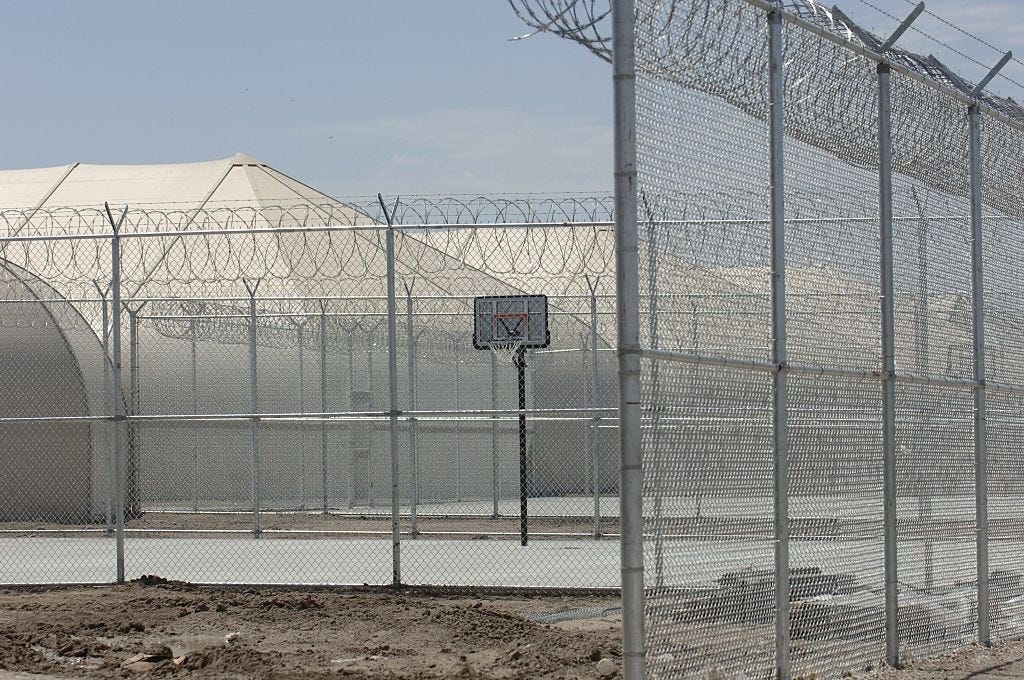
In 2025, 32 people died in the custody of the U.S. Immigration and Customs Enforcement (ICE). That figure was the largest in more than two decades and tied for the highest number of deaths among ICE’s detainee population ever.
2026 is only three weeks old, and it’s already shaping up to be much worse. In just 21 days, at least six people have died in ICE custody.
Last year, ICE did not have six in-custody deaths until April 25. The early trends put ICE on pace for 120 in-custody deaths in 2026.
Several of the deaths, according to family members and advocates, are related to substandard medical care. Popular Information reported on Monday that ICE stopped paying for third-party medical treatment for detainees on October 3, 2025. As a result, according to an administration source, numerous detainees are either being turned away by providers or denied access to care.
Other deaths are allegedly suicides. These deaths could also be a function of inadequate mental health care or supervision of detainees. The detained population in ICE facilities has exploded from less than 40,000 in January 2025 to over 73,000 today.
Geraldo Lunas Campos
On January 3, Geraldo Lunas Campos, a 55-year-old from Cuba, died at the Camp East Montana detention facility on Fort Bliss in El Paso, Texas. Lunas Campos was “legally admitted to the U.S. in 1996.” In 2005, an immigration judge ordered his removal. Initially, ICE said in a January 9 press release that Lunas Campos died after “experiencing medical distress” and that it was investigating his death. According to ICE, Lunas Campos had been placed in “segregation” after he “became disruptive while in line for medication and refused to return to his assigned dorm.” ICE stated that medical staff attempted to initiate lifesaving measures after staff observed him in distress.
Last week, however, the Washington Post reported that Lunas Campos’ daughter was told by an employee of El Paso County’s Office of the Medical Examiner that it was “likely to classify the death as a homicide,” pending the results of a toxicology report. The Post reported that the employee said that a doctor was “listing the preliminary cause of death as asphyxia due to neck and chest compression.”
According to the Post, Lunas Campos “died following a struggle with detention staff.” A detainee who was an eyewitness said that “he saw at least five guards struggling with Lunas Campos after he refused to enter the segregation unit, complaining that he didn’t have his medications.” The detainee said that “he saw guards choking Lunas Campos” and that he could be heard repeatedly stating, “No puedo respirar,” which is Spanish for “I can’t breathe.”
The Department of Homeland Security (DHS) told the Post in a new statement that Lunas Campos had “attempt[ed] to take his own life.” DHS said that Lunas Campos “violently resisted the security staff” and “stopped breathing and lost consciousness” during the struggle, and that medical staff made repeated attempts to resuscitate him.
Luis Gustavo Nunez Caceres
On January 5, Luis Gustavo Nunez Caceres passed away at a hospital in Texas. Nunez, who was 42 years old and from Honduras, was arrested by ICE on November 17. On November 25, Nunez was brought to the Joe Corley Processing Center in Conroe, Texas. According to ICE, Nunez was transported to the hospital on December 23 “for complications related to congenital heart failure.” On December 31, Nunez suffered from “multiple life-threatening medical emergencies” and was admitted into the intensive care unit. It is not clear how long Nunez had been in the U.S.
Luis Beltran Yanez-Cruz
Luis Beltran Yanez-Cruz, 68, died in ICE custody on January 6. He had immigrated from Honduras, living in the U.S. for 26 years and working in construction before he was arrested by ICE on November 16 in Newark, New Jersey.
After his arrest, Yanez-Cruz was sent to a detention facility in Calexico, California, where he soon began experiencing stomach and chest pain, according to his daughter and a family friend. Yanez-Cruz’s daughter said he told her he reported pain and shortness of breath to facility staff, but was only given some pills. According to the family friend, Yanez-Cruz had not experienced these symptoms before entering ICE custody.
Yanez-Cruz was transferred to the medical unit of the Calexico ICE detention facility on January 4, and then moved to John F. Kennedy Memorial Hospital in Indio, California, where he died from “heart-related health issues” according to ICE.
His daughter has raised questions about why ICE allowed her father’s symptoms to go untreated for so long. “He started having symptoms weeks ago; they could have done something,” she said.
Parady La
Parady La, a 46-year-old immigrant from Cambodia, died in ICE custody in Philadelphia on January 9 after experiencing “severe drug withdrawal.”
La’s family said he had long struggled with drug addiction and informed officers that he was experiencing withdrawal from fentanyl shortly after being detained on January 6, but did not receive any treatment. On January 7, La was found unresponsive in his cell. ICE said guards administered CPR and multiple doses of Narcan before he was transferred to a nearby hospital. The family has questioned why Narcan was administered, as it is meant to treat overdose, not withdrawal.
At the hospital, La was diagnosed with “anoxic brain injury, post cardiac arrest, shock and multiple organ failures” and declared brain dead. He was taken off life support on January 9.
La was born in a Cambodian refugee camp and came to the U.S. with his parents to escape the Cambodian genocide when he was two years old. He was granted legal status as a refugee, but eventually lost it due to a series of criminal convictions, according to ICE.
Victor Manuel Diaz
There have been multiple deaths at the Camp East Montana detention facility this year. On January 14, Victor Manuel Diaz, a 36-year-old from Nicaragua, “died of a presumed suicide” at the facility, according to ICE. According to a press release, Diaz was found “unconscious and unresponsive in his room.” The official cause of Diaz’s death is still under investigation.
Diaz was arrested by ICE on January 6 in Minneapolis, Minnesota. Diaz entered the U.S. on March 26, 2024. In August 2025, an immigration judge ordered that Diaz be “removed in absentia.” He was processed as a final order of removal by ICE on January 12.
The Camp East Montana facility, which is one of the largest ICE facilities in the U.S., has faced scrutiny from human rights groups and members of Congress in recent months for alleged inhumane conditions. In December, a coalition of human rights groups including the ACLU sent a letter to ICE that alleged “accounts of horrific conditions” at the facility, “including beatings and sexual abuse by officers,” “medical neglect,” “hunger and insufficient food,” and “denial of meaningful access to counsel.” Representative Veronica Escobar (D-TX) has also sent multiple letters alleging inhumane conditions at the facility and has called for it to be shut down. DHS has denied the reports of inhumane conditions at the facility.
Heber Sanchez Domínguez
Mexican national Heber Sanchez Dominguez, 34, was found hanging by the neck in an ICE detention facility in Lovejoy, Georgia on January 14 at 2:05 a.m. and declared dead at a nearby hospital an hour later. According to ICE, the cause of death is under investigation and the Mexican consulate has requested further information on the death.
Sanchez Dominguez was arrested at the U.S. border near Nogales, Arizona in December 2023 and released without bail. He was then arrested in Richmond County, Georgia on January 7 for driving without a license and taken into ICE custody. According to ICE, Sanchez Dominguez showed “no signs of distress” during the intake process.
It is a deliberate campaign of genocide. When Trump is gone mass trials will be required to hold all of the guilty to account.
Not that anyone deserves to be treated inhumanely, but these detainees don't sound like the worst of the worst that Trump and his administration vowed would be prioritized as a function of curbing illegal immigration. I would ask how the president's supporters could justify this treatment of people, but if they can explain away Renee Good's death despite clear visual evidence that her murderer wasn't in danger, they'll justify this, too.