

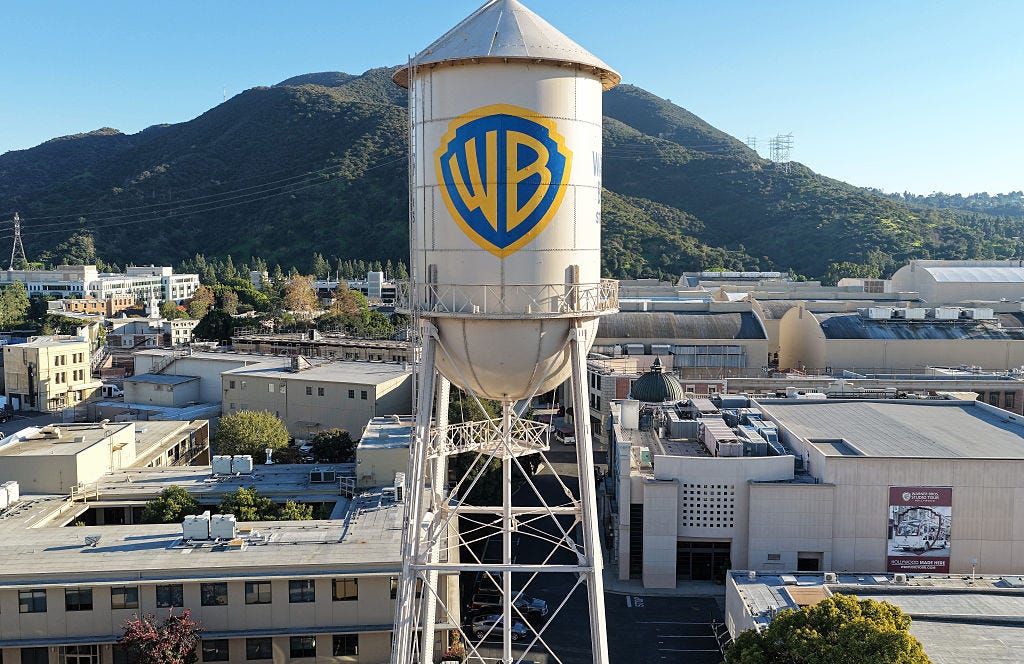
On Monday morning, Paramount announced a $77.9 billion hostile takeover offer of Warner Bros. Discovery (WBD), an American media conglomerate that owns an iconic movie studio, HBO, and other news and entertainment properties. The offer is meant to upend Netflix’s deal to purchase WBD for $72 billion, which WBD accepted last Friday.
Paramount’s press release announcing the offer says that the $40 billion in equity financing will be “backstopped by Ellison Family and RedBird Capital.” The CEO of Paramount is David Ellison, the son of Oracle co-founder Larry Ellison, the second-wealthiest person in the world. RedBird Capital is an investment fund based in New York. (The rest of the cash for the purchase will be raised as debt from American banks.)
What is not mentioned in the press release is that while the equity financing is “backstopped” by American individuals and entities, the majority of the equity financing — $24 billion — comes from the sovereign wealth funds of Saudi Arabia, Abu Dhabi, and Qatar. That fact is buried on page 42 of a separate SEC filing.
$24 billion is a massive investment by foreign governments on Paramount’s behalf. To put it in perspective, the current value of Paramount is just $15 billion.
Also participating in the deal is Affinity Partners, the private equity firm run by President Trump’s son-in-law, Jared Kushner. Nearly all of Affinity Partners’ assets come from the same sovereign wealth funds bankrolling the proposed Paramount takeover of WBD. Kushner collects tens of millions in fees from Saudi Arabia and other Middle Eastern countries annually.
Kushner’s involvement in the deal highlights the ongoing legal and ethical problems with his dual role. On the one hand, Kushner is operating as a high-ranking official representing the Trump administration in the most sensitive foreign policy matters. On the other hand, he is being paid by and partnering with Middle Eastern governments as they seek to expand their political, economic, and cultural interests.
Any acquisition of WBD requires the approval of multiple federal agencies. On Sunday, the day before Paramount’s hostile takeover bid was announced, Trump warned that Netflix’s planned acquisition “could be a problem“ because the combined company would have too much market share. It was a somewhat surprising comment from a president who has not made antitrust a central issue of his presidency. Trump also emphasized that while he would consult “some economists” he would also personally “be involved” in the decision.
Ted Sarandos, Netflix’s CEO, reportedly “wooed Trump“ at the White House in advance of the company’s WBD offer. Netflix agreed to pay WBD $5.7 billion if the deal did not receive regulatory approval, one of the largest breakup fees ever. This reflected Netflix’s confidence that the deal would win Trump administration approval — at least before Kushner became involved.
A reporter asked Trump on Monday if Kushner’s involvement with Paramount’s deal could influence his views. “I don’t know,” Trump responded. “I’ve never spoken with him about it.”
Paramount is willing to conform to Trump’s ideological agenda
Trump may be more amenable to Paramount’s bid for WBD, because Paramount has a history of bowing to Trump’s political demands, especially since David Ellison became CEO in August.
In September, CBS News announced that it hired a Trump loyalist, Kenneth R. Weinstein, to “receive and evaluate any complaints of bias or other concerns involving CBS” as the company’s new ombudsman. Paramount had promised to create the job to secure approval for its merger with Skydance. Weinstein had no experience with producing or overseeing news coverage and previously was the president of the Hudson Institute, a right-wing think tank. Weinstein has an extensive record of praising Trump, and in July 2024, Weinstein donated $20,000 to a committee supporting Trump’s campaign.
In October, Paramount announced that it was hiring anti-woke crusader Bari Weiss as the new editor-in-chief of CBS News and purchasing Weiss’ The Free Press for a reported $150 million. Weiss, a former New York Times opinion editor and writer, had no experience in broadcast news. In 2021, Weiss founded The Free Press, a right-leaning publication that often criticizes what it deems the “woke” left and efforts to promote diversity, equity, and inclusion (DEI). A Popular Information review of The Free Press’ articles found that it repeatedly distorted the truth in order to conform to a right-wing ideological agenda.
Larry Ellison is also a close ally of Trump. In 2020, he held a “six-figure-per-person campaign fundraiser” for the president at his California estate, where guests could pay $100,000 to golf and take a photo with Trump or $250,000 to “also participate in a round-table discussion.” He has also dined with Trump at Mar-a-Lago, sat in on a transition meeting at Mar-a-Lago, and has reportedly met with Trump frequently this year.
The foreign ownership problem
Having foreign governments own such a large stake in a company like WBD — which has sensitive financial information about millions of Americans — creates significant regulatory uncertainty. Such transactions frequently require an additional layer of approval by the Committee on Foreign Investment in the United States (CFIUS).
In the SEC filing regarding the offer, Paramount claims that it has structured the deal to be outside of CFIUS’s jurisdiction:
Our other outside financing partners (the Public Investment Fund (Kingdom of Saudi Arabia), L’imad Holding Company PJSC (Abu Dhabi), Qatar Investment Authority (Qatar) and Affinity Partners (Jared Kushner)) have agreed to forgo any governance rights – including board representation – associated with their non-voting equity investments. Accordingly, the Transaction will not be within CFIUS’s jurisdiction.
It is telling that Affinity Partners, a U.S. company owned by an American, is lumped into this group. Paramount is tacitly acknowledging that Kushner is using Affinity Partners as a vehicle for foreign influence.
But Paramount’s claim that CFIUS no longer has jurisdiction over the deal is false. A company cannot extinguish concerns about foreign ownership simply by nominally giving up governance rights. There are many other ways that entities providing $24 billion in equity investment can influence the operations of a company.
That’s why CFIUS has jurisdiction to investigate the deal between Paramount and WBD to determine what influence the sovereign wealth funds have and whether that influence raises national security concerns.
The creative and economic concerns about Netflix’s takeover bid
Netflix’s bid to buy WBD is also controversial.
Lawmakers on both sides of the aisle have raised anti-trust concerns about the deal. Senator Mike Lee (R-UT), who leads a Senate subcommittee on antitrust, said on X that the deal raised “a lot of antitrust red flags” and that he would hold “an intense antitrust hearing.” Meanwhile, Senator Elizabeth Warren (D-MA) said that the deal “looks like an anti-monopoly nightmare.” If Netflix were to buy WBD, it would own two of the top three largest streaming services, Netflix and HBO Max. This market power could allow Netflix to raise prices for its subscription services, which are already increasing rapidly.
The Writers Guild of America said the Netflix deal would “eliminate jobs, push down wages, worsen conditions for all entertainment workers, raise prices for consumers, and reduce the volume and diversity of content for all viewers.”
Another issue is the impact that the Netflix purchase could have on movie theaters. Netflix typically does not show its movies in theaters. Netflix’s CEO has said that declines in box office sales show that going to the movie theater is “an outmoded idea” and consumers would prefer to watch movies at home. With WBD films making up roughly a quarter of box office sales in North America, a theater-owner trade group said “the negative impact of this acquisition will impact theaters from the biggest circuits to one-screen independents.” Netflix has said that it would continue showing WBD movies in theaters, although this was met with skepticism from many in the industry.
One big bloated entertainment/news company is the goal I guess. I get that Jared kUshner is the center of this story of greed and foreign influence but as a consumer of entertainment I want a diverse range of shows and movies and I want my news based on fact and with as little bias as possible. These simple things we take for granted are all disappearing as the Twump cwime family continue to rape and pillage wherever they smell blood in the water a/k/a money to be had.
Purely from a consumer standpoint, this seems like a no-win situation. The only small sense of satisfaction with Netflix buying WBD is that it would keep any and all Ellisons away from the merger. At the end of the day, though, it's just more media conglomeration on top of ethical concerns of a potential Saudi-backed hostile takeover.