

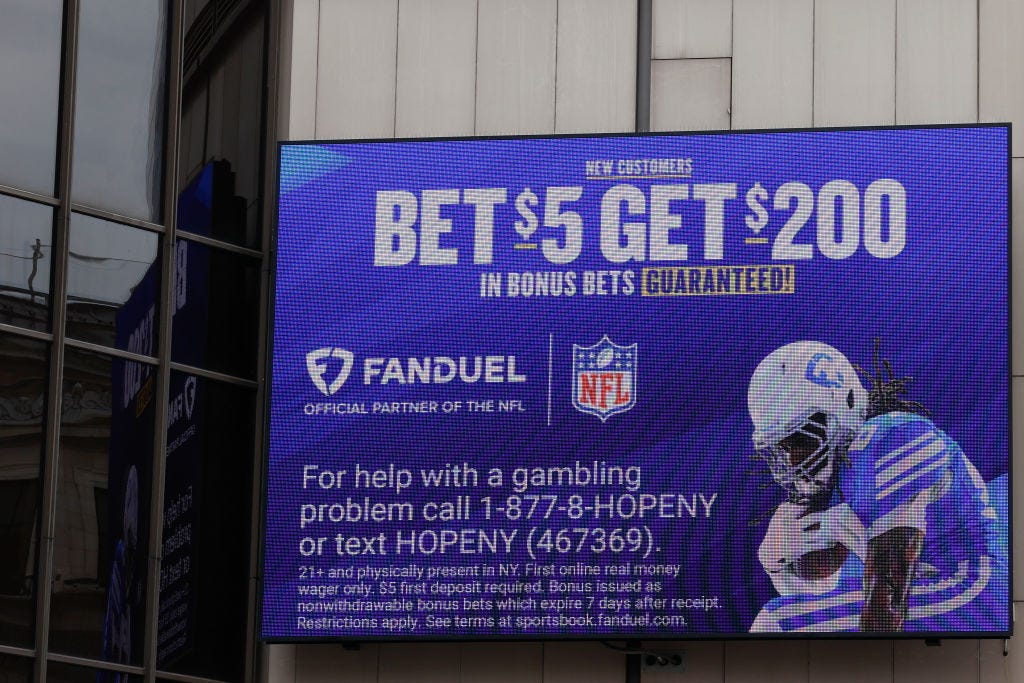
A new product liability lawsuit alleges that the online sportsbooks DraftKings and FanDuel use a variety of sophisticated tactics to addict users, comparing their offerings to tobacco, cocaine, and heroin. The case, filed by the Public Health Advocacy Institute (PHAI) at Northeastern University School of Law on behalf of two former gamblers, is being led by Richard Daynard — the same lawyer who secured a $206 billion settlement from the tobacco industry.
Filed in Pennsylvania state court, the lawsuit argues that DraftKings and FanDuel are “defective” products that are fundamentally different from traditional sportsbooks. Specifically, the plaintiffs allege that the two companies “capture every aspect of a customer’s interaction in real-time through automated analytical tools, and then process the data through predictive algorithms to generate bets that are optimized to stimulate compulsive gambling.”
When sports gambling was restricted to brick-and-mortar locations, “a person had to physically go to a casino or a sports bookmaker’s establishment with their money in hand to place their bet.” That meant gamblers were offered a limited number of bets — generally on the winner of the game or the total points scored — that had to be placed before the game started. The outcome, crucially, was decided hours later when the game concluded.
DraftKings and FanDuel, on the other hand, use advanced analytics to offer near-instantaneous real-time bets throughout every game. In a typical NFL game, for example, the companies take real-time bets on “whether the next play in the game will be a passing or running play, or whether the outcome of the next play will be yards gained, yards lost, an incompletion, a touchdown, or a turnover.”
Across all sports, DraftKings offers an average of 517 different bets per game. In-game prop bets accounted for “54% of the total amount of money wagered on the DraftKings Sportsbook App” in 2025. According to the lawsuit, these in-game betting opportunities are “intentionally designed and implemented to be as addictive as possible, to ensure that customers spend as much time as possible in the ‘dark flow’ of gambling, and to prevent customers from understanding the risk of addiction that attends these products.”
The lawsuit also names the NFL and its data partner, Genius Sports, for providing the statistics to sportsbooks that enable in-game bets.
“These defendants, including the NFL, are engaging in a coordinated effort to convert ordinary sports fans into nonstop gamblers,” PHAI Executive Director Mark Gottlieb said. “By coordinating their use of immersive marketing, AI, cloud computing, and algorithms customized for every customer, they hijack customers’ brains.”
How users get hooked
One of the plaintiffs, Christopher Sage, had been gambling on sports since 2003, when he was a senior in high school. At that time, to place a bet, he had to travel to a physical sportsbook. Sage gambled periodically on football and tennis in this way for 15 years, and it “was a sustainable recreational activity in his life that did not create any friction or problems.”
This changed in 2018, when a Supreme Court decision allowed Pennsylvania to legalize online sports gambling. Sage signed up for DraftKings and FanDuel and “became consumed by the rapid pace of the microbets and became uninterested in making a bet that did not resolve instantaneously.” He would find a tennis match and “bet on every single point.” He also placed in-game wagers on “NFL football, soccer, and baseball.” If no U.S. games were available, he would place bets on individual points of international table tennis matches.
Although he had never previously had a gambling addiction, Sage “soon found himself betting nearly 24 hours per day, 7 days a week.” If he set his phone down for a moment, the DraftKings and FanDuel apps would quickly alert him to “various betting opportunities that were personalized to him” or lure him back to the action with “various promotions, profit boosts, and customized bets.”
As a result, Sage “soon became unable to pay his bills,” and his truck was repossessed twice. Sage “started to lie to everyone in his life, including his wife, to hide the depth of his gambling addiction and scope of his financial losses.” He borrowed $40,000 from family members and another $25,000 from loan sharks. In total, Sage “made more than $1,645,000 worth of wagers on the FanDuel Sportsbook App” — almost entirely in in-game bets — and lost more than $133,000. On DraftKings, Sage bet another $360,000 and lost about $42,000.
The other plaintiff, Terry Thompson, suffered even greater losses. Thompson paired in-game betting on football games with “parlays.” In a parlay, gamblers combine various individual bets (known as “legs”) to secure a higher theoretical payoff — but must win every individual leg to win. The lawsuit alleges parlays, which are heavily promoted by DraftKings and FanDuel, are “a particularly dangerous and addictive form of gambling…because of the ‘near-miss’ effect.” Gamblers frequently believe they just missed out on a huge payday, correctly predicting, for example, three of the four legs.
A 2009 University of Cambridge study found that “near-misses” increase the desire for more gambling through the “recruitment of brain reward circuitry.” The lawsuit alleges that DraftKings and FanDuel “supercharge addiction by combining the dopamine payoffs associated with fast-resolving in-game bets with the psychological reinforcement caused by near-misses.” Parlays are particularly profitable because they rarely win, and online sportsbooks “do not increase their payouts to customers to account for the increase in the house edge.”
Thompson “placed approximately $18,500,000 worth of wagers on the FanDuel Sportsbook App, almost all of which consisted of microbets on NFL football games, resulting in a loss of approximately $1,520,000.” Thompson also placed $4.5 million in bets on DraftKings, losing about $336,000.

The VIP treatment
Both Sage and Thompson were assigned “VIP Hosts” by the online sportsbooks. These hosts employ a variety of tactics to ensure big gamblers keep betting.
Bryttanni Morgan, one of Sage’s VIP hosts on FanDuel, “would text him multiple times a week to ensure that he continued to wager,” offering “gifts, bonus bets, and other promotional perks.” If Sage lost a significant amount of money, he would “receive a commiserating text “ and “an exhortation to continue betting.” Sage’s host gave him free tickets to Phillies baseball games and even helped him plan a bachelor party in Atlantic City. Another VIP host assigned to Sage, Dyleisha Lewis, “would even send him pictures of herself while she was out and about at different sporting events, including a golf outing.” Lewis allegedly continued to contact Sage even after he put himself on the gambling self-exclusion list in March 2025.
Thompson was also assigned Bryttanni Morgan by FanDuel. According to the complaint, Morgan messaged Thompson “hundreds of times as part of FanDuel’s strategy to ensure that Plaintiff Thompson continued to gamble and lose money.” She sought to portray herself as a friend to Thompson, chatting about “their favorite restaurants and bars in the Philadelphia area and their preferred brands of tequila, travel plans, vacations, and children.”
Although her role was to keep Thompson losing money, she portrayed herself as part of his “team,” rooting for his success. “Hit a crazy one! Get us on a good roll!” she texted in November 2021. As journalist Danny Funt explained in the book Everybody Loses, winning players are kicked out of VIP programs.
In 2022, Morgan gave “Thompson and his son free tickets and hotel accommodations for Super Bowl LVI in California, including special access that allowed them to walk on the field before the game and hobnob with celebrities, including comedian Chris Rock.” In January 2023, when Thompson was on a particularly brutal losing streak and trying to cut back on his betting, Morgan told him to call her due to an “emergency.” It turned out the emergency was “yet another Super Bowl gift package that included two tickets for Super Bowl LVII in Arizona, free hotel accommodations, two tickets to a FanDuel Super Bowl party, two tickets to a Sports Illustrated Super Bowl party, and free transportation during Super Bowl weekend.” That spurred Thompson to resume betting heavily again.
Thompson ultimately took a second and third mortgage on his home to fuel his gambling addiction until he completely exhausted his family’s financial resources. In February 2026, according to the complaint, he voluntarily checked himself into a psychiatric facility.
The NFL’s role
Genius Sports, which provides data from NFL games to DraftKings and FanDuel, says its business is to convert fans into in-game gamblers. Genius Sports describes itself as “an immersive, intelligent, interactive tool to convert traditional fans into high-engagement, in-play bettors” who are “significantly more profitable for Genius and for our sportsbook partners.”
Genius Sports earns a commission on the in-game bets facilitated by its data. The company “earned $126.1 million in commissions from live microbetting in 2025.” Although many sports leagues partner with Genius Sports, the NFL is also Genius Sports’ second-largest investor.
In response to the lawsuit, the NFL, Genius Sports, FanDuel, and DraftKings have all declined to comment.
It's really rich of DraftKings and FanDuel to insist on people gambling "responsibly" when they bombard users with notifications about betting opportunities and even assign people to specific customers to target them and convince them to keep going. The NFL's partnership with and promotion of these sportsbooks also shouldn't be diminished. They are essentially serving up vulnerable individuals to these companies in the interest of profit. It's predatory behavior, pure and simple.
So terribly predatory. I’ve never found gambling appealing at all, but I know that one of my grandparents had their lives ruined because of this addiction. It’s awful that huge businesses are being built around exploiting this.