

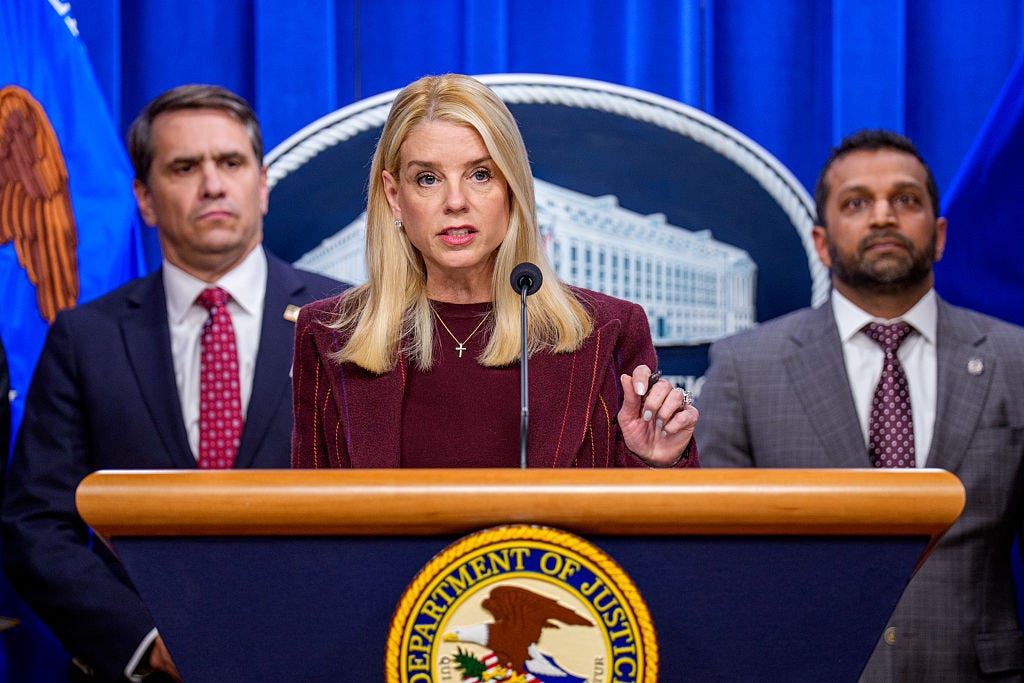
In an extraordinary letter sent to a federal judge Monday evening, Attorney General Pam Bondi admitted that the Department of Justice (DOJ) has not disclosed more than 99% of the files related to convicted sex offender Jeffrey Epstein — despite a federal law that required full disclosure by December 19, 2025.
According to the letter, the DOJ “has now posted to the DOJ Epstein Library webpage approximately 12,285 documents (comprising approximately 125,575 pages).” Meanwhile, “there are more than 2 million documents potentially responsive to the Act that are in various phases of review.” The number of undisclosed documents has nearly doubled since the last DOJ statement, on December 24, which claimed that one million Epstein-related documents had not been released.
The failure to release these documents is a violation of the Epstein Files Transparency Act, which was signed into law by President Trump on November 19. The law requires Bondi to “make publicly available in a searchable and downloadable format all unclassified records, documents, communications, and investigative materials in the possession of the Department of Justice” related to Epstein within 30 days.
The law allows the DOJ to redact records that “contain personally identifiable information of victims,” material depicting child sex abuse, and other sensitive information. Each redaction “must be accompanied by a written justification published in the Federal Register and submitted to Congress.” Many of the limited number of documents that have been released are heavily redacted. One document that was “released” is 100 blacked-out pages. But the DOJ has not provided a written justification for any redaction.
Further, 15 days after the release of the files, the DOJ is required to submit to Congress a report with a summary of all redactions and the legal justification for each redaction. Under the law, the report was due no later than January 3, 2026. The DOJ has not produced this report.
In the letter to the court, Bondi suggests that the DOJ is working as quickly as possible but there has simply not been enough time to review the Epstein files since the law was passed last year. Bondi stressed the “large volume of materials” and said that “over 400 lawyers across the Department will dedicate all or a substantial portion of their workday to the Department’s efforts” to review and release the Epstein files.
This mirrors previous statements from Deputy Attorney General Todd Blanche, Trump’s former personal attorney who is overseeing the process:

This directly contradicts Bondi’s previous claims that a review of the Epstein files — including the redaction of sensitive victim information — was initiated last February and was completed no later than July.
On February 27, 2025, Bondi released the “first phase“ of files related to Epstein. According to a press release, the DOJ said it was “committed to transparency” and would “release the remaining documents upon review and redaction to protect the identities of Epstein’s victims.” In a March 14 appearance on Fox Business, Bondi said she received a “truckload” of new documents and would “get out as much as we can, as fast as we can, to the American people.” In a March 23 appearance on Fox News, Bondi claimed “we are releasing all of these documents as soon as we can get them redacted to protect the victims.”
In an unsigned July 7 memo, the DOJ said the review of the Epstein files was complete. “As part of our commitment to transparency, the Department of Justice and the Federal Bureau of Investigation have conducted an exhaustive review of investigative holdings relating to Jeffrey Epstein,” the memo said. The DOJ described this review as exhaustive and included “digital searches of [FBI] databases, hard drives, and network drives as well as physical searches of squad areas, locked cabinets, desks, closets, and other areas where responsive material may have been stored.” As part of the review completed July 7, “[t]eams of agents, analysts, attorneys, and privacy and civil liberties experts combed through the digital and documentary evidence with the aim of providing as much information as possible to the public while simultaneously protecting victims.”
In an abrupt reversal, however, the DOJ said that “no further disclosure would be appropriate or warranted.” That remained the DOJ position until the passage of the Epstein Files Transparency Act.
On December 19, the deadline for the DOJ to release the files as required by the law, Blanche said in an interview on Fox News that the DOJ would not be meeting the deadline. “I expect that we’re going to release more documents over the next couple of weeks, so today several hundred thousand and then over the next couple weeks, I expect several hundred thousand more,” Blanche said. “There’s a lot of eyes looking at these and we want to make sure that… when we do produce the materials we’re producing, that we’re protecting every single victim.”
On December 23, Axios reported that Trump administration officials said that “about 750,000 records have been reviewed and disclosed by a team of about 200, and about 700,000 more records remain to be examined” and that “they expected to be done with the Epstein releases within a week.”
But on the following day, December 24, the DOJ posted on X that an additional million documents were uncovered. “The US Attorney for the Southern District of New York and the FBI have informed the Department of Justice that they have uncovered over a million more documents potentially related to the Jeffrey Epstein case,” the DOJ wrote. The DOJ promised to “release the documents as soon as possible,” noting that it “may take a few more weeks.”
Although the DOJ claimed in July that all Epstein-related documents were identified and reviewed, the number of unreviewed files continues to increase.
Members of Congress considering contempt charges against Bondi
If the DOJ does not comply with the law and release all the Epstein files, Trump administration officials could face inherent contempt charges. Representatives Ro Khanna (D-CA) and Thomas Massie (R-KY), who introduced the Epstein Files Transparency Act, have said they are pursuing inherent contempt against Bondi, a rarely used method for Congress to “fine or arrest and then bring to trial officers who are obstructing legislative functions.”
“The quickest way, and I think most expeditious way, to get justice for these victims is to bring inherent contempt against Pam Bondi,” Massie said in a December 21 interview with CBS’ Face the Nation. Massie said that he and Khanna were “talking about and drafting that right now.” Khanna said he believed they would “get bipartisan support in holding her accountable.”
Khanna told the Washington Post that the measure would likely “give Bondi a 30-day grace period and then start fining her daily until she released all the records.” Congress has the authority to hold proceedings and cite people for contempt. The House could approve the measure with a majority vote, and would not need Senate approval. Inherent contempt has not been used since the 1930s, according to the American Bar Association.
Bondi is an incompetent clown and a liar. Keep the pressure on.
When all else fails, go for their wallet. I support holding Bondi in inherent contempt 100%.