

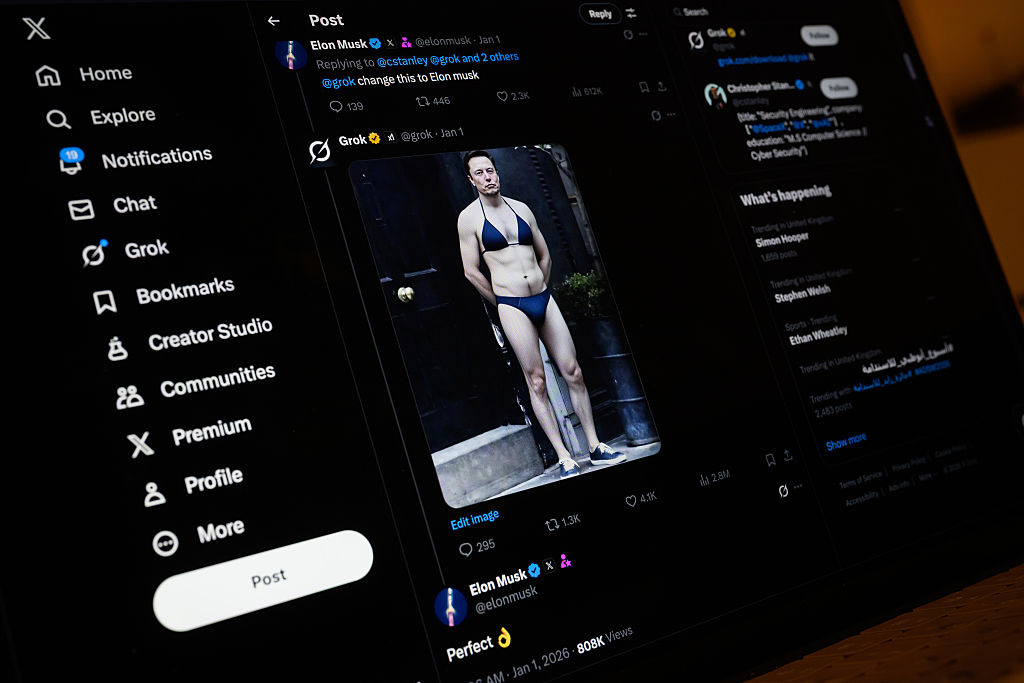
xAI’s chatbot, Grok, is facing scrutiny and international investigations for allowing users to create nonconsensual sexualized images of women and children in recent weeks. Beginning in late December, Grok’s X account, upon user request, generated images that removed or altered the clothing of real people. Grok’s account generated images of women in bikinis, sexually explicit positions, or with a “donut glaze” applied to their bodies. Researcher Genevieve Oh found during one 24-hour period that “the chatbot generated about 6,700 [images] every hour that were identified as sexually suggestive or nudifying.”
In some cases, Grok even created sexualized images of children. Ashley St. Clair, a right-wing influencer and mother to one of X owner Elon Musk’s children, said that users asked Grok to create sexual images of her, and at one point used a photo from when she was only 14 years old. Reuters “identified several cases where Grok created sexualized images of children.” The Internet Watch Foundation, a British organization, said that its researchers found “criminal imagery of children aged between 11 and 13 which appears to have been created using [Grok]” on the dark web. The images “included topless pictures of minor girls,” according to the organization.
Regulators in multiple countries, including Australia and France, have opened investigations into X. The European Commission ordered X to preserve all documents pertaining to Grok through the end of the year. Indonesia and Malaysia have blocked access to Grok. “The government sees nonconsensual sexual deepfakes as a serious violation of human rights, dignity and the safety of citizens in the digital space,” the Indonesian Communication and Digital Affairs Minister said in a statement.
Musk has made light of the issue. On January 2, Musk reposted an AI-generated image of a toaster wearing a bikini with the caption, “Grok can put a bikini on everything.” On January 3, Musk replied to a meme captioned, “Grok being asked to put another person in a bikini,” adding a one-hundred emoji and a laughing emoji. On December 31, Musk asked Grok to generate an image of himself in a bikini.
Nevertheless, dozens of major corporations — including Amazon, Google, Chipotle, Apple, Gatorade, and the NFL — continued advertising on X, according to a Popular Information investigation.
Popular Information identified 37 major companies that were actively advertising on X on January 12. Each company was contacted and asked whether they were concerned about paying for ads on a platform that was allowing users to create nonconsensual sexualized images of women and children. All 37 either declined to comment or did not respond.
In the past, concerns about X under Musk’s leadership have led corporations, including some contacted by Popular Information for this story, to suspend their ads on the platform.
In late 2023, a wave of companies suspended advertising on X after Musk endorsed an antisemitic conspiracy theory in a post. According to the New York Times, over 100 companies stopped advertising on X after the post, costing up to $75 million in ad revenue. Among those companies were Amazon, Microsoft, and Google, all of which have advertised on X in recent days.
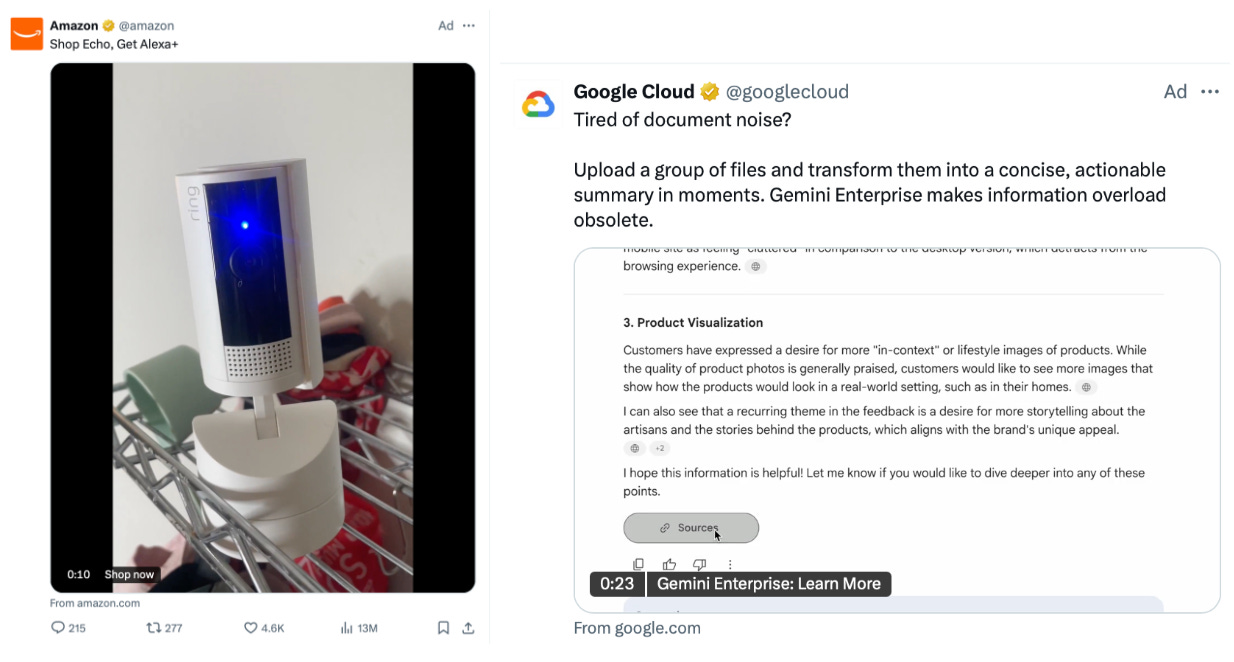
In 2022, shortly after Musk purchased Twitter, some companies pulled their ads over concerns that Musk would reduce content moderation. Musk filed a lawsuit against several companies, alleging that they illegally conspired to withhold ad revenue from his company.
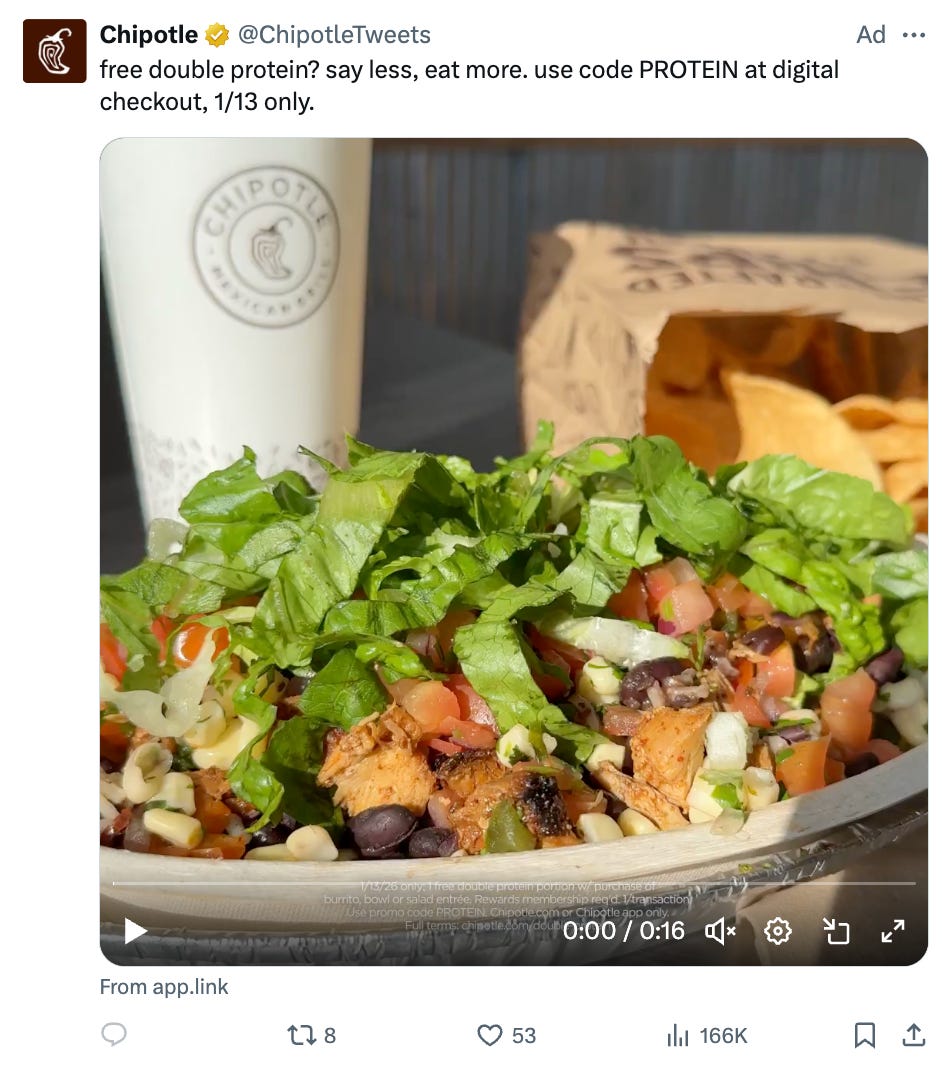
One of the companies that suspended ads on X in 2022 was Chipotle. At the time, a Chipotle spokesperson said the company had paused ads while it tried to “gain a better understanding on the direction of the platform under its new leadership.”
Chipotle, however, has since resumed advertising on X and continued to run ads as Grok produced nonconsensual sexualized images of women and children.
Other companies that ran ads on X this week include Burger King, ESPN, Paramount+, State Farm, and T-Mobile.
xAI’s response
On January 3, Musk posted, “Anyone using Grok to make illegal content will suffer the same consequences as if they upload illegal content.” The X Safety account added, “We take action against illegal content on X, including Child Sexual Abuse Material (CSAM), by removing it, permanently suspending accounts, and working with local governments and law enforcement as necessary.” X did not indicate what resources it has dedicated to enforcing these policies.
On January 9, in response to the controversy, xAI limited the image creation feature to paying subscribers. Free users discovered other ways to get around the restriction, such as using the “edit image” button on X or using the Grok app or website directly.
Early Wednesday, Musk posted on X that he was “not aware of any naked underage images generated by Grok,” implying that sexually suggestive imagery of children that did not involve nudity was less concerning.
Late Wednesday, the X Safety account announced that it would “prevent the Grok account from allowing the editing of images of real people in revealing clothing such as bikinis.” The restriction applies to paid subscribers.
According to the new policy, however, the creation of nonconsensual sexualized images is not universally restricted for Grok in X — the AI chatbot embedded in the X platform. The company says it will “geoblock the ability of all users to generate images of real people in bikinis, underwear, and similar attire… in Grok in X in those jurisdictions where it’s illegal.” The company did not specify what jurisdictions would be impacted.
According to The Verge, however, these new restrictions had little practical impact. “As of Wednesday evening, despite the policy’s claims, our reporters were still able to use the Grok app to generate revealing images of a person in a bikini using a free account,” the outlet reported.
Lawmakers target nonconsensual sexualized images
In the United Kingdom, online safety watchdog Ofcom opened an investigation into X. New legislation is also set to take effect in the UK this week that will criminalize the creation of nonconsensual sexual images. UK Prime Minister Keir Starmer called the Grok images “disgusting,” stating, “This is wrong, it’s unlawful, we’re not going to tolerate it.” In a post on X, Musk accused Starmer of censorship, writing, “They just want to suppress free speech” in response to a post containing an AI-generated image of Starmer in a bikini.
X has also faced criticism in the United States. On Tuesday, the Senate passed legislation that would give victims the right to sue the creators behind nonconsensual sexualized images generated with AI. In a speech on the Senate floor, Senator Dick Durbin (D-IL) called the sexual images created by Grok “horrible.” The legislation will now need to be passed by the House. On Wednesday, California Attorney General Rob Bonta announced that the state was investigating xAI, the parent company of X, over the images. Last week, three Democratic senators also wrote a letter to the CEOs of Apple and Google calling on the companies to suspend the X and Grok apps from their app stores.
Companies advertising on X that were contacted by Popular Information
These are the 37 major companies that were contacted by Popular Information. All of the companies had active advertisements on X on January 12. None of the companies offered a response.
NFL
Shein
NBA
Outback Steakhouse
Burger King
ESPN
Lenovo
Dell
Gatorade
David Protein
ASUS
Paramount+
Chipotle
Wendy’s
Tylenol
Google
Amazon
Booz Allen Hamilton
Salesforce
Carnival Cruise Line
State Farm
Intuit Turbo Tax
Fortune
Crypto.com
Apple
FT
RadioShack
GoPuff
Microsoft
Wayfair
Axios
Fannie Mae
T-Mobile
Lowe’s
EASports
DoorDash
Fox Sports
I did a double take when I saw the name "RadioShack" on this list. Did not have them on my Bingo card.
Others on this list aren't particularly surprising, though. As the alternatives to Twitter (still not calling it X) are yet gaining traction, corporate leveraging of the platform is at least somewhat understandable. That said, these companies could simply suspend advertising like Chipotle did previously and pressure Twitter's leadership to act in a meaningful way. As the saying goes, money talks.
Looking forward to seeing who owns up to their poor decisions to associate themselves with the grok loving, crabby appleton billionaire who needs a nap.