

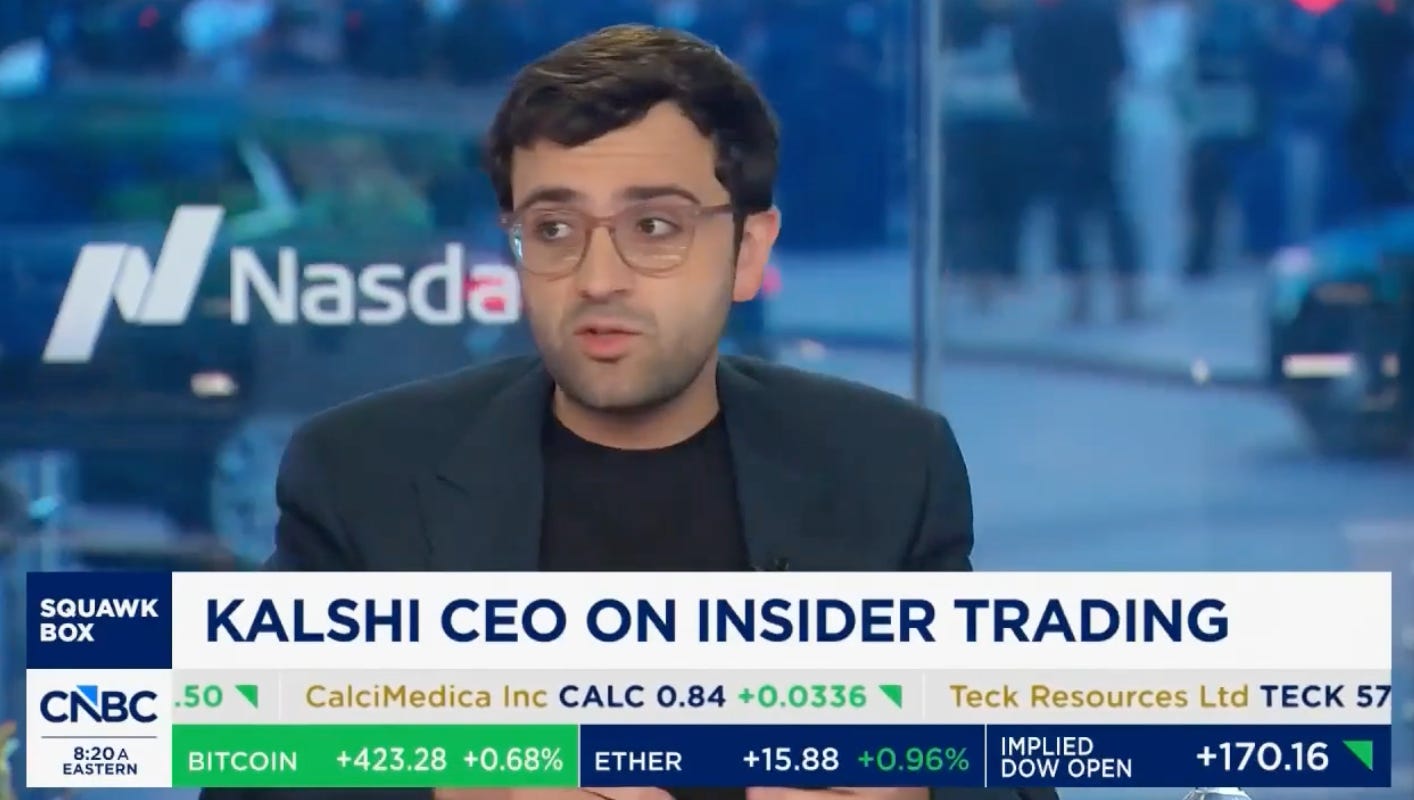
On Monday, a joint investigation by Popular Information and Public Notice revealed that Kalshi has been heavily promoted by CNN and CNBC since Kalshi inked a financial partnership with both networks in December. The existence of this financial relationship, however, is inconsistently disclosed to viewers.
CNN’s response was included in the initial article. But after the story was published and spread rapidly on social media, Kalshi and CNBC also weighed in.
All three responses had one thing in common: they argued that Kalshi prediction markets are newsworthy, like other data included in journalism. CNN said that Kalshi data is “a complement to other reporting and data sources.” CNBC said that Kalshi data is “part of the broader set of market indicators.” Kalshi said, “in a world of echo chambers and clickbait, wisdom-of-the-crowd data can add additional context and perspective.”
This raises the question: if this data is being featured because of its news value, why does Kalshi need to pay CNN and CNBC to feature it?
Kalshi data is public. In the absence of a deal, there is nothing preventing CNN or CNBC from including it in their broadcasts. It only makes sense for Kalshi to pay CNN and CNBC if that secures more coverage than the networks would otherwise provide. Kalshi hinted at this in its statement, saying the deal with CNN includes “featuring our odds on Harry Enten’s show, along with other mentions across their programming” and the deal with CNBC provides “integration across their platforms, including a dedicated CNBC curated page on Kalshi.”
The CNN deal is exclusive, meaning CNN cannot mention Polymarket odds, even though Polymarket generally has more robust markets outside of sports.
Contrast this arrangement with how CNN reports on polling, which prediction market coverage generally supplements or replaces. CNN regularly reports on polls produced by companies without any kind of financial relationship because these polls are genuinely considered newsworthy. It is also free to report on polls from any source, not just one favored polling firm that pays CNN a fee.
CNBC discloses its financial relationship with Kalshi when it is “directly relevant to the story.”
The investigation by Popular Information and Public Notice documented more than 20 occasions where CNBC covered Kalshi on air or on its website but did not disclose their financial relationship. The deal between Kalshi and CNBC is extensive. CNBC invested in Kalshi and also receives a fee when it refers new users.
In response, CNBC says it “discloses commercial relationships when they are directly relevant to the story.” It defended the omissions, arguing that in those cases disclosure was not relevant
It is a puzzling position, because CNBC has included its disclosure in pieces that are substantively identical to pieces where the disclosure is omitted. For example, “As SpaceX IPO nears, traders think it’s a near-certainty Musk becomes the first trillionaire,” published May 29, includes the disclosure “CNBC and Kalshi have a commercial relationship that includes customer acquisition and a minority investment.” But “SpaceX won’t reach Mars this decade, Kalshi traders say,” published June 15, does not.
Similarly, “Nearly 40% chance of stagflation by end of 2026, traders say,” published May 14, includes the disclosure. But “Inflation peaked in May as energy prices fell in June, Kalshi traders think,” published July 1, does not.
Asked to clarify how CNBC determines when its financial deal with Kalshi is “relevant” to its audience and who makes that determination, the network did not respond.
According to Kalshi’s statement, “People aren’t dumb; they hear and see these disclosures and can choose to use our data as added context or choose not to.” Kalshi did not address the numerous documented cases where the relationship between Kalshi and cable networks was not disclosed.
Everything is for sale. News, the World Cup, the White House.
The worst thing is that organizations like Kalshi try to make it seem like you’re the one in the wrong if you have a problem with this scenario.
It is the “I’m a lowlife so therefore everyone must be.” defense.
According to Kalshi’s statement, “People aren’t dumb; they hear and see these disclosures and can choose to use our data as added context or choose not to.”
🤔actually people are dumb… politicians and corporations have long known this, so… a wink 😉 + a nod 🫨 will suffice.