

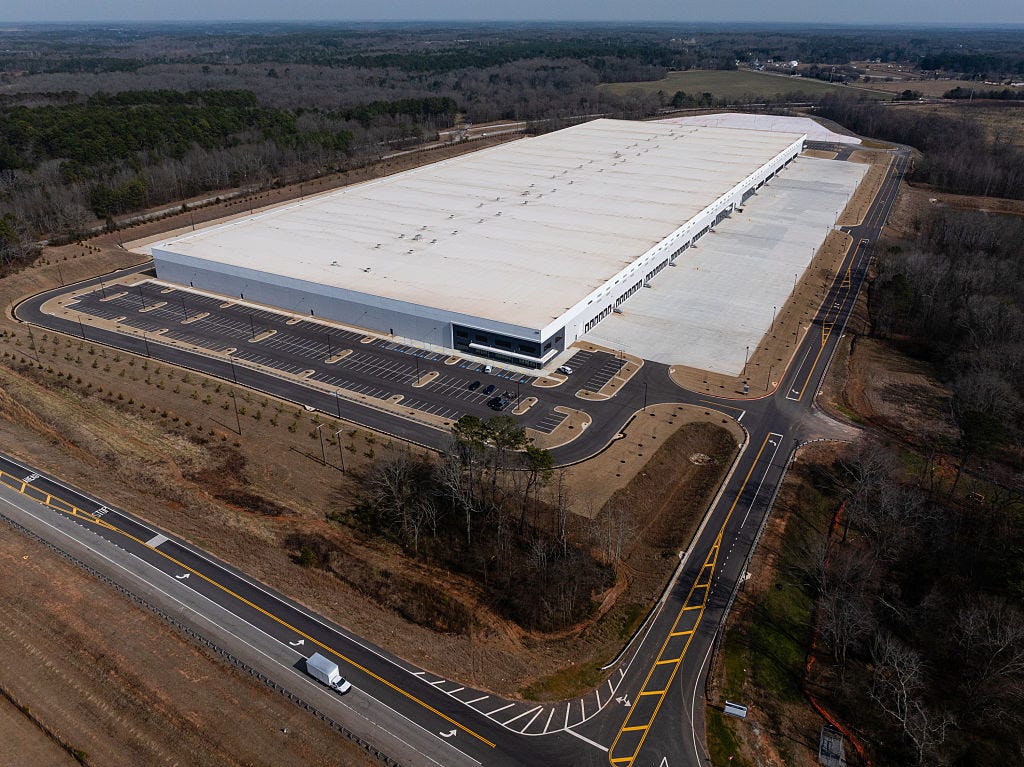
Across the country, local and state officials are fighting to prevent U.S. Immigration and Customs Enforcement (ICE) from turning local warehouses into sprawling detention centers to support the Trump administration’s mass deportation agenda.
The most powerful weapon in their arsenal? Water.
Over the last year, the number of people in ICE custody skyrocketed. According to a January report from the American Immigration Council, there are 75% more people in ICE detention on a given day than there were at the start of 2025. And although a smaller percentage have criminal records, fewer of those in custody are being released on bond.
The warehouses ICE is buying up are meant to help the agency keep up with its huge influx of detainees. But a warehouse and a facility where up to 10,000 people will live 24 hours a day are very different. A warehouse ICE purchased in Roxbury, New Jersey, for example, only has four toilets, one urinal, and five sinks. It is supposed to be converted into a facility that will hold 1,500 people. As detention facilities, these converted warehouses will need far more power, sewage treatment, and water.
ICE has claimed it conducted “thorough due diligence” to ensure that surrounding communities were equipped to provide the warehouses with necessary utilities and infrastructure. In at least three states, however, officials say that the new ICE facilities will overwhelm local water and sewage infrastructure or damage the local environment.
So, they are shutting off the water.
Upper Bern and Tremont Townships, PA
Shortly after ICE purchased two warehouses in small Pennsylvania towns in early February, Governor Josh Shapiro (D) sent a letter to then-Homeland Security Secretary Kristi Noem promising that his administration would “aggressively pursue every option to prevent these facilities from opening.”
Shapiro’s letter was accompanied by another letter from state health, environmental, and emergency response officials outlining the harm that the ICE facilities could cause in Upper Bern Township and Tremont Township, with populations of 1,600 and 300, respectively.
The Tremont facility previously used under 8,000 gallons of drinking water per day, but ICE’s plan for a 7,500-person detention facility would require an estimated 800,000 gallons per day. The total capacity of the Schuylkill County Municipal Authority’s water system — which serves Tremont and other nearby towns — is just one million gallons per day. The Schuylkill County area has experienced extreme drought in the last few months, meaning its water supply is already stretched thin, and the state has had to issue several emergency permits allowing more water to be hauled in.
Sewage at the Tremont facility poses similar problems. The warehouse was initially approved for just 6,000 gallons of sewage per day, but Pennsylvania officials estimate the ICE facility would produce hundreds of thousands of gallons per day.
The Upper Bern Township facility is a 1,500-person processing facility meant to hold detainees for just a few days. But officials in Pennsylvania say it will cause similar water and sewage problems.
As a result, Pennsylvania’s Department of Environmental Protection sent five administrative orders to ICE stating that ICE’s current plans would violate state water and sewage regulations. As a result, water and sewer service will not be provided, and ICE cannot proceed with converting the warehouses until they comply with state law.
These orders, issued on March 6, gave ICE a 20-day deadline to show the state its plans for providing drinking water and disposing of sewage without overburdening local infrastructure. In theory, ICE should already have these plans completed. However, the agency recently asked Pennsylvania for an extension, saying it will not have completed water and sewage plans until the end of April.
Until then, the warehouses remain closed.
Social Circle, GA
When ICE purchased a warehouse in December 2025 in Social Circle, Georgia — a small town outside of Atlanta with a population of just under 5,500 — city leaders did not learn of the purchase until reporters asked about it.
The planned detention center, which could hold up to 10,000 detainees and employ 2,500 people, would triple the local population, overwhelming local water and sewage systems.
City leaders have shut off water and sewage at the warehouse and padlocked the water meter. “The lock is there until ICE indicates how water and sewer will be served without exceeding our limited infrastructure capacity. The City of Social Circle is not satisfied that an adequate engineering analysis has been conducted,” City Manager Eric Taylor said.
Social Circle currently has the capacity to treat 1.25 million gallons of wastewater per day, and an ICE document shared by the city indicates that ICE expects the detention facility to produce 1 million gallons of wastewater per day. In the document, ICE says that this is not a problem because Social Circle is planning to build another three-million-gallon treatment plant — but this plant has not been built, and accelerating the construction would come at a huge cost to the city.
“If DHS intends to rely on this future facility to meet the demands of its project, the question remains whether it plans to assist in alleviating the significant financial burden associated with accelerating or expanding that infrastructure,” city leaders have said.
Social Circle is primarily in Walton County, Georgia, which voted overwhelmingly for President Trump in 2024.
Salt Lake City, UT
In late March, the Salt Lake City council voted unanimously to alter city ordinances to prevent new nonresidential developments from using more than 200,000 gallons of drinking water per day.
This new rule will directly impact a warehouse in the city that ICE purchased earlier in the month to turn into a detention center that could hold up to 10,000 people. Salt Lake City officials estimate that such a facility could use up to two million gallons of drinking water per day. Previously, the warehouse used less than 6,000 gallons per day.
The new water use limit came after Salt Lake City Mayor Erin Mendenhall vowed to “use every tool at the city’s disposal to stop [the ICE facility].” But city officials also say that the ordinance is as much about protecting the city’s water resources as it is about opposing ICE.
Salt Lake City, with a population of over 200,000, is much larger than Social Circle and Upper Bern and Tremont Townships. So the new ICE facility will not necessarily exceed the capacity of the city’s water or sewage systems.
However, Salt Lake City is facing a water crisis. The region received very little snow over the winter and faced record-breaking high temperatures in March, causing the city to issue a stage 2 drought advisory the week before voting to limit water use by new developments. As a part of the drought advisory, the city is aiming to reduce water usage by 10 million gallons per day.
Mendenhall said she met with ICE to discuss how they would mitigate the environmental impacts of the facility, and they were unable to provide a clear plan.
“They indicated they are waiting for a due diligence report on their recently acquired parcel of land,” she said. “They did not provide information about the anticipated environmental and traffic impacts to the area, nor did they have specific information on utility needs for the site.”
Absolutely shocking that these tentative detention centers, on top of being an emblem of a cruel Trump presidency, would be poorly thought-out as well. This administration is so detail-oriented. *dies of sarcasm*
The due diligence of ice is comparable to the due diligence of the Republican parties over the years. It appears the Republicans are short-sighted when it comes to long-term planning. Who knew not keeping utilities up and Roads paved would be a problem later on.