

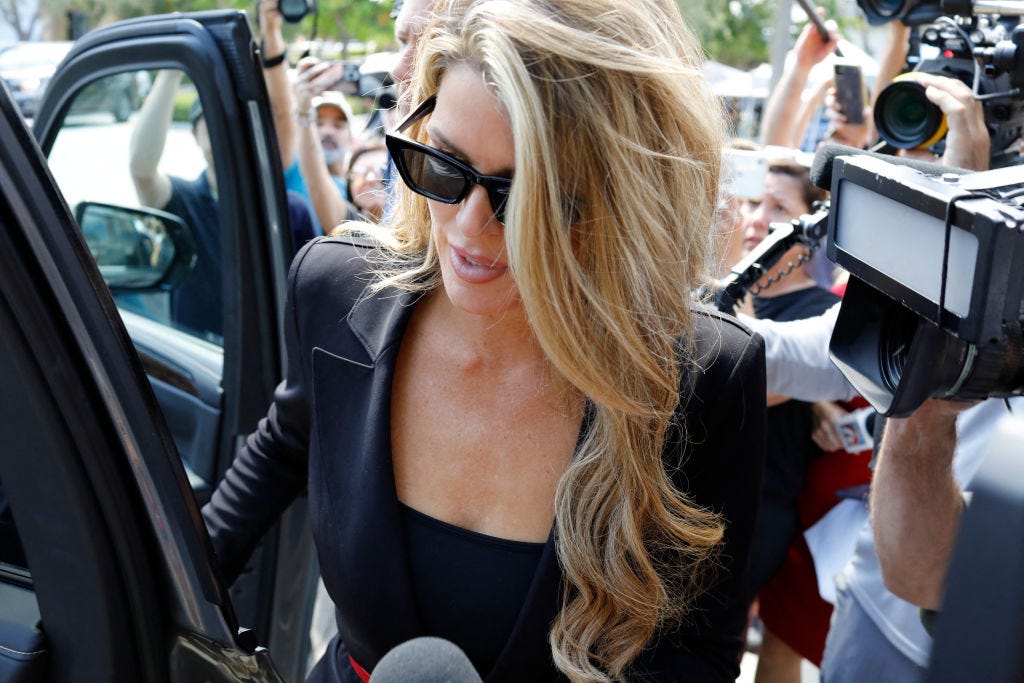
Lindsey Halligan, a 2013 graduate of the University of Miami Law School, has extensive experience as an insurance lawyer. From 2014 to 2022, the 36-year-old practiced at Cole, Scott & Kissane, a large firm based in Ft. Lauderdale, where she defended insurance companies in cases involving fire, water damage, vandalism, and theft.
In November 2021, Halligan met President Trump at his golf club in Palm Beach and was recruited to join Trump’s legal team. In that role, she sued CNN on Trump’s behalf, arguing that calling Trump’s false claim that he won the 2020 presidential election the “Big Lie” was defamatory. Halligan was also part of the team defending Trump against charges of mishandling classified documents.
When Trump returned to the White House, Halligan joined his administration, taking on a variety of tasks, including leading the effort to purge “woke” ideology from the Smithsonian.
Halligan has no experience, however, in prosecuting federal crimes. Nevertheless, on September 23, Trump appointed Halligan as interim U.S. Attorney for the Eastern District of Virginia.
Two months later, Halligan finds herself in hot water.
Trump appointed Halligan to the role because he was desperate to find someone to indict former FBI Director James Comey and other political enemies. Comey drew the ire of Trump for his role in investigating Russia’s interference in the 2016 presidential election.
The problem for Halligan was that the basis for the charges against Comey was very weak. Her predecessor, Erik Siebert, resigned rather than indict Comey and another Trump antagonist, New York Attorney General Letitia James. Halligan, on the other hand, is a loyalist.
In an effort to quickly deliver exactly what Trump wanted, Halligan submitted an indictment to the court that the full grand jury had neither seen nor voted on. It is an extremely rare form of misconduct, but other lawyers who have engaged in similar acts have been suspended, disbarred, and criminally charged.
The legal requirements for a valid grand jury indictment
Under federal law, to prosecute someone for a felony, you must obtain an indictment from a grand jury. It is spelled out in the Fifth Amendment to the Constitution: “No person shall be held to answer for a capital, or otherwise infamous crime, unless on a presentment or indictment of a grand jury…”
A federal grand jury consists of 16 to 23 people. To return a valid indictment, at least 12 people must “concur” with the indictment. While the grand jury foreperson can sign the indictment on behalf of the jury, the indictment is the record of an actual vote.
The case against Comey
Halligan appeared before the grand jury on September 25 and presented an indictment charging Comey with three counts.
The first count accused Comey of making a false statement to Congress. This involved Comey answering a question from Senator Ted Cruz (R-TX) in a September 30, 2020, Senate hearing about whether he had ever authorized anyone at the FBI to leak information about the investigation into Russian interference in the 2016 presidential election. Comey said he stood by his earlier 2017 testimony, in which he denied the allegation.
It’s unclear exactly which purported leak Cruz was asking about. But Comey did authorize his friend, Columbia Law Professor Daniel Richman, to share Comey’s personal diaries about his interactions with Trump with the New York Times in 2017. Richman had no association with the FBI at the time.
The second count accused Comey of obstructing a federal proceeding, presumably based on the same facts that underpinned the first charge.
The third count accused Comey of making a false statement to Congress when he was asked by Senator Lindsey Graham (R-SC) if he remembered receiving a tip from the intelligence community that Hillary Clinton’s 2016 campaign “was going to create a scandal regarding Trump and Russia.” Comey responded, “That doesn’t ring a bell.”
Whatever evidence Halligan presented to the grand jury involving Comey’s response to Graham was not convincing. According to Halligan, the grand jury approved the first two counts but rejected the third. So the original three-count indictment was rejected.
Halligan’s big mistake
If Halligan’s story is accurate, she should have presented the grand jury with a new indictment containing only the two charges they supposedly supported. But she did not do that.
Instead, she prepared a new indictment with only two counts and had the foreperson of the grand jury sign it in the presence of only one other grand jury member. Halligan admitted in court yesterday that the full grand jury did not see or vote on the new indictment.
“If this procedure did not take place, then the Court is in uncharted legal territory in that the indictment returned in open court was not the same charging document presented to and deliberated upon by the grand jury,” Magistrate Judge William Fitzpatrick wrote in an earlier ruling. Fitzpatrick suspected the grand jury was not presented with the new indictment based on how quickly it was provided to the court after the original three-count indictment was rejected.
Time was of the essence because the five-year statute of limitations on Comey’s testimony expired on September 30, 2025.
What happens to attorneys who present altered grand jury indictments to a court
Submitting an indictment that has not actually been approved by a grand jury does not happen often. But, when it does, the consequences for the lawyers involved are severe.
In 2010, an assistant county prosecutor in Ohio, Jason Phillabaum, reviewed an indictment that charged a man with felony assault and aggravated robbery. Phillabaum noticed that the indictment failed to include a charge for using a gun during the robbery. Rather than take that charge back to the grand jury, he had a legal assistant add the gun charge to the original indictment. He then signed it.
Phillabaum was criminally charged in 2012 “for forgery, dereliction of duty, tampering with records, interference with civil rights and using a sham legal process.” He ultimately pled guilty to one count of dereliction of duty and was sentenced to 90 days in jail. (That sentence was suspended contingent on Phillabaum’s successful completion of community service and probation.) In 2015, Phillabaum’s law license was also suspended for one year.
In 1993, a county district attorney in Oregon, Julie Ann Leonhardt, convened a grand jury in a case involving police misconduct by two officers. Leonhardt did not present any evidence to the grand jury, but told them that an individual named Scott Thompson said the officers attempted to enlist him in the sale of drugs.
The grand jury returned an indictment against the officers based on Leonhardt’s claims. After the indictment was signed by the jury foreperson, Leonhardt had her staff add in “Scott Thompson by affidavit” in the witness section. The change made “it appear that the indictments were based on a written, sworn statement from a witness, Scott Thompson.”
But the grand jury never saw that change to the indictment or any sworn statement from Thompson. Leonhardt then submitted the indictment to the court.
Leonhardt, who was also accused of some unrelated misconduct involving her boyfriend, was disbarred.
If only loyalism to Trump had consequences for the man himself. Oh, well. For her flagrant violation of the Fifth Amendment, Halligan deserves to be held accountable.
Accountability is something absent with this group of loyalists. Judd thanks for a clearer more factual reporting than I’ve seen by anyone. The
Truth sends waves of opposition against those who lie.