

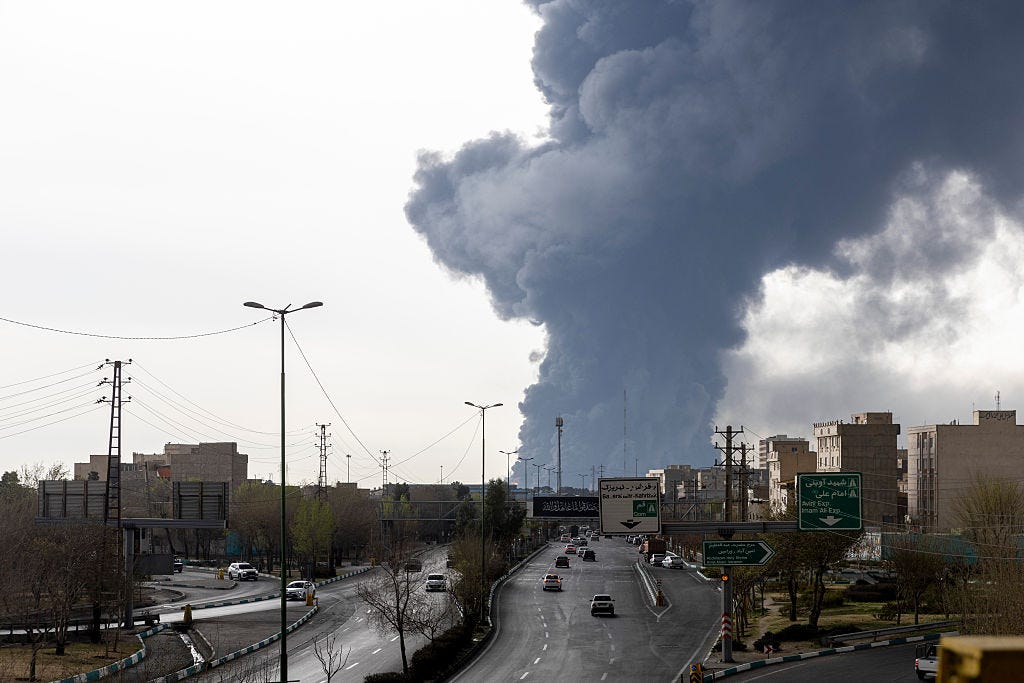
Testifying before the House Appropriations Committee last week, Director of the Office of Management and Budget Russell Vought said the US had spent $30 billion on the Iran War. The real cost is over $100 billion.
The Trump administration has offered Congress lowball war cost estimates before. On May 12, Pentagon comptroller Jay Hurst, testifying alongside Secretary of War Pete Hegseth, said the war had cost $29 billion. On April 29, Hurst said it was $25 billion. Despite repeated congressional requests, neither Hurst nor Hegseth has provided supporting documentation for the estimate. Vought hasn’t either.
The Trump administration itself has admitted that the war has cost far more than $30 billion. On June 24 — a week before Vought’s testimony — the White House formally requested $88 billion in supplemental funding from Congress, including $72 billion for the Iran War. No doubt Vought was aware of this funding request; after all, he wrote it — his signature appears on the second page.
Throughout the conflict, the cost of the Iran War has been habitually understated. Establishment media have parroted Hegseth’s defactualized cost estimates and similarly low estimates from establishment think tanks. The estimate that came closest to the Trump administration’s requested $72 billion for the war came from Popular Information. In May, we estimated the Iran War had cost $71.8 billion.
But that estimate was just for the war’s first 60 days, and the Trump administration plans on funding additional war costs through another reconciliation bill. In short — not all war costs are accounted for in that $72 billion figure. Another cost assessment is needed.
Despite de-escalation, costs continue to mount
Through four months, the US has spent more than $103 billion on the Iran War — larger than all but three countries’ military budgets. The figure refers only to direct war costs — the immediate budgetary costs directly tied to the war, including operations, personnel, and matériel.
This table provides an overview of the $103 billion in direct war costs incurred from February 28 to June 27, 2026.
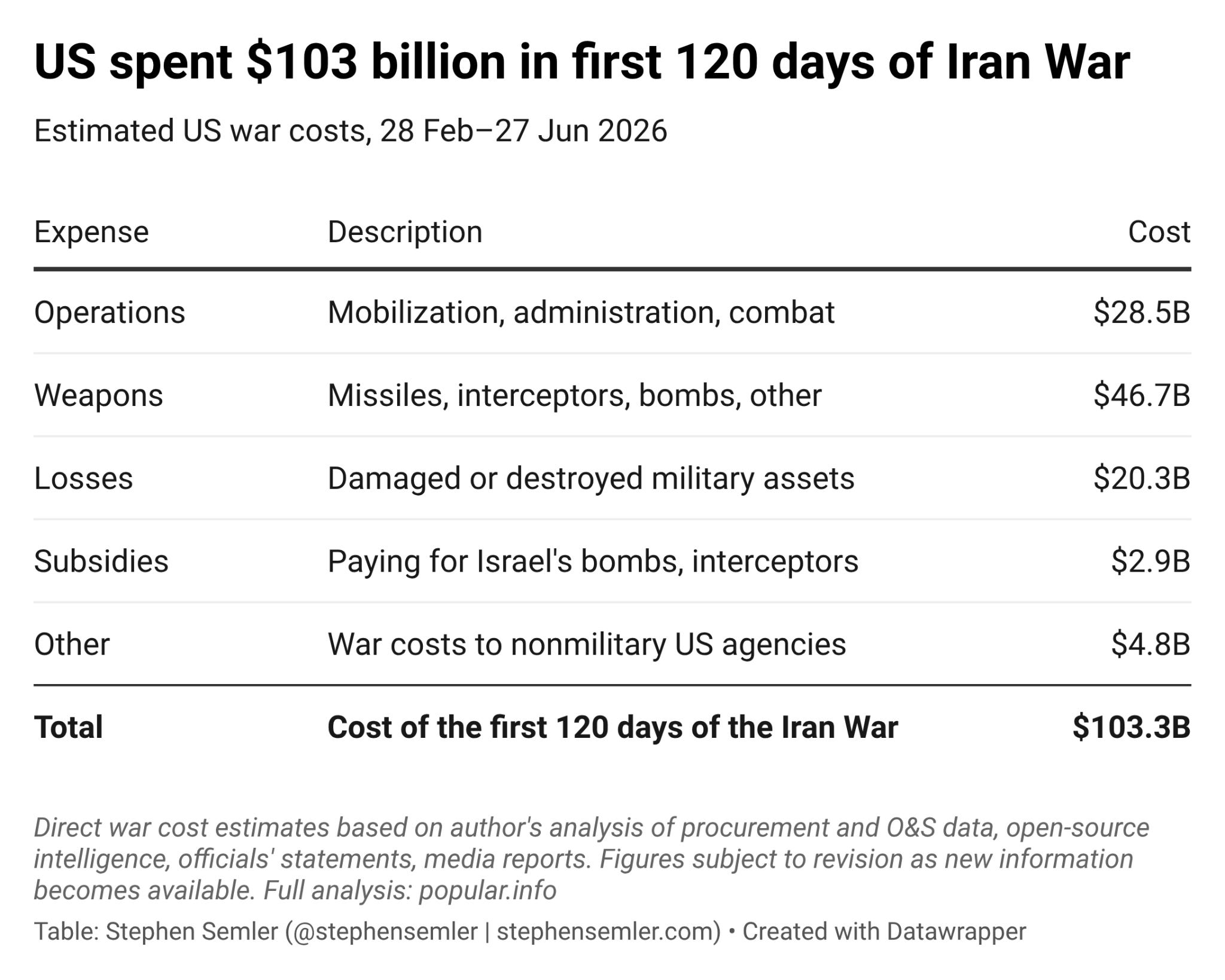
Despite a lack of full-scale conflict, the US accrued $31 billion in war costs from days 60 to 120. Costs stem from US forces maintaining a wartime posture in the Middle East, enforcing a blockade of the Strait of Hormuz (after Iran had already shut down the Strait), and firing hundreds of munitions, including at least 49 Tomahawk cruise missiles during the June 10 strikes alone (FY2027 unit cost: $3.7 million). Iranian drones and missiles have inflicted additional damage to US military bases in the region and destroyed more US military equipment.
Other cost increases are related to data availability: New satellite imagery has revealed far more extensive damage to US military bases than previously known. (Under government pressure, US satellite imagery companies like Planet Labs have withheld imagery of large swaths of the Middle East, concealing damage to US military property.) The Trump administration’s supplemental funding request disclosed war costs incurred by nonmilitary US agencies, including for the State Department — $1.9 billion for diplomatic protection, civilian evacuation, embassy fortification, and equipment replacement — and the Department of Homeland Security — an additional $2 billion for operational costs incurred by the Coast Guard in assuming roles vacated by US military units to fight in the Iran War.1
Neither the Trump administration nor congressional Republicans have a plan to “pay for” the Iran War, either through a commensurate increase in taxes or reduction in spending.
Apparently, they don’t believe they ought to. “War is never paid for when you fight it,” House Appropriations Committee Chair Tom Cole (R-OK) said in a March interview. “We didn’t pay for World War II or Korea or World War I ... so I don’t think [the cost of the Iran war] should be offset.”
Rep. Cole is wrong. Taxes were levied in 1914, 1916, 1917, and 1919 to fund World War I; in 1940, 1941, 1942, and 1944 for World War II; and in 1950 and 1951 for the Korean War. Cutting taxes during major conflicts and financing them with the national debt is a post-9/11 contrivance, unique to the US wars in Afghanistan, Iraq and now Iran. “How do you pay for it?” is a question imposed on many policies, but war is not one of them.
Interest on the national debt is an example of the Iran War’s indirect costs, which cover broader budgetary and economic costs like veterans care and inflation. Incorporating the full spectrum of war costs sends the Iran War’s total beyond $1 trillion over the next decade, according to Harvard University professor and public finance expert Linda Bilmes. Meanwhile, establishment media outlets like the New York Times are reporting $132 billion in combined direct and indirect war costs, not much higher than our $103 billion estimate for only the direct costs.
The $103 billion in direct costs itemized above has gone to what has become the most unpopular US war in history. Few Americans believe the Iran War is worth the cost.
A detailed methodology for the $103 billion estimate is available HERE.
Suggested citation: Popular Information, “The real cost of the Iran War: $103 billion in 120 days,” Stephen Semler, July 8, 2026, https://popular.info/p/cost-of-iran-war-120-days
War cost estimates from establishment think tanks tend to largely omit operational costs, claiming that nearly all the war’s operational costs are already budgeted for. They are not. If they were, the Trump administration’s supplemental funding request wouldn’t include more than $20 billion for operational war costs in 2026 (including “$17.3 billion for Operational Costs” for the War Department), nor would the Pentagon’s CFO have said in April that the Trump administration’s $1.5 trillion military spending request for 2027 excludes any funding for the Iran War.

It's just astounding to me how we can insist that children show their work when solving math problems, but we can't compel the Department of War to show their work in justifying a $30 million price tag for Iran after requesting an additional $88 million in funding. Evidently, we have some adults in the Trump administration who need to go back to grade school.
What an excellent and well researched article. I was a career senior budget analyst in the Pentagon so I have been very curious about what not only this war, but the entirety of the DOD’s expenditures have been. There has never been a darker screen over the visibility of expenditures. I’m retired now but during my career, Congress was intimately involved in all of the financial and operational aspects of DOD. Our country’s resources are being bled dry. I appreciate all of the analytical work behind your article.