

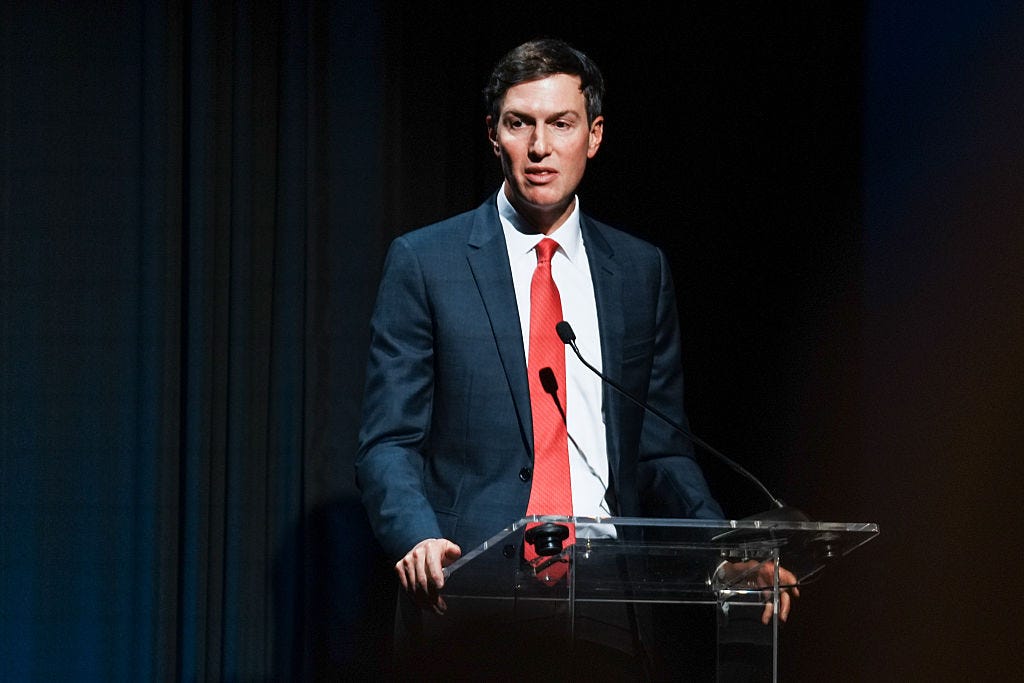
Jared Kushner, President Trump’s son-in-law, has represented the United States in high-stakes negotiations involving nearly every major foreign policy issue of Trump’s second term — including Iran, Ukraine, and Gaza. Simultaneously, Kushner has collected untold millions in fees from Middle Eastern governments in his role as the founder of Affinity Partners, a private equity firm.
How is it legal for someone representing the United States in foreign policy negotiations to be on the payroll of foreign governments? It’s not.
The Foreign Emoluments Clause prohibits any officer of the United States from accepting “any present, Emolument, Office, or Title, of any kind whatever, from any King, Prince, or foreign State.” This is likely why, prior to Trump returning to the White House, Kushner pledged not to be involved in any “foreign policy work” in a second Trump administration. “I served in government, and I think my track record is pretty impeccable,” Kushner told Axios’ Dan Primack in February 2024. “Now I’m a private investor.”
Kushner quickly broke that pledge. He maintains that his conduct is legal because he is not working for the government at all. The Trump administration calls him a “volunteer” and argues the legal restrictions on government officials do not apply to him.
This argument is not credible. According to the Department of Justice’s Office of Legal Counsel (OLC), an individual’s status is not definitively determined by whether there was an official appointment. Rather, anyone “quite clearly engaging in a governmental function” and “working under the direction or supervision of the President” is a government employee. Kushner clearly meets that standard. Kushner has also declined to file the standard financial disclosure required of senior government employees.
Kushner’s decision to disregard legal requirements and remain on the payroll of foreign governments is one of the most egregious conflicts of interest — and corruption scandals — in American history.
Democrats in the House and Senate have repeatedly requested Kushner appear under oath and testify about his conduct. But, lacking a majority in any committee, they were effectively powerless to do so. In a March 16 letter, for example, Democrats on the House Foreign Affairs Committee asked Trump to direct “Jared Kushner to appear before the House Foreign Affairs Committee for a public hearing at the earliest possible opportunity.” Trump simply ignored the request.
Now, the balance of power in Washington has changed.
In 2027, Democrats will take control of the House and Senate, giving them subpoena power. That gives them a number of options to hold Kushner accountable.
Subpoena Jared Kushner
Democrats, once the new Congress is sworn in, will have a majority in every committee of the House and Senate. This will give Democrats the ability to issue a congressional subpoena compelling Kushner to testify under oath.
Kushner would likely attempt to fight such a subpoena but, ironically, his insistence that he is merely an informal “volunteer” would make it more difficult for him to prevail. The president cannot be required to testify before Congress. As a result, the Department of Justice (DOJ) says that the president’s “immediate advisers“ are also immune from testimony.
An “immediate adviser,” however, is defined by the Justice Department “as the President’s alter ego, assisting him on a daily basis in the formulation of executive policy and resolution of matters affecting the military, foreign affairs, and national security and other aspects of his discharge of his constitutional responsibilities.” In other words, not just a government official but among the most important officials in all of government.
The administration has spent the last two years arguing that Kushner is the opposite — a volunteer with no formal government role. It is impossible to simultaneously argue that Kushner is such an essential part of the government that he cannot be compelled to testify but also not part of the government at all. (Although Kushner doesn’t qualify under the DOJ’s standard, two federal courts have rejected the DOJ’s standard as overly broad, finding that “presidents are not kings.”)
Even if, somehow, courts determined that Kushner qualified as an “immediate adviser” generally immune from providing testimony, such immunity does not apply to an “inquiry related to their own private affairs.” Kushner’s work with Affinity is, by definition, a private affair.
If Congress is successful in compelling Kushner to comply with the subpoena, he could be asked to detail all communications with foreign officials regarding investments in Affinity. He should also be required to disclose any conversations about U.S. foreign policy he has had with those same foreign officials — or their colleagues elsewhere in foreign governments. The lack of transparency makes it impossible to know when Kushner is representing the interests of the United States and when he is advancing his own financial interests.
In addition to his personal testimony, Congress could demand all physical and electronic records of these communications, including his reported WhatsApp messages with Saudi Crown Prince Mohammed bin Salman.
Kushner could also be asked about his contacts with foreign leaders outside the Middle East. Kushner’s plans to develop a luxury resort on ecologically sensitive land in Albania, for example, have spurred months of protests calling for the ouster of the country’s prime minister. Kushner could be asked about his contacts with the Albanian government and whether those contacts were made in his role as foreign policy adviser to Trump or as manager of Affinity’s private equity fund.
Subpoenas, of course, only matter if they can be enforced. There is virtually no chance that the DOJ would file a contempt charge against Kushner. But, under the law, the Senate can initiate a lawsuit to enforce a subpoena. That power does not extend to “an officer or employee of the executive branch of the Federal Government acting within his or her official capacity,” but Kushner insists that classification does not apply to him.
Subpoena Affinity and Kushner’s business partners
Congress also has the power to subpoena Affinity, a private company. Even if a subpoena request for Kushner got held up in court, Congress could still get detailed information from the company itself. While Affinity could also fight the subpoena in court, the firm would have even weaker claims than Kushner.
Thus far, Affinity has ignored multiple requests from Democrats for information about its activities.
Specifically, Congress could subpoena Affinity and demand details on the firm’s fundraising, including how much the company is being paid. Congress could ask for information on who exactly is paying Affinity, what the terms of the deals are, when the fundraising was conducted, and when investors are able to withdraw.
Congress could also subpoena Affinity for information on whether Kushner fundraised for the company after Trump took office. In March, the New York Times reported that Kushner was trying to fundraise “$5 billion or more” for the firm, contradicting earlier statements by Kushner that suggested that he would not fundraise while Trump was in office. Representatives for Affinity reportedly met with Saudi Arabia’s Public Investment Fund (PIF), and were expected to ask for additional funding from sovereign wealth funds in the United Arab Emirates and Qatar.
Kushner reportedly “discussed his plans to raise billions in new investments for Affinity in private meetings with international business leaders” while in Davos, Switzerland, “as part of the official U.S. delegation at the World Economic Forum.” Affinity’s chief legal officer later told the Times that the company had “early conversations” concerning fundraising, but that it “does not intend to take in any additional capital while Jared is volunteering for the government.”
Congress could subpoena Affinity for details on who exactly was sought for additional funding and what the terms were. Congress could also ask for details about what, if any, official procedures were taken to bifurcate the fundraising efforts from Kushner’s foreign policy role.
Congress could also subpoena the companies involved with Affinity and ask these same questions. According to a March Securities and Exchange Commission (SEC) filing, Affinity’s administrator is SEI Investments Company; its auditor is Ernst & Young; and Bank of America, First Horizon, and the Israeli bank Mizrahi Tefahot are its custodians. These companies have broader interests than Kushner and the Trump administration, and therefore may be more willing to provide information.
Affinity’s counterparties could also be subpoenaed for information. For example, in August, a consortium including Affinity and PIF completed the acquisition of video game company Electronic Arts. The deal also involved Silver Lake, a private equity firm, which could also be subpoenaed.
Since 2025, Democrats have sent letters demanding information into the void and Kushner has continued to act with impunity. Those days should be coming to an end.
Going after Trump’s son-in-law would be a real shot across the bow to the Thief-in-Chief himself and other members of the administration so brazen in their contempt for the rule of law. Not merely for that reason -- Kushner is corrupt as they come -- but Democrats should vigorously pursue this course of action. Hear, hear!
I hope they pursue him. If his actions aren't corrupt, we need a new definition. If he isn't convicted of a crime, I hope at least it leads to strengthening of our laws. He comes from a corrupt family and he clearly learned from his father.