

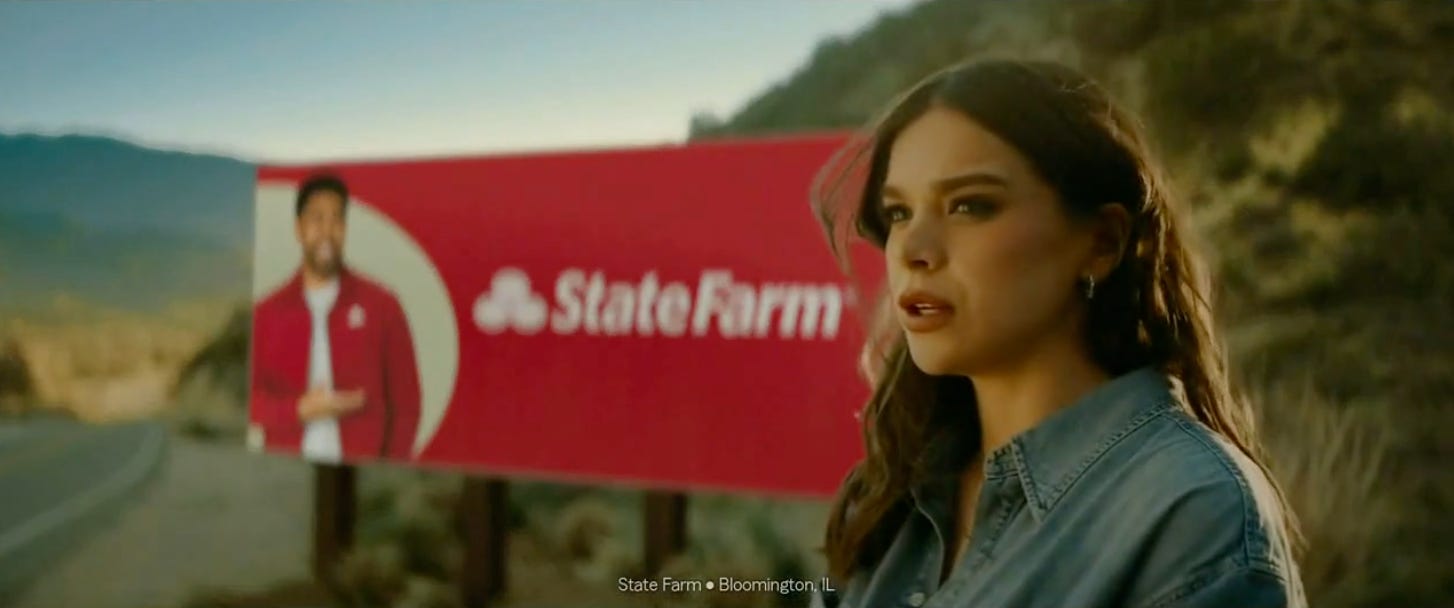
Jake from State Farm, call your office.
The company kicked off 2026 with a splashy Super Bowl commercial featuring two popular comedic actors, Danny McBride and Keegan-Michael Key, as insurance agents for a fictional State Farm competitor, Halfway There Insurance. The duo riffs on the Bon Jovi classic, Livin’ on a Prayer:
There is damage to your home on this block
We won’t make things right cuz filing a claim is tough
No luck
Whoa, we’re halfway there
Whoa, you’re living on a prayer
State Farm described the ad, which also includes a cameo by Jon Bon Jovi himself, as “a humorous parody that encourages viewers to not settle for coverage that makes you feel ‘halfway there.’” The ad “exaggerates potential common consumer frustrations with their insurance experiences, from confusing terms to impersonal corporate environments.”
No expense was spared. The full ad debuted during the most widely watched broadcast of the year and was extended through March Madness. In 2025, State Farm spent $1.139 billion on advertising.
On Monday, the ad was cited in a lawsuit filed by Los Angeles County on behalf of the people of California seeking at least $160 million in restitution plus civil penalties of up to $2,500 per violation.
The lawsuit alleges that State Farm failed to pay benefits due to victims of the 2025 LA wildfires. According to the complaint, many Californians with State Farm insurance “cannot return home because smoke, soot, ash, debris, and chemical contamination have made their homes unsafe and Defendants have failed to agree to conduct the necessary testing or to fully and timely cover the costs of remediation.” Some State Farm policyholders, the complaint claims, now “face eviction or homelessness.”
The 107-page complaint contains several horror stories. In one case, a “97-year-old Palisades resident” lived in a home “within 250 yards of burned structures.” Nevertheless, “State Farm refused to authorize or pay for environmental testing, telling the family that if they wanted testing, they could pay for it themselves.” Meanwhile, remediation contractors said “they could not begin cleaning without knowing what contaminants were present, because lead, asbestos, and other toxins require different protocols.”
The man’s daughter, despite persistent efforts, has been unable to reach a resolution with State Farm. In one instance, she was placed on hold for two hours and fifty-six minutes before being disconnected. The man, who suffered a stroke shortly after the fire, “has never been able to return to his home.”
In other cases, according to the complaint, State Farm denied payments until the policyholder went to the press or reported the company’s behavior.
In one total-loss claim, consistent with many others, State Farm began sending checks almost immediately after the policyholder went to the press. In another total-loss claim, State Farm refused to pay for 16 months and then immediately sent 4 checks to consumers the next morning after they told an EPA representative, who was visiting the Altadena area, about State Farm’s failure to pay them.
Los Angeles County also seeks penalties against State Farm for false advertising, specifically citing the Halfway There campaign. From pages 76-77 of the complaint:
State Farm’s Head of Marketing, Alyson Griffin, said the campaign was meant to convince viewers that State Farm’s services are more than just halfway there, and that State Farm chose the song because it “gets customers to realize we’re here to help.” She said State Farm wanted customers “to feel confident in their insurance” and did not “want them to feel like they’re living on a prayer.”
…The campaign was built to induce consumers to choose or stay with State Farm on the representation that it, unlike inadequate alternatives, delivers complete claims service and makes things right after a covered loss.
The complaint describes the Halfway There campaign as “a false-advertising problem of State Farm’s own making.” According to Los Angeles County, State Farm “defined adequate insurance as insurance that ‘makes things right’ after covered damage” even as it was, in the complaint’s words, “delivering to its own California and Los Angeles County policyholders the very inadequacies the advertisement mocked.”
The website State Farm created to promote the Halfway There campaign has been taken offline and the ads have been removed from YouTube.
The lawsuit cites the California Department of Insurance (CDI), which concluded that State Farm “delayed, underpaid, and buried policyholders in red tape at the worst moment of their lives.” CDI found that in more than half of the claims it reviewed related to the LA wildfires, State Farm violated state law.
The gap between the ad and the reality facing State Farm’s California policyholders, the lawsuit alleges, constitutes “a materially false statement about the nature of State Farm’s services, aimed at California consumers and likely to deceive them.”
Los Angeles County attempted to resolve its issues directly with State Farm, but the company allegedly “declined to substantially comply with the People’s requests for voluntary production of documents or a later-issued administrative subpoena.”
As State Farm slow-rolled California policyholders, its coffers continued to swell. The company “ended 2025 with $170 billion in net assets — $24.8 billion more than a year earlier.”
State Farm is not OK
California is not the only state with grievances against State Farm.
On June 24, Oklahoma Attorney General Gentner Drummond (R) filed a lawsuit against State Farm alleging that the company fraudulently denied or underpaid claims to Oklahoma customers for damages caused by hail and wind. Drummond alleged that the company “engaged in a pattern of deceptive and fraudulent conduct that harmed policyholders throughout Oklahoma by using undisclosed claims-handling practices, restrictive internal standards and outcome-oriented engineering reviews to reduce claim payments and increase corporate profits.”
The lawsuit claims that the company started an internal program called the “Hail Focus Initiative” to limit the number of approved roof replacements and reduce claim payments. The lawsuit alleges that State Farm continued to market and sell homeowner policies as covering replacement costs for hail and wind damage, while creating undisclosed internal guidelines designed to deny claims and minimize coverage.
“The allegations describe a corporate scheme that threatens the integrity of Oklahoma’s insurance marketplace and undermines public confidence in an industry families rely on when disaster strikes,” Drummond said in a statement. Drummond also filed a similar lawsuit against Allstate in July.
Hundreds of Oklahoma homeowners have sued State Farm over similar issues. The company’s alleged scheme to reduce costs related to wind and hail damage allegedly began in Texas in 2020 before expanding to other states. Court documents released in August in a case between State Farm and an Oklahoma couple revealed that the company “reduced its payouts to policyholders by more than a billion dollars,” NBC News reported. In an internal email, a claims manager stated that there was “[a]bout a $1.4B decrease in indemnity from 2020 to 2021.” The email said, “When we started this work, we were replacing roofs at a rate of 5.6 to every 1 we repaired. In 2021 we landed at 2.0 for every 1 and 2022 increased to 2.2 to every 1.”
In a statement on its website, State Farm writes, “Over the past two years alone, State Farm has paid more than $1 billion to Oklahoma customers for wind and hail damage. By contrast, the number of bad-faith lawsuits currently pending in Oklahoma is equivalent to approximately 1% of the roughly 30,000 residential and commercial claims State Farm has responded to each year, on average, over the past five years.”
Yeah. This is how insurance works. Promise to cover claims. Receive premiums. Refuse to cover as many claims as possible. Profit.
We used to live in a world where corporations were under the impression that they would lose customers if the services they provided were shitty. Those days are dead. Now there are so few competitors that they all know that they can all provide the same shitty services without losing market share.
Great piece.
One of our neighbors is a successful general contractor. I chose my home insurance on the basis of what insurance he liked to work with after a client experienced a catastrophic event.
Is that a guarantee of future performance? Of course not, but it’s still better than choosing insurance companies on the basis of a TV advertisement.