

On Monday, Popular Information broke the news that President Trump publicly praised two companies, Thermo Fisher Scientific and Apple, the same day he bought their stock. Trump took a tour of a Thermo Fisher facility and called on large pharmaceutical firms to partner with the company on the same day he bought between $15,000 and $50,000 of Thermo Fisher stock.
In a third example from Popular Information’s report, Trump bought between $50,000 and $100,000 in Micron stock and, the next day, touted Micron as “one of the hottest companies” in an interview on Fox News. Trump also encouraged people to “go out and buy a Dell computer” nine days after buying between $1 million and $5 million worth of Dell stock.
Popular Information’s investigation was based on Trump’s 113-page financial disclosure that was belatedly disclosed on May 14. The filing revealed that Trump had engaged in thousands of stock trades in the first three months of 2026. The hyperactive trading was an egregious violation of the presidential norm to avoid real or perceived conflicts of interest. In June 2016, in recognition that a president could not ethically trade individual stocks, Trump liquidated his stock portfolio.
Some major media outlets picked up the story. For example, MS NOW’s Rachel Maddow extensively covered Popular Information’s investigation during her Monday night show. You can watch that clip here:
It was also covered in detail on Morning Joe on Tuesday morning:
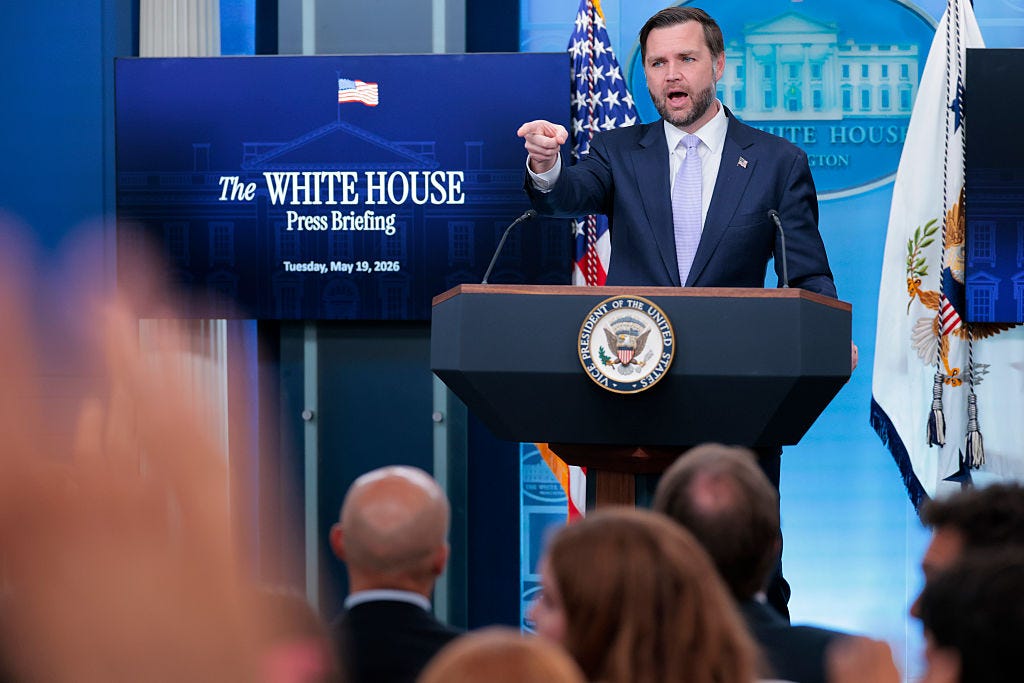
By Tuesday afternoon, J.D. Vance, appearing at the White House press briefing, was confronted by journalist Andrew Feinberg with Popular Information’s reporting:
FEINBERG: The president's financial disclosures were released recently, and they showed a lot of stock trades in companies that he has talked up at events, official events… [H]ow can you and your administration argue to Americans that you're cleaning up corruption… when the president seems to be talking up stocks that he owns, selling them and enriching himself?
Vance responded by scolding the reporter for not being “objective.” He then quipped that Trump does not have a “Robinhood account” and it was “absurd” to suggest he was “buying and selling stocks.”
Of course, no one has alleged Trump had an online brokerage account or that he personally executed the trades. Vance’s response was a deflection to avoid the incoherence of his own position.
“I am a big fan of banning members of Congress from trading stocks,” Vance continued, “So is the president of the United States.” Vance did not explain why members of Congress should be banned from trading stocks but not the president.
Popular Information is a three-person newsletter, but we can rattle the cages of the most powerful people in the world.
You can support this work — and help us expand our capacity to do more of it — by upgrading to a paid subscription.
Ignoring a major scandal
Other major media outlets have not only failed to report on the damning timing of Trump’s stock trades, but have failed to mention Trump’s May 14 financial disclosure at all. Media outlets who have ignored the story completely include Business Insider, CBS, CNN, Fox News, NPR, PBS, Politico, and Semafor.
The decision of outlets that employ hundreds of journalists to skip coverage is inexplicable. A sitting president trading hundreds of millions of dollars worth of individual stocks is undeniably newsworthy.
The real meaning of “independence”
Even among media outlets that covered Trump’s stock transactions, the coverage lacked critical context.
For example, the most widely distributed article about Trump’s trades was published by the wire service Reuters. The piece notes that Trump “disclosed a flurry of at least $220 million in financial transactions earlier this year in the securities of major U.S. companies.” It also, appropriately, publishes the Trump Organization’s response:
President Trump’s investment holdings are maintained exclusively through fully discretionary accounts independently managed by third-party financial institutions with sole and exclusive authority over all investment decisions. Trades are executed and portfolios are balanced through automated investment processes and systems administered by those institutions.
Neither President Trump, his family, nor The Trump Organization plays any role in selecting, directing, or approving specific investments. They receive no advance notice of trading activity and provide no input regarding investment decisions or portfolio management of any kind.
The piece fails to note, however, that the federal government has a formal mechanism to ensure that the assets of public officials are “independently managed.” It is called the Qualified Blind Trust Program.
Under a Qualified Blind Trust (QBT), there is an independent trustee with no prior relationship to the government official. The independence of the trustee must be certified by the Office of Government Ethics (OGE). Once certified, there is no communication permitted between the official and the trustee, except written communication approved in advance by the OGE. And, critically, the official is not informed about the investment decisions of the trustee. That is what makes it blind and avoids conflicts of interest.
Trump did not elect to have a QBT and the management of his assets has nothing in common with a QBT. Trump’s assets are in a revocable trust, managed by his son, Donald Trump Jr., whom he speaks to frequently. Trump Jr. may have selected a “third-party financial institution” to help manage his father’s stocks, but that advisor is not legally independent. The statement says that Trump does not receive “advance notice of trading activity,” but it does not specify whether Trump speaks with Trump Jr. or whomever is trading on his behalf. There is nothing preventing Trump from doing so.
Moreover, nothing about the arrangement prevents conflicts because it is not blind; Trump knows exactly what stocks he owns. As part of his financial disclosure, Trump certified that the listing of his stock trades and current holdings is correct.

That is how you know that Trump continues to be legally in control of his stocks. He is signing this document. If the stocks were really independently managed, the document would be filed by the independent manager and not made public.
In a May 15 post on X, Eric Trump, another Trump son, sought to mislead the public about these facts, claiming that his father’s assets were “in a blind trust” and only invested in “broad market indexes.” Both of these claims are demonstrably untrue.

The Financial Times, the Wall Street Journal, USA Today, The Hill, and Variety all published stories about Trump’s stock trading without mentioning Trump’s failure to use a blind trust. Forbes published Eric Trump’s claims without noting they were false.
Meanwhile, NOTUS, the Washington Post, the New York Times, and Fortune all reported that Trump failed to establish a blind trust.
Keep after the scoundrels
That explains why Trump keeps jerking the stock market around. "Buy low, sell high." I had suspected as much, thanks for the confirmation.