

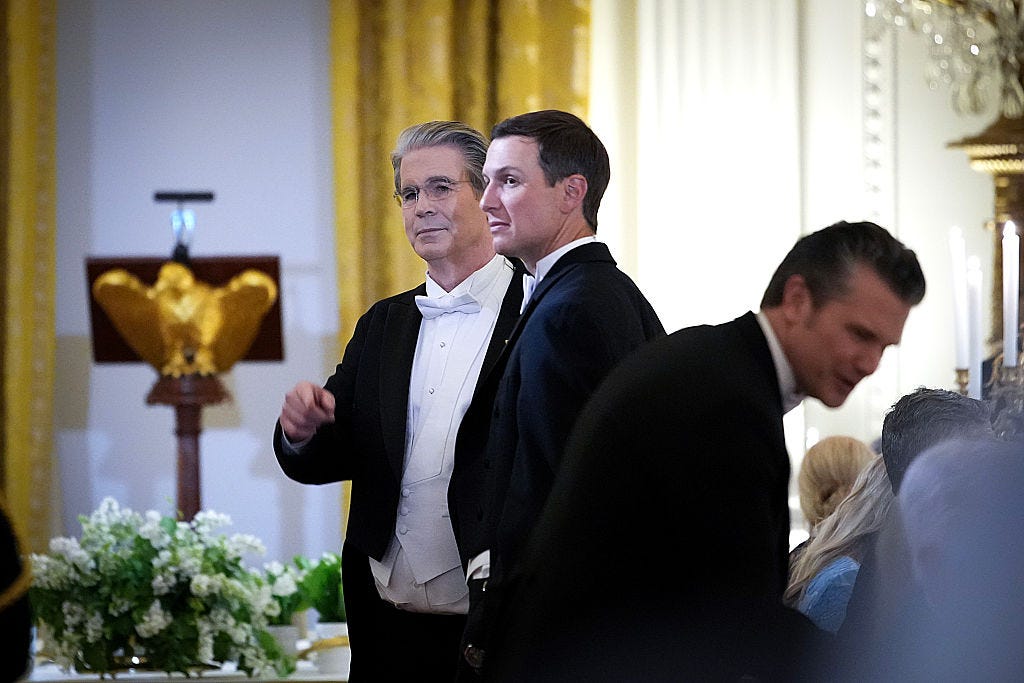
The Iran War is more than 100 days old — and there is no resolution in sight. Although Trump has claimed for weeks that a deal is imminent, the fighting has intensified.
One of the primary sticking points in the peace negotiations is the status of $24 billion in frozen Iranian assets. In a June 5 interview on CNN, Mohsen Rezaei, a top military adviser to Iranian Supreme Leader Ayatollah Mojtaba Khamenei, said the money was “a test of trust that Iran wants to have with Trump – this is a test that America must pass.” Rezaei described the $24 billion as “our own money, not America’s money.”
According to reports, Iran is seeking the immediate release of $12 billion as part of an interim deal that could set the stage for a long-term agreement. Bloomberg reports that the negotiations, which are co-led by Trump’s son-in-law Jared Kushner, have “bogged down“ over the issue.
Now, according to CBS News, the Trump administration is pursuing a plan to “use Iranian assets to help U.S. Gulf allies recover from damage caused by Tehran’s regime during the Iran war.” As a starting point, Treasury Secretary Scott Bessent is seeking “comprehensive estimates from Gulf allies of the costs associated with repairing damage caused by Iran since the conflict began.” The money could also be used “for rebuilding and repair efforts related to any future damage inflicted by Iran.”
The initiative, Bloomberg reports, “risks further chilling negotiations on a truce extension, reopening the Strait of Hormuz and paving the way for more detailed talks over Iran’s nuclear program.”
The move to divert Iran’s frozen assets to other nations highlights the acute conflict of interest between Kushner’s dual role as a top negotiator for the Trump administration and the private equity manager of $6.2 billion in funds from foreign governments. Many of the potential top recipients of frozen Iranian assets — including the UAE, Saudi Arabia, and Qatar — are also Kushner’s top investors at his private equity firm, Affinity Partners.
As Kushner navigates these issues, Middle Eastern governments are paying Kushner tens of millions in fees annually. Kushner was also reportedly seeking additional funds from these same governments — although those efforts have purportedly been put on hold. These activities would be illegal, but the Trump administration insists that Kushner is merely acting as a “volunteer” and not an employee of the federal government.
The idea that Kushner can repeatedly represent the United States in high stakes international negotiations and retain his status as a volunteer is not consistent with the Department of Justice’s longstanding interpretation of the law.
Prior to the beginning of Trump’s return to the White House, Kushner seemed to understand this. He pledged not to be involved in a second Trump administration. In February 2024, Axios’ Dan Primack asked Kushner whether accepting billions in investments from public investment funds run by the governments of Saudi Arabia and the UAE would make it “very difficult… to do any sort of foreign policy work” in a second Trump administration. “I’m an investor now,” Kushner replied. “I served in government, and I think my track record is pretty impeccable. Now I’m a private investor.”
Ian Brekke, the Chief Legal Officer at Affinity Partners, has defended Kushner’s conduct, saying that Kushner has “complied with all applicable laws” and “always operated in the best interests of the United States.” This is unfalsifiable. Kushner does not reveal the substance of his conversations with Middle Eastern leaders, his advice to Trump, or his positions during closed door negotiations with his Iranian counterparts or mediators. The American public has no idea whose interests Kushner is advancing — and that is the problem.
On March 24, the New York Times reported that Saudi Crown Prince Mohammed bin Salman, Kushner’s single largest investor, “has been pushing President Trump to continue the war against Iran, arguing that the U.S.-Israeli military campaign presents a ‘historic opportunity’ to remake the Middle East.” More than two months later, with Kushner in a top negotiating role, the war continues.
Coverage of the Trump administration’s plans to transfer Iranian assets in CBS News, Bloomberg, Reuters, Fortune, and CNBC did not include any discussion of Kushner’s dual role. This is part of a broader pattern of the media ignoring or downplaying his historic conflict of interest.
At the earliest moment, number one on day one: freeze assets&forensically investigate the entire Trump family.
#2: judicial reform&term limits.
The USA has its very own 21 century Romanov family.