


As the Iran War drags on, President Trump has repeatedly belittled the economic impact of the conflict on Americans.
Last week, Trump was asked by a reporter to what extent he considers “Americans’ financial situations” while negotiating with Iran. “Not even a little bit,” Trump responded. “The only thing that matters when I’m talking about Iran, they can’t have a nuclear weapon. I don’t think about Americans’ financial situation. I don’t think about anybody.”
Trump doubled down on the comment later last week. In an interview with Fox News, Trump said, “That’s a perfect statement. I’d make it again.” Trump went on to say that it was worth having “to pay a little more, not that much more, a little more for gasoline, for a very short period of time” to prevent Iran from obtaining nuclear weapons.
On Tuesday, Trump said that high gas prices amounted to “peanuts.”
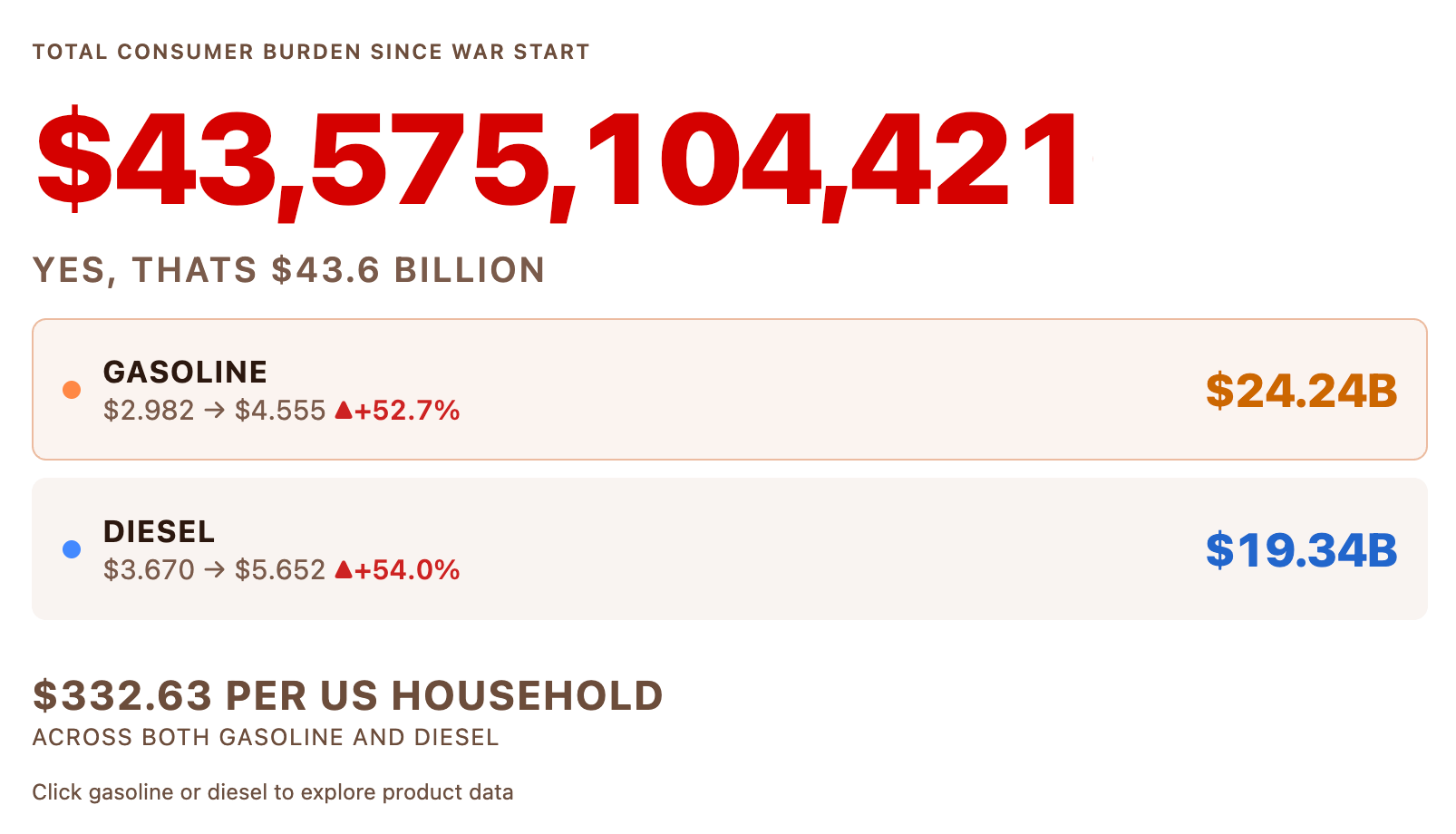
But according to The Iran War Energy Cost Tracker at Brown University, the Iran War has caused Americans to spend an additional $43.6 billion on fuel costs so far.
For that price, Americans could buy 14.5 billion pounds of peanuts, which is more than twice the amount produced annually in the United States.
The tracker, which compares actual prices to an estimate of prices without the war, estimates that each U.S. household has paid an extra $331 across both gasoline and diesel. So the equivalent of each household buying 110 pounds of peanuts.
Americans have spent an additional $184 per U.S. household on just gasoline because of the war, according to the tracker. In some states, the total extra cost is over $250, including Utah ($261.78 per household), Alabama ($274.94 per household), and Wyoming ($258.79 per household).
The higher fuel costs are in addition to the direct cost of the war. A cost estimate of the Iran War conducted by Stephen Semler for Popular Information found that the U.S. spent an estimated $71.8 billion through the first 60 days of the conflict. This cost also ultimately falls to the American taxpayer.

But as the costs continue to climb, there is no end to the Iran War in sight.
11 weeks and no end in sight
Despite comments Trump has made throughout the last several weeks claiming that the war will soon be over, negotiations with Iran remain at a stalemate. Importantly for consumer prices, the Strait of Hormuz remains mostly closed.
Before the war, about 20% of the world’s oil and gas passed through the Strait of Hormuz, making its current closure the biggest disruption to global fuel supply in history. Although Trump has floated some ideas for lowering gas prices for Americans, like pausing the federal gas tax, experts have said that the only sure way to bring fuel costs down is opening the strait.
Trump has frequently claimed to be on the verge of a deal with Iran to reopen the Strait of Hormuz. So why hasn’t it happened yet?
On April 7, the U.S. and Iran reached a ceasefire agreement that Trump claimed would open the strait. However, Iran kept it closed, blaming Israeli attacks in Lebanon which it said violated the terms of the agreement. The next week, the U.S. announced a blockade on Iranian ports until Iran gave up its nuclear weapons program and Iran said it would continue to keep the strait closed until the blockade was over.
Since then, Iran and the U.S. seem to have made little progress. In mid-April, Trump claimed that Iran had agreed to end its weapons program indefinitely, but last week he said he would be satisfied with a 20-year moratorium.
Earlier this week, Trump said that the military was ready to launch a “full, large scale assault of Iran, on a moment’s notice,” but that he had delayed an attack at the request of Emirati, Saudi, and Qatari leaders. Among those leaders was Mohammed bin Salman Al Saud (MBS), Crown Prince of Saudi Arabia. This raises questions about who is influencing Trump’s conduct in the war. Jared Kushner, Trump’s son-in-law who has been involved in negotiations with Iran, receives tens of millions of dollars per year from a Saudi investment fund controlled by MBS.
On Wednesday, Trump said he might be willing to sign a deal to open the Strait of Hormuz while leaving nuclear weapons and other priorities for later negotiations. But ultimately, he added, “I’m in no hurry.”
“Peanuts” is the giveaway. Not a gaffe, a confession. The $43.6 billion isn’t spread across “Americans,” it’s concentrated on the households least able to absorb it: $275 in Alabama, $262 in Utah, the people for whom $331 is the difference between making rent and not.
That’s the cost asymmetry that runs through everything I write. The decision-maker pays nothing. He’s “in no hurry” because the strait staying closed costs him nothing and costs MBS, who pays Kushner tens of millions a year, quite a lot to keep that way. The war’s price is socialized onto the powerless; the war’s patience is purchased by the powerful.
And the precarity isn’t a side effect. A household one bad month from collapse doesn’t organize, doesn’t protest, doesn’t resist. “I don’t think about anybody” isn’t callousness. It’s the operating principle of a system that runs on your anxiety and calls your suffering peanuts.
Johan
Trump has nothing left for this fight. No sense, no attention span and certainly no cards. Just anger and hatred for everything and everyone, including himself. He’s a miserable, pathetic and increasingly dangerous fraud.