

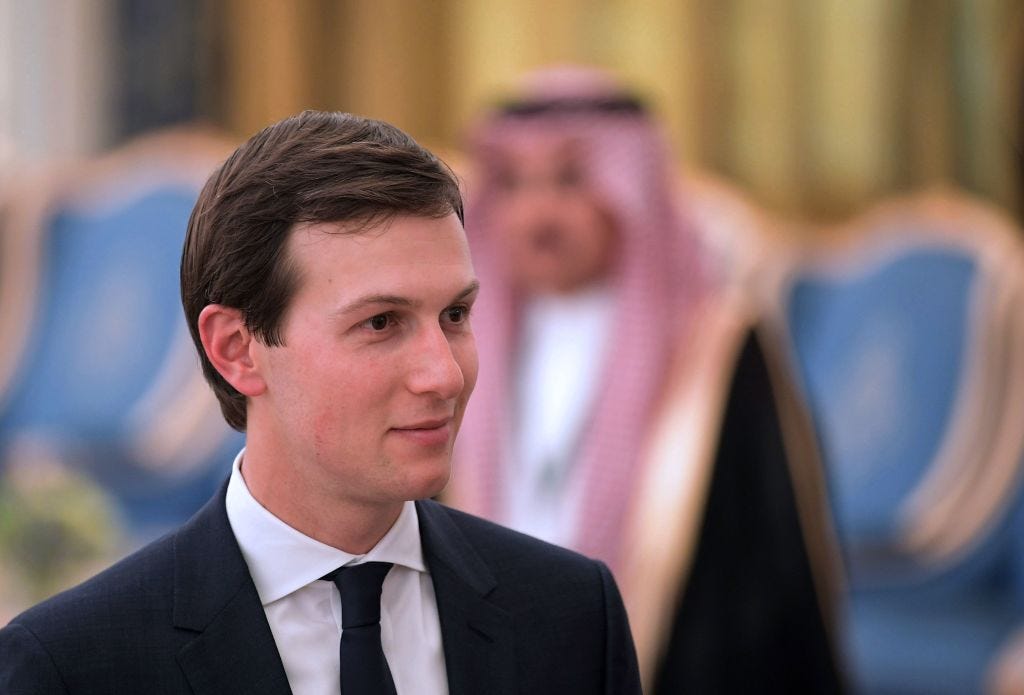
On Wednesday, the Trump administration signed a 30-year nuclear agreement with Saudi Arabia that paves the way for the kingdom to enrich its own uranium. The Saudi government has been aggressively seeking such a deal for years, eager to gain an edge over regional rivals. The agreement lacks safeguards that previous administrations, and many independent foreign policy analysts, viewed as essential to prevent nuclear proliferation.
The deal comes after the Saudi government’s Public Investment Fund (PIF) invested $2 billion in Jared Kushner’s private equity fund, Affinity Partners. Since 2021, Kushner, President Trump’s son-in-law, has collected over $110 million from the Saudi government in management fees. In March, Kushner was seeking billions more from the Saudis. (After Kushner’s fundraising was exposed, his efforts were purportedly put on hold.)
Kushner also has a close personal relationship with Saudi Crown Prince Mohammed bin Salman (MBS) — the pair are known to communicate regularly over WhatsApp. In 2021, when the PIF committee originally recommended rejecting Kushner’s proposal due to the high price and Kushner’s inexperience, MBS overruled the recommendation.
As he continues to collect fees from the Saudi government, Kushner has resumed his role as a top foreign policy aide to Trump. He has played a key role in virtually every significant foreign policy negotiation since Trump returned to the White House.
Kushner’s specific involvement in the nuclear pact, if any, has not been disclosed. But the fact that one of the president’s top foreign policy advisors is receiving large, ongoing financial payments from the Saudi government is unquestionably relevant to the story.

Nearly all major media coverage of the US-Saudi nuclear agreement ignored Kushner’s financial conflicts — including articles by the Wall Street Journal, Washington Post, AP, and CNN.
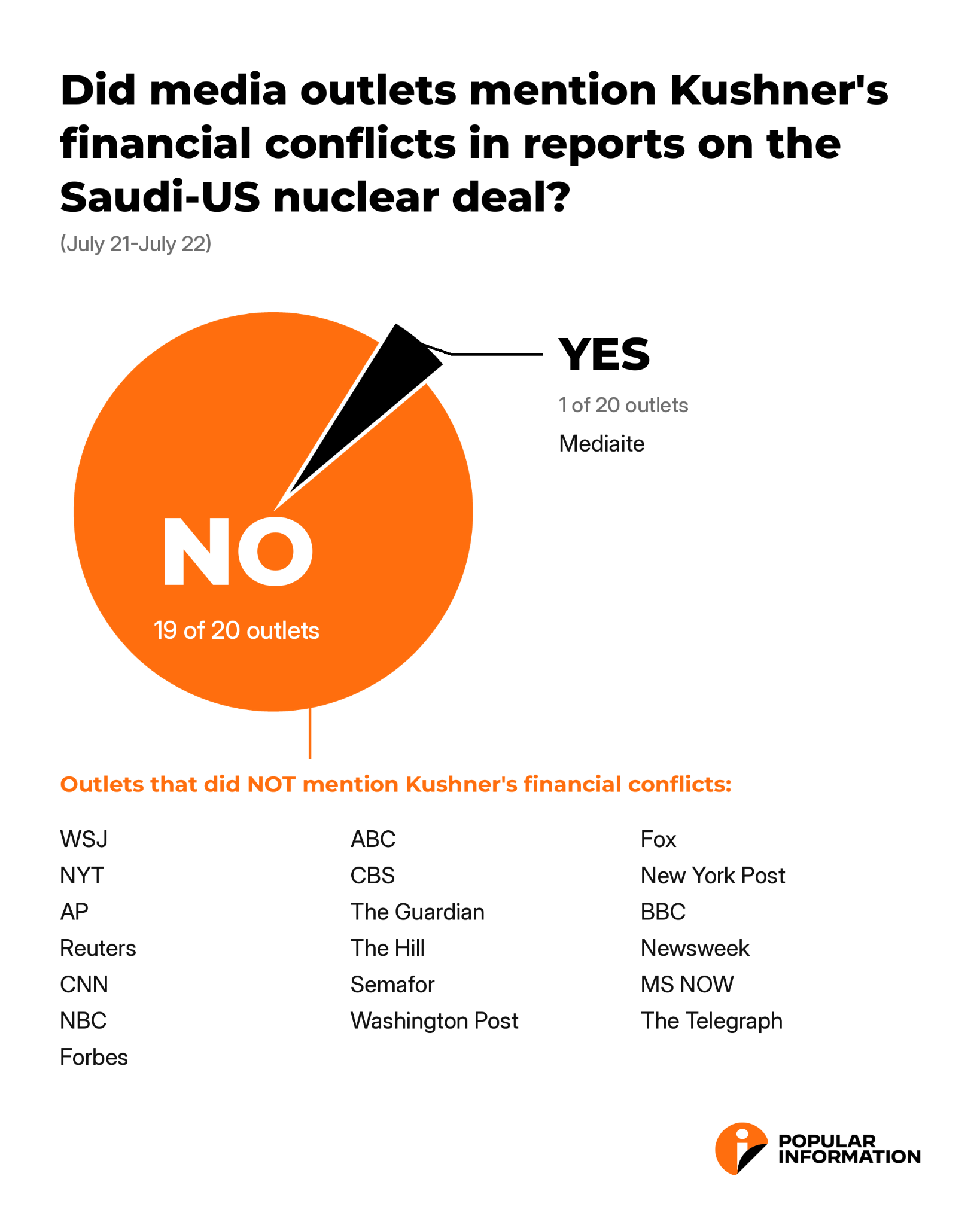
Semafor, for example, called the deal “a major win for Crown Prince Mohammed bin Salman,” who has been negotiating with Trump for months, but did not note the potential conflict of interest stemming from his involvement with Kushner. The New York Times explained how the deal with Saudi Arabia broke a precedent for nuclear deals set by previous administrations, but did not examine the unprecedented relationship Trump has with Saudi Arabia through his son-in-law.
As of Wednesday, Popular Information could only identify one article on the deal from a prominent outlet mentioning Kushner. Mediaite briefly discusses the funding that Kushner’s private equity firm has received from the Saudi sovereign wealth fund. (A Forbes piece focused on the Trump Organization’s financial ties to Saudi Arabia, but did not mention Kushner.)
This is not the first time that the media has ignored Kushner’s conflicts of interest.
In April, Popular Information reported that in 202 articles published by major outlets about Kushner’s role in negotiations with Iran, only six mentioned his financial connections to Saudi Arabia. The silence continued after it was reported that MBS had pushed Trump to initiate the war with Iran and later to continue attacking.
The information landscape in the United States is busted. Billionaires are using the powerful social media platforms and media outlets they control to curry favor with Trump.
Google paid Trump $25 million to settle a bogus lawsuit.
Jeff Bezos purged Trump critics from the Washington Post opinion page.
Meta CEO Mark Zuckerberg canceled fact-checking on Facebook.
A pro-Trump billionaire bought CBS News — and is now buying CNN.
The only way to fight back is to build up independent media that is free from the influence of billionaires and corporate America.
If you believe in independent accountability journalism and can afford $50 per year or $6 per month, please consider becoming a paid subscriber.
A sweetheart deal for MBS
The deal with Saudi Arabia will reportedly allow the kingdom to begin a civilian nuclear program. The Wall Street Journal, which was first to report the approved deal, reported that it was a “30-year, multibillion-dollar deal.” (The full text of the agreement has not been released.)
The reported details of the deal involve American companies developing the program and providing Saudi Arabia with “new power reactors and other nuclear technology.” The Trump administration argues that U.S. involvement would prevent a weapon from being developed.
According to the Wall Street Journal, the agreement “would have American companies build a uranium enrichment facility in Saudi Arabia if a joint U.S.-Saudi study determines such a step would be warranted.” If a nuclear enrichment facility is not built under the terms of the agreement, Saudi Arabia would be prohibited from advancing enrichment activities for 10 years.
The agreement takes effect automatically unless Congress blocks it, but that is unlikely. It requires a two-thirds majority to override a Trump veto.
The facility would be built under a “black box” agreement that purportedly would prevent the transfer of sensitive technology to the Saudi government. Critics argue that the reported deal does not include enough safeguards to prevent Saudi Arabia from eventually attempting to develop nuclear weapons.
While Saudi Arabia is a member of the International Atomic Energy Agency (IAEA), “the agreement is not expected to include the IAEA’s Additional Protocol, which would allow for more monitoring, inspections and verification,” the Associated Press reported.
Trump administration officials said that there is a separate agreement that “will still provide for adequate monitoring of the U.S.-provided sites,” but critics argue that would be “inadequate to investigate suspected nuclear activities that don’t involve the U.S.”
The new agreement could also increase tensions with Iran, as the U.S. is currently involved in negotiations with Iran to limit its nuclear program. While Saudi Arabia “insists its intentions are peaceful,” MBS said in 2018 that his country would “without a doubt” develop a nuclear weapon if Iran did first.
Saudi Arabia is not the only country with connections to Kushner that the Trump administration has recently negotiated with despite security risks. Politico reported that the “Trump administration ignored warnings from career staff at the Commerce Department when it granted the United Arab Emirates sweeping access to advanced American semiconductors and other technology.” The UAE has invested over $200 million into Affinity Partners.
If this were Hunter Biden instead of Jared Kushner, we'd never hear the end of it. Instead, as noted, mostly silence. I get it for the outlets that are specifically trying to curry favor with Trump, even if I detest it. For the others, though? You would think a story of corruption involving an ethically unsound Saudi regime would be of interest. For crying out loud.
Only Trump and his dimbulb son-in-law would think it's a good idea to give nuclear technology to well known murderer MBS and the country that bankrolled the 9/11 attacks while supplying the majority of the terrorists themselves.