

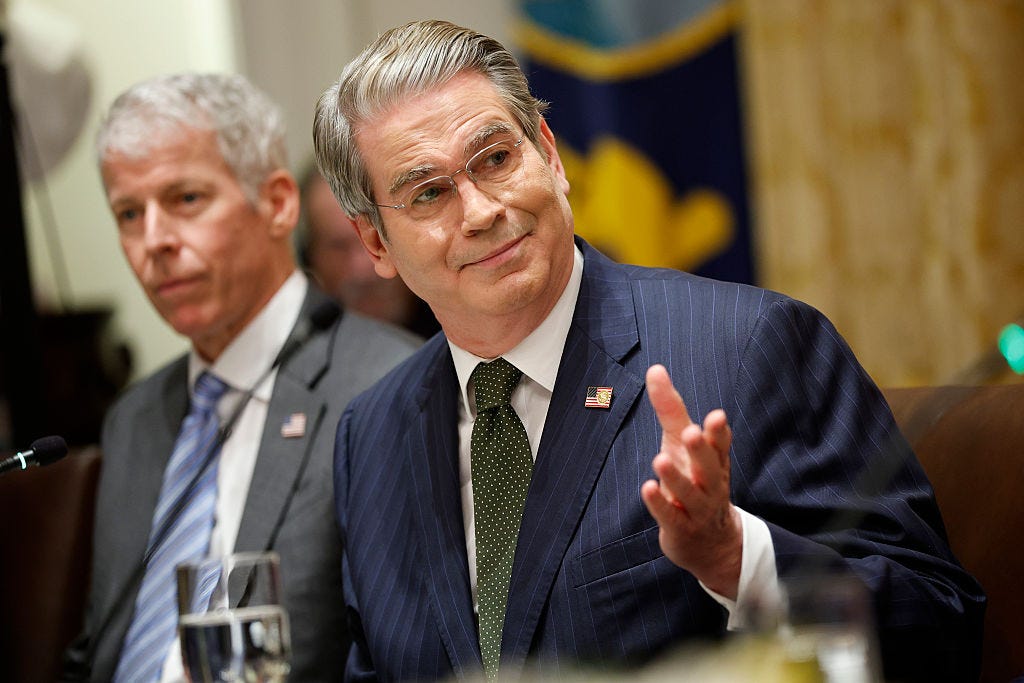
On September 24, Treasury Secretary Scott Bessent announced a $20 billion bailout for Argentina. Under that plan, Bessent will swap taxpayer dollars for Argentine pesos. President Trump admitted that the bailout, even if it succeeds, will provide little benefit to Americans. But as Popular Information first revealed, the bailout is critical to the economic fortune of hedge fund billionaire Robert Citrone, a personal friend and former colleague of Bessent, who has invested heavily in Argentine assets.

Weeks later, the cost of the Argentine bailout to United States taxpayers may grow to $40 billion.
Javier Milei, the President of Argentina, desperately needs an influx of dollars to prevent a rapid devaluation of the peso. Controlling the peso’s value is key to Milei’s plan to reduce inflation, which reached 200% in Argentina in 2023.
Milei’s policy is to keep the peso’s exchange rate with the dollar within a certain range. At present, the floor is 1,491 pesos to the dollar. If the peso exchange rate threatens to drop below the band’s floor, the Argentine central bank needs to buy pesos with dollars to protect the exchange rate. The U.S. announced the $20 billion swap as the Argentine government ran out of foreign currency.
The problem with this approach is that Argentina cannot borrow enough foreign currency to stabilize the peso at an inflated exchange rate. A recent Morgan Stanley analysis found that, even in the most favorable scenario, the Argentine peso will not stabilize below 1,700 pesos to the dollar.
So long as the Argentine government is willing to buy pesos with dollars at an inflated rate, demand will be insatiable.

The $20 billion U.S. swap was announced just a couple of months after the International Monetary Fund (IMF) extended its own $20 billion package. On October 15, weeks after Bessent announced the $20 billion swap, he said that he was organizing a separate $20 billion facility financed by banks and private equity.
From the beginning, this made little sense. Banks stopped lending to Argentina, one of the most heavily indebted nations in the world, years ago because it is unlikely the country will ever have the means to repay them. Argentina already owes the IMF $60 billion. If banks were willing to lend to Argentina, the initial $20 billion swap from the U.S. government would not have been necessary. Bessent stepped in because Argentina had run out of options.
A report this week by the Wall Street Journal details what is really happening. The group of banks assembled by Bessent to help Argentina, which includes JPMorgan Chase, Bank of America, Citigroup, and Goldman Sachs, is demanding “some type of guarantee or pledge to ensure they will get their money back.” Specifically, they are asking “if Washington would plan to backstop the facility.” In other words, these banks are willing to lend Argentina money as long as they can keep the profits, while losses are shouldered by U.S. taxpayers. The Treasury Department did not dispute the Wall Street Journal’s report, saying only that talks with the banks “remain ongoing” and details would be announced “when these talks are complete.”
This is all very risky business. Bessent says that it’s a great deal for American taxpayers because the Argentine peso is currently undervalued. If that is the case, why aren’t private investors eager to exchange their dollars for pesos?
Since the first $20 billion bailout was formalized on October 9, the Argentine peso has declined from 1,421 pesos per dollar to 1,488 pesos per dollar. According to Bloomberg, the peso would have sunk even lower on Tuesday, but both the Argentine central bank and the U.S. Treasury intervened, buying pesos with dollars.
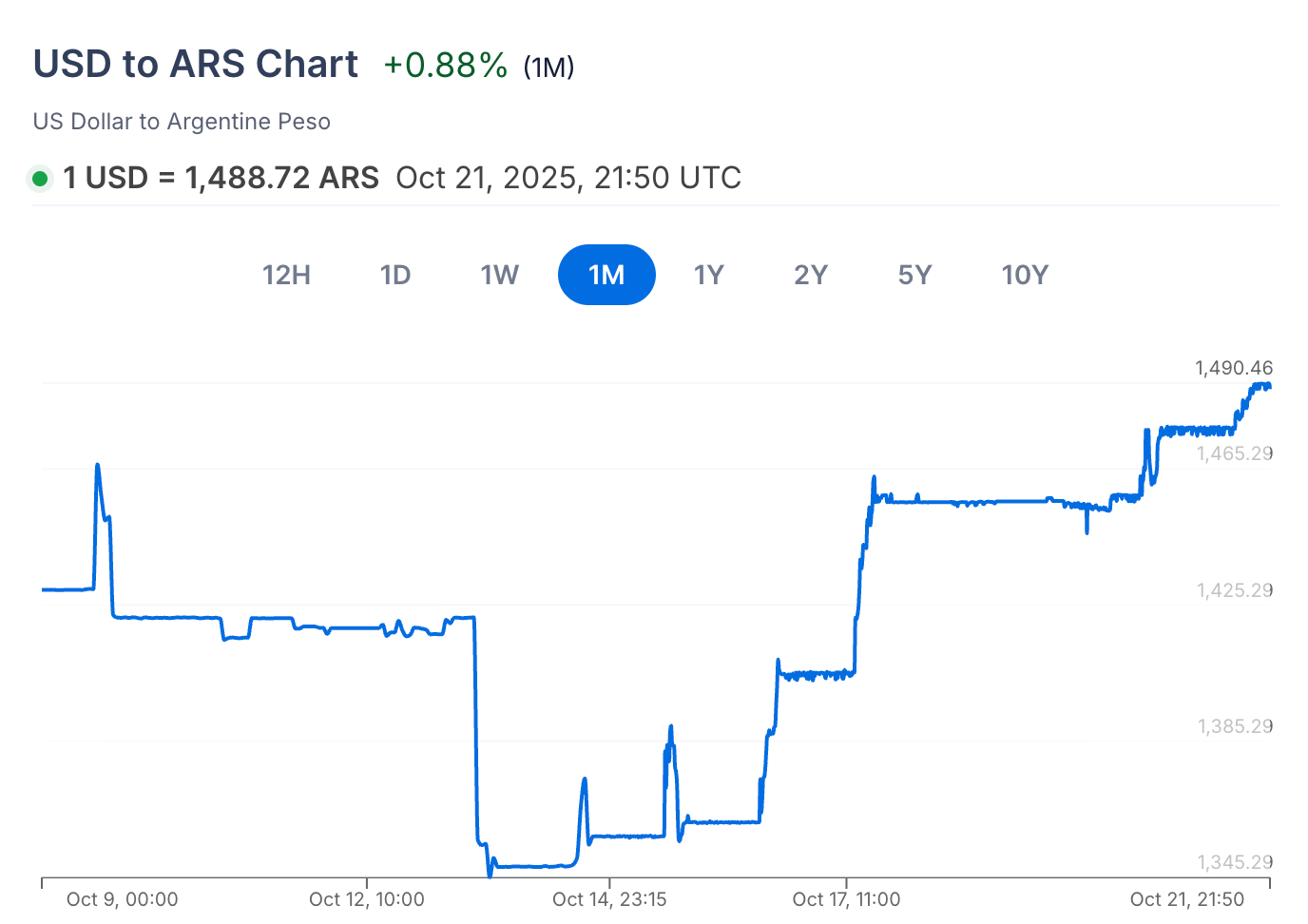
Despite extraordinary support from the Trump administration, the billions in taxpayer dollars — and the promise of billions more — have not salvaged Milei’s economic plans.
As I understand this, to add insult to injury, the Save Argentina from Itself solution also includes buying their beef. While US cattle ranchers deal with drought and screwworms and their own government undercutting their industry, the real screw worms in DC, gathered on the front Panera porch formerly known as the rose garden, plan more demolition of the US economy (just a few hundred feet away from the actual demolition of the East Wing of the people’s house) as the very program that can buy this beef, SNAP, runs out November 1. Trump continues to dump a pile of shit (not just AI generated) at our doorsteps each morning. The only way out is through and the only way through is together.
This adds to a long list of actions demonstrating that the Trump regime has no interest in governing, in leadership, nor in working FOR the American people. It is all about power, self-aggrandizement, and Funds-With-Friends. So obviously said "Friends" will continue to bluster and manipulate so their exploitation of American taxpayers can continue.